Korea "Expanding Centrist, Metropolitan, and Youth Support through Political Reform"
Some Intra-Parliament Opposition and Views That Timing Is Premature
Acceleration of Livelihood Laws Including 'Abolition of Financial Investment Tax' and 'Differentiated Minimum Wage Application'
With Han Dong-hoon elected as the leader at the People Power Party's national convention, political reforms promised by him and the party, such as the revival of district party organizations and the reduction of lawmakers' salaries, are expected to accelerate. Leader Han is also speeding up policies addressing livelihood issues. Among them, he expressed a strong will to first implement the abolition of the financial investment income tax (Geumtu Tax).
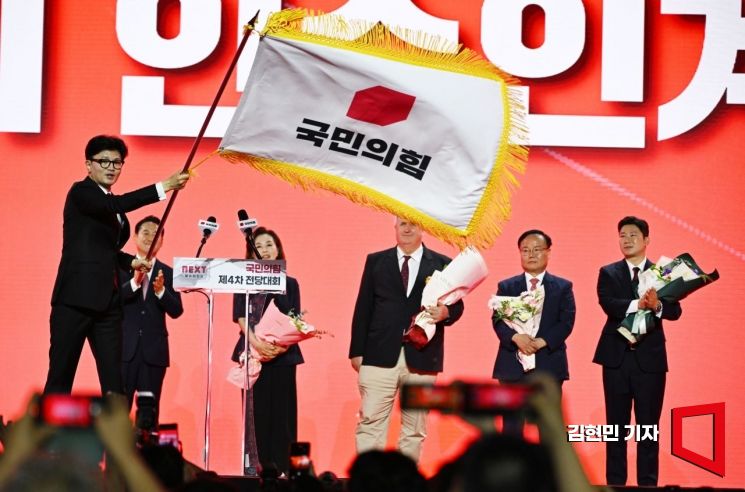 Han Dong-hoon, who was elected as the leader of the People Power Party, is waving the party flag at the 4th People Power Party Convention held on the 23rd at KINTEX in Goyang, Gyeonggi Province. Photo by Hyunmin Kim kimhyun81@
According to political circles on the 24th, Leader Han emphasized during the convention that the revival of district party organizations is necessary to provide fair opportunities to out-of-parliament party branch chiefs and political newcomers. Unlike the current system where local party councils manage regions as subordinate organizations of the central party, district party organizations have the advantage of receiving direct financial support from the central party. Out-of-parliament party branch chiefs, who are relatively disadvantaged compared to incumbent lawmakers during candidate nominations, also support the revival of district party organizations. In his acceptance speech the day before, Leader Han firmly expressed his intention regarding the revival of district party organizations, saying, "I will definitely implement the rebuilding of the grassroots political system that I mentioned when I ran." Besides this, Leader Han mentioned strengthening the policy functions of the Yeouido Research Institute, expanding the political base through flexible operations, and abolishing privileges, arguing that the People Power Party should approach the centrist voters, metropolitan area residents, and youth through political reform.
Since Leader Han has consistently shown his commitment to political reform, it is expected that he will take action. However, there are voices of opposition within the parliamentary ranks, and some say the timing is still premature. A pro-Han faction lawmaker said in a phone interview, "Since Leader Han has consistently said that political reform measures such as salary cuts are valid, they will be implemented," but added, "After the election, the priority is to heal the wounds caused by conflicts during the campaign, so I expect political reform measures to emerge as an agenda after party unity and reconciliation are achieved."
A first-term lawmaker said, "Some say that instead of cutting salaries, lawmakers should just work harder." Another first-term lawmaker said, "Some say that being a lawmaker costs more money than expected," adding, "There is not yet active discussion on this within the parliamentary ranks."
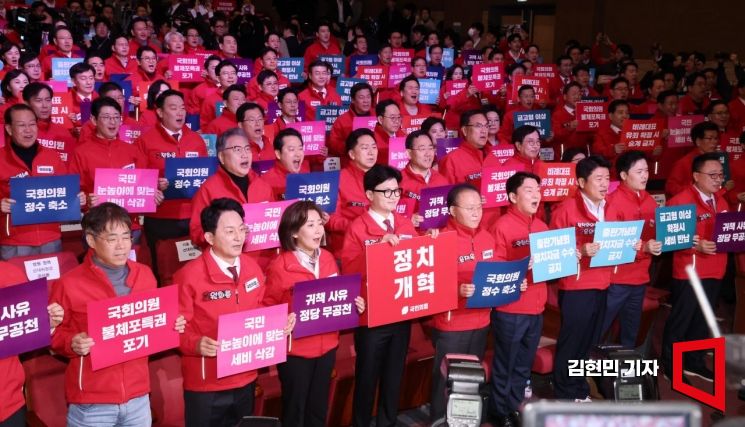 Handonghun, the General Election Committee Chairman of the People Power Party, along with attendees, is performing a political reform act at the Central Election Committee Launch Ceremony and Nominee Conference for the 22nd National Assembly Election held on the 19th at the National Assembly Members' Office Building. Photo by Kim Hyunmin kimhyun81@
The People Power Party had already pledged political reforms at the candidate convention held on March 19 before the general election, including △waiving the parliamentary immunity from arrest, △prohibiting political fund acceptance from book publication events, △returning salaries if sentenced to imprisonment or higher, △reducing the number of lawmakers, △not nominating parties responsible for faults, △cutting salaries to meet public expectations, and △prohibiting succession of proportional representation seats if convicted. However, since the opening of the National Assembly, political reform has not been actively discussed due to difficulties in negotiating the organization of the assembly and legislative dominance by the major opposition party.
Leader Han also emphasized policies for the people's livelihood. In his acceptance speech the day before, he declared, "I will prioritize implementing the most urgent policies for the people's livelihood, such as abolishing the Geumtu Tax," and promised, "Together with you, I will definitely find a way to open up opportunities and paths for the younger generation who cannot find growth opportunities or avenues." Leader Han also proposed applying differentiated minimum wages by industry in the era of a '10,000 won minimum wage.' Lawmaker Song Eon-seok of the People Power Party also introduced a bill to reduce the social and economic side effects caused by the uniform application of the minimum wage by allowing differentiated minimum wage payments, so related discussions are expected to become more active.
© The Asia Business Daily(www.asiae.co.kr). All rights reserved.
![Clutching a Stolen Dior Bag, Saying "I Hate Being Poor but Real"... The Grotesque Con of a "Human Knockoff" [Slate]](https://cwcontent.asiae.co.kr/asiaresize/183/2026021902243444107_1771435474.jpg)

















