Business Agreement Signed on the 23rd for Overseas Expansion of Large Nuclear Power Plants and SMR Construction
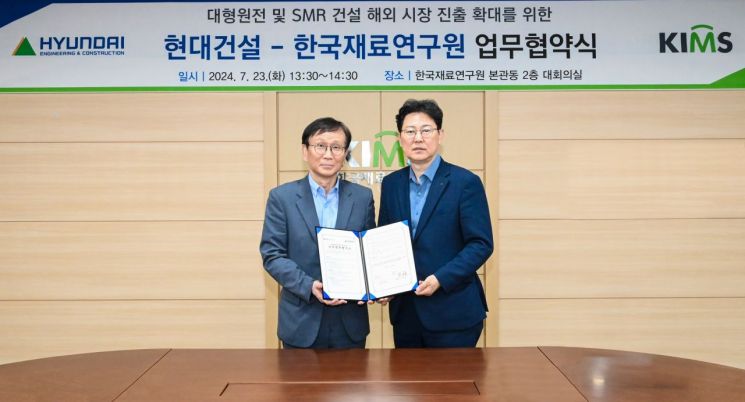 On the 23rd, at the Korea Institute of Materials Science in Changwon, Gyeongnam, Choi Young, Head of New Energy Division at Hyundai Engineering & Construction (right), and Choi Cheol-jin, Director of the Korea Institute of Materials Science (left), are taking a commemorative photo after signing a Memorandum of Understanding to enhance competitiveness for overseas expansion in large nuclear power plants and SMR construction. (Photo by Hyundai Engineering & Construction)
Hyundai Engineering & Construction is set to establish global standards for core nuclear construction technologies and prepare for the stable construction of overseas nuclear power plants. On the 23rd, Hyundai Engineering & Construction signed a Memorandum of Understanding (MOU) with the Korea Institute of Materials Science to enhance competitiveness in overseas expansion of large nuclear power plants and SMRs (Small Modular Reactors).
The Korea Institute of Materials Science is a government-funded research institute under the Ministry of Science and ICT specializing in materials. It focuses on research into next-generation nuclear power plant innovative manufacturing technologies, including special materials such as high-strength stainless steel for SMRs and multilayer metal materials, as well as 3D printing and special welding to commercialize SMRs and secure economic feasibility. Since being approved as Korea’s first accredited nuclear inspection agency in 1993, it has conducted accredited inspections for 25 domestic and international nuclear power plants, including the Barakah Nuclear Power Plant in the United Arab Emirates (UAE).
Through this agreement, both parties plan to collaborate on establishing international standards for nuclear power plant construction technology and quality standards, as well as developing construction materials and welding technologies for SMRs. To this end, they will promote joint research, intellectual property (IP) technology transfer, personnel support, and the operation of mutual consultative bodies.
Additionally, the two organizations will conduct research necessary for constructing reactor types based on ASME (American Society of Mechanical Engineers) standards in European countries. They will specify manufacturing and construction standards and develop coaching programs to improve the quality of domestic and overseas local suppliers. This will help solidify the foundation for Hyundai Engineering & Construction’s bid, as it was selected as the preferred negotiator for the large nuclear power plant project in Bulgaria in February this year.
Hyundai Engineering & Construction has been responsible for constructing a total of 24 large nuclear power plant projects, including the UAE Barakah Nuclear Power Plant, Korea’s first nuclear export. Since acquiring ASME certification in 1982?the first Korean construction company to do so?it has renewed the certification 14 times, demonstrating its capabilities in nuclear power plant construction and management. ASME certification is an essential international certification for securing overseas nuclear projects.
A Hyundai Engineering & Construction official stated, "We will build differentiated capabilities by collaborating with the Korea Institute of Materials Science, which has accumulated decades of experience through accredited nuclear inspections. We will strive to develop and commercialize fundamental technologies related to nuclear power plant materials to secure a leading position in the nuclear construction sector."
© The Asia Business Daily(www.asiae.co.kr). All rights reserved.
![From Bar Hostess to Organ Seller to High Society... The Grotesque Con of a "Human Counterfeit" [Slate]](https://cwcontent.asiae.co.kr/asiaresize/183/2026021902243444107_1771435474.jpg)
















