Exports of 245.3 Million Barrels and Export Value of 23.8 Billion Dollars
Exports of Gasoline to Japan Up 50.5% and Aviation Fuel Up 70.4%
The domestic refining industry set a record for the largest ever export volume of petroleum products in the first half of this year.
The Korea Petroleum Association announced on the 24th that the export volume of petroleum products from four refineries?SK Energy, GS Caltex, S-Oil, and HD Hyundai Oilbank?reached 245.3 million barrels in the first half of this year, marking the highest level in six years since 2018. This represents a 7.3% increase compared to the same period last year.
The export value rose by 9% to $23.76224 billion (approximately 33 trillion KRW), ranking third among the country's major export items following semiconductors and automobiles. Domestic refiners recovered 59% of their crude oil import costs, which amounted to $40.4 billion (approximately 56 trillion KRW), through exports.
Domestic refiners increased their operating rates to 80% to respond to the global rise in demand for petroleum products such as gasoline and jet fuel. The most exported product was diesel, accounting for 40% of total exports, followed by gasoline at 23%, jet fuel at 18%, and naphtha at 8%.
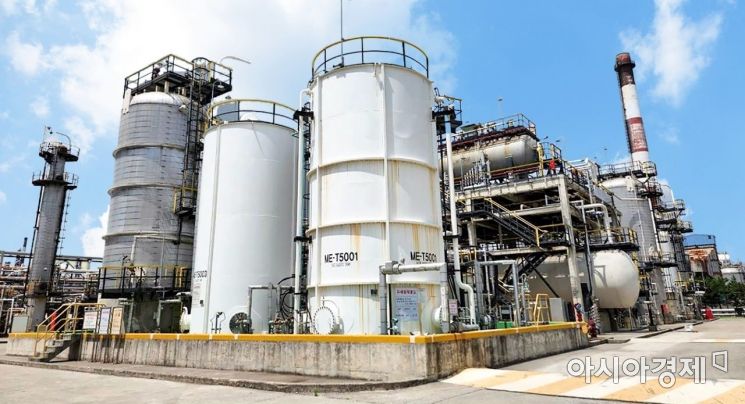 SBM (Solid Bed Merox) process at SK Innovation Ulsan Plant. A facility that recycles waste generated from the jet fuel production process.
 [Photo by SK Innovation]
The main export destinations were Australia (18.6%), Singapore (13%), Japan (11.5%), China (9%), and the United States (8.7%). Exports of gasoline and jet fuel to Japan increased by 51% and 70%, respectively. Japan is experiencing a reduction in refining capacity and fuel production due to refinery consolidations that took place 10 years ago. This has led to gasoline supply disruptions and a jet fuel shortage caused by a surge in foreign tourists due to the recent weak yen. In response, domestic refiners quickly expanded exports, resulting in increased export volumes to Japan.
The association assessed that "despite these circumstances, the outlook for petroleum product exports is not promising." Refining margins deteriorated in the second quarter due to increased petroleum product exports from China and India, and in the medium to long term, global economic slowdown, improved fuel efficiency, and the transition to electric vehicles are expected to slow the growth in petroleum product demand. The association added, "The main export product, jet fuel, is also expected to gradually transition to sustainable aviation fuel (SAF) in the European Union (EU), the United States, and other regions," emphasizing that "the domestic refining industry needs strategic responses aligned with market changes."
© The Asia Business Daily(www.asiae.co.kr). All rights reserved.

















