Biden's Economic Approval at 37%... "Harris Also Responsible"
US Voters' Dissatisfaction Deepens Over Inflation
Kamala Harris, the Vice President of the United States, is considered a leading Democratic presidential candidate, but there is an analysis that she could be hindered by President Joe Biden's economic policies.
On the 22nd (local time), CNBC reported that Biden's economic policies have become a challenge that Vice President Harris must overcome to defeat former President Donald Trump.
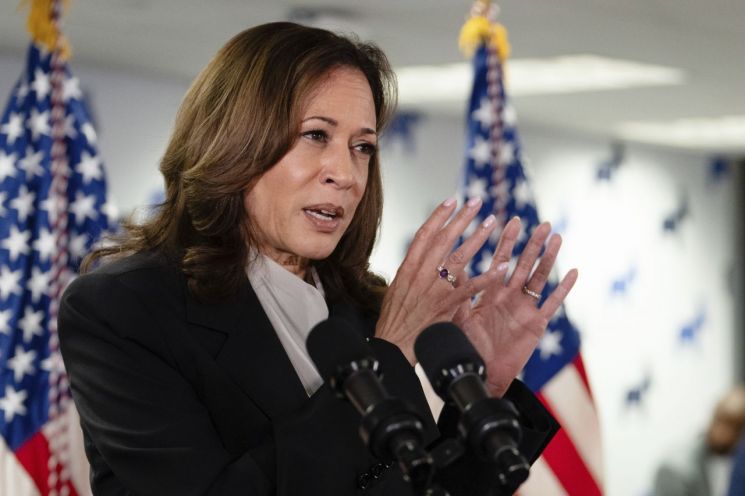
Despite low unemployment rates and macroeconomic growth, the economy is seen as a weakness of the Biden administration. According to a poll released on the 25th of last month by Ipsos and major foreign media, only 37% of Americans support President Biden's economic policies. In comparison, former President Trump's economic policy approval rating stands at 43%.
There are also issues with debt and deficits. The federal government's fiscal deficit has increased by about $7.2 trillion under the Biden administration. Furthermore, this year is expected to see a deficit of $2 trillion.
CNBC stated that these economic problems could hold Vice President Harris back. If Harris becomes the Democratic candidate succeeding President Biden, it is expected that she will present pledges aligned with Biden's existing economic policies.
Greg Valliere, Chief Policy Strategist at AGF Investments in the U.S., said, "Vice President Harris has to take some responsibility because she works for the Biden administration." He added, "It is difficult to present new pledges because it could be seen as insincere," and "Vice President Harris is in a difficult position."
Mark Zandi, Chief Economist at Moody's Analytics, who has advised bipartisan administrations as a Democrat, said, "I don't see a significant difference between Vice President Harris's views on economic policy and those of the Biden administration," adding, "Vice President Harris was involved in discussions setting those policies. The Biden administration's policies are Vice President Harris's policies."
The main reason voters are dissatisfied with the Biden administration's economic policies is inflation. According to the U.S. Department of Labor, the Consumer Price Index (CPI) in June rose 3% year-over-year. Although it has declined for three consecutive months recently, it is more than double the 1.4% rate when President Biden and Vice President Harris took office. CNBC reported that under the Biden administration, food costs have risen by 21%, energy prices surged by 33%, and median housing prices jumped by 18.5%.
Joseph LaVorgna, former Chief Economist of the White House National Economic Council during former President Trump's administration and current Chief Economist at SMBC Nikko Securities, said, "The limited time until the election will prevent a noticeable change in the economic blueprint," adding, "Vice President Harris has economic achievements to present and claims to make, but fundamentally she is the same as President Biden."
CNBC analyzed that Vice President Harris could seek differentiation from President Biden in policies related to the Federal Reserve (Fed). In 2018, as a senator, Harris voted against the confirmation of Jerome Powell, then nominated by former President Trump as Fed Chair. Powell was a Republican, and they had differing views on areas such as bank regulation. Later, President Biden re-nominated Powell in 2022. Since Powell's term ends in 2026, there is room for Vice President Harris to seek changes.
© The Asia Business Daily(www.asiae.co.kr). All rights reserved.

















