Hyundai Motor's electric buses will operate as route buses on Yakushima Island in Japan. Following its entry into the Japanese passenger car market, Hyundai plans to accelerate the electrification transition in the commercial vehicle market through the supply of electric buses.
On the 18th, Hyundai announced on the 23rd that it held a memorandum of understanding (MOU) signing ceremony for the purchase of the zero-emission electric bus 'Elec City Town' with Iwasaki Group at the Imperial Hotel in Tokyo, Japan. Iwasaki Group is a transportation company engaged in transportation and tourism services mainly in Kagoshima Prefecture, Japan. About 40 representatives from both companies attended the event, including Jo Wonsang, head of Hyundai Motor Japan (HMJ), and Yoshitaro Iwasaki, CEO of Iwasaki Group.
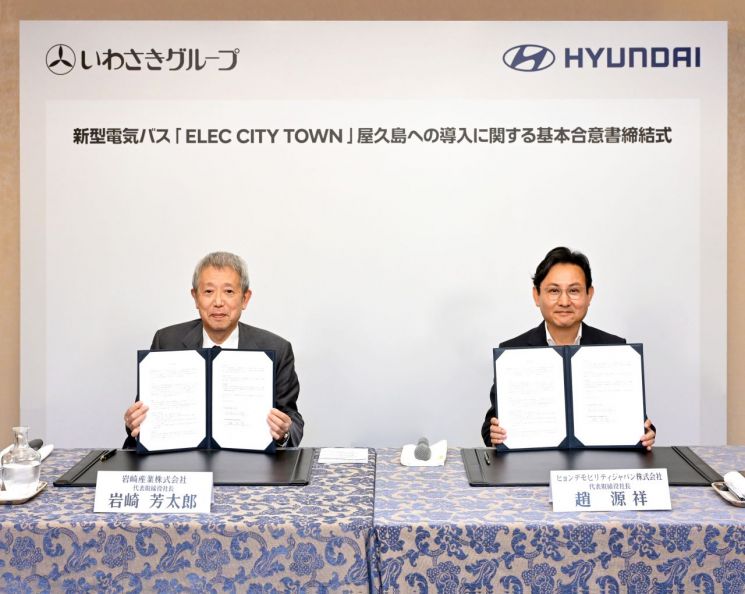 Jowon Sang, Head of Hyundai Motor Japan Corporation (HMJ) (right in the photo), and Yoshitaro Iwasaki, CEO of Iwasaki Group, are posing for a commemorative photo at the letter of intent signing ceremony.
 [Photo by Hyundai Motor]
The memorandum of understanding is a document that outlines the major terms and mutual agreements before the formal contract is signed. Through this agreement, Hyundai will start delivering the first Elec City Town electric bus, which will be launched in the fourth quarter of this year, and supply a total of five units to Iwasaki Group by the first quarter of next year. Iwasaki Group plans to operate the Elec City Town as a route bus on Yakushima Island.
President Yoshitaro said, "Currently, Chinese electric buses are also being sold in Japan, but above all, we chose Hyundai's electric buses because of their high quality and reliability," adding, "We plan to replace all vehicles operating on Yakushima with electric vehicles in the future."
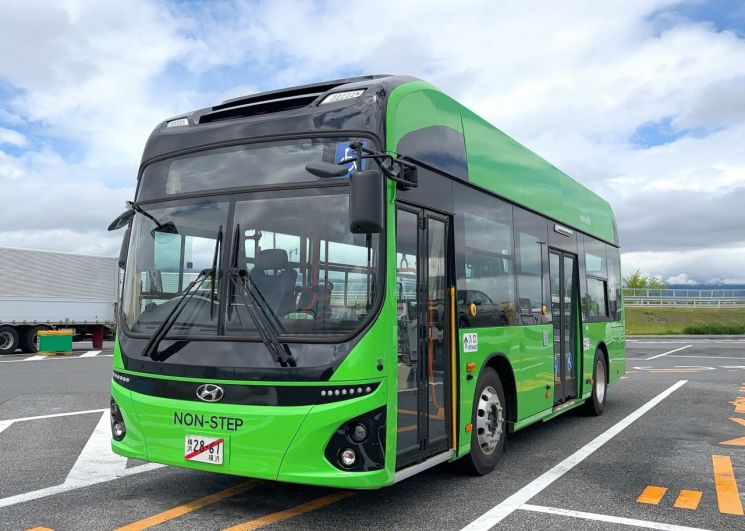
The Elec City Town is a 9-meter-class medium-sized low-floor electric bus specially developed to suit local conditions. It is equipped with a high-efficiency motor delivering a maximum output of 160 kW and a 145 kWh capacity battery. The maximum driving range per charge is expected to exceed 220 km (based on Japanese standards), and charging infrastructure accessibility has been enhanced by adopting the CHAdeMO charging method to suit local conditions in Japan. At the same time, it supports fast charging of up to 180 kW (based on dual-port charging).
In May, Hyundai successfully conducted driving tests of the Elec City Town test vehicle on two of the most challenging local bus routes on Yakushima. Hyundai also plans to establish an inventory management system capable of delivering more than 95% of parts within two days. In collaboration with local insurance companies, Hyundai is exploring ways to partially cover replacement costs for frequently damaged parts such as front glass, side mirrors, and tires for a certain period. The goal is to provide after-sales service (AS) at the highest level in the bus industry.
Hyundai entered the Japanese market in 2022, starting with the Ioniq 5. It has introduced only 100% electrified models in the local passenger car market, including the Nexo hydrogen fuel cell vehicle, Kona Electric, and the high-performance electric Ioniq 5 N, and plans to launch a new compact electric vehicle model next year. Following the introduction of the Elec City Town, Hyundai is also considering the deployment of additional commercial electric vehicle models.
A Hyundai official said, "It is meaningful to supply Hyundai's first electric bus in Japan, the Elec City Town, to Yakushima, which is designated as a UNESCO World Natural Heritage site," adding, "We will solidify our position as a leading electrification brand and continue to introduce electrified vehicles to provide local customers with the differentiated value of 'EV Life.'"
© The Asia Business Daily(www.asiae.co.kr). All rights reserved.


















