Research Team Develops Ion Exchange Desalination Battery... Solving Energy Storage and Seawater Desalination Together
Desalination Battery's Longstanding Challenge Addressed with Chlorine Capture Method, Published in ACS Energy Letters
As water scarcity becomes more severe due to climate change, the need for seawater desalination has increased.
A research team at UNIST has developed a technology that enables both renewable energy storage and desalination simultaneously, aiming to address the issue of CO2 emissions generated during the desalination process.
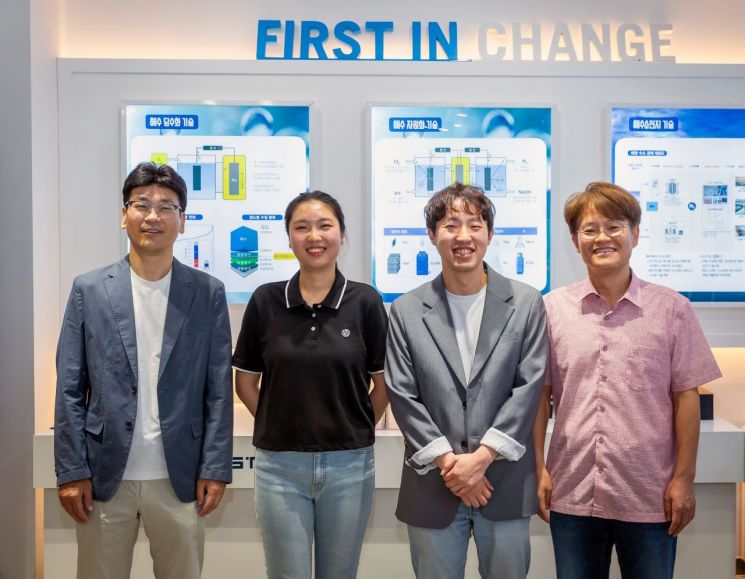 From the left, Professor Ahn Kwangjin, Researcher Cho Yunjung (co-first author), Researcher Jung Sungwoo (co-first author), Professor Kim Youngsik.
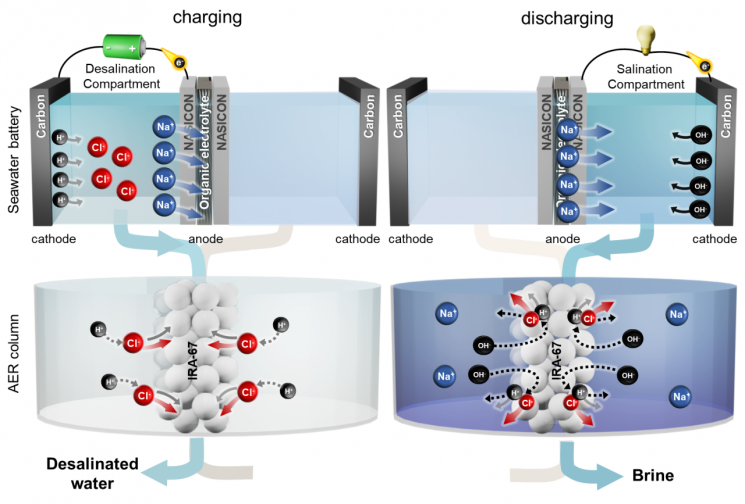
The teams led by Professor Kwangjin An and Professor Youngsik Kim from the Department of Energy and Chemical Engineering at UNIST have developed a battery that can desalinate seawater. This battery repeatedly captures chlorine during its charging and discharging cycles. By utilizing an anion exchange resin, chlorine can be effectively captured and regenerated.
The research team succeeded in desalinating 375 mL of seawater to the level required for industrial water. Conventional batteries left about 60% of chlorine on the electrodes during discharge, making regeneration difficult, but the desalination battery removed more than 99% of chlorine, demonstrating excellent regeneration capability.
During the discharge process, sodium captured at the cathode is released, and at the same time, chlorine captured in the anion exchange resin is also released. The principle involves regenerating the ion exchange resin using hydroxide ions (OH-) generated at the anode, without requiring additional energy.
The battery operated normally even in real seawater environments, desalinating seawater from about 3.9 wt% to approximately 0.7 wt%. This is a level suitable for use as industrial water.
Professor Kwangjin An explained, “With this technology, we can integrate energy storage batteries and seawater desalination equipment into a single system, reducing facility costs. By storing renewable energy, it will contribute to sustainable seawater desalination.”
Professor Youngsik Kim said, “Seawater desalination using desalination batteries will accelerate the commercialization of next-generation seawater desalination technologies.”
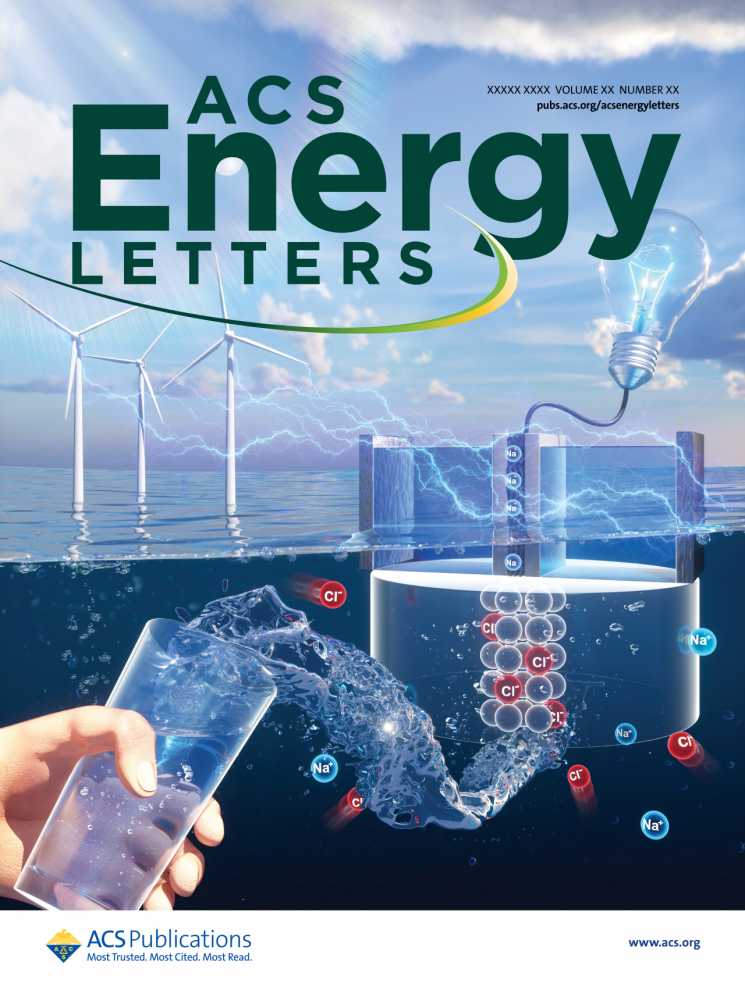
The research results were published in ACS Energy Letters on May 16, 2024. The study was supported by the National Research Foundation of Korea, the Ministry of Trade, Industry and Energy, and the Donggrami Foundation.
© The Asia Business Daily(www.asiae.co.kr). All rights reserved.
![Clutching a Stolen Dior Bag, Saying "I Hate Being Poor but Real"... The Grotesque Con of a "Human Knockoff" [Slate]](https://cwcontent.asiae.co.kr/asiaresize/183/2026021902243444107_1771435474.jpg)


















