Governance Forum Hosts Seminar Opposing Merger
Shareholder Interest Infringement and Strengthening of Controlling Shareholder Power
Criticism of 'Predatory Capital Transactions'
The Korea Corporate Governance Forum criticized the merger between Doosan Bobcat and Doosan Robotics, promoted by the Doosan Group, stating that each company's board of directors should reconvene and reconsider the merger from the perspective of shareholder interests. A representative of an overseas fund invested in Doosan Bobcat officially expressed opposition to the merger.
International credit rating agencies have given negative evaluations of the merger, which has sparked controversy over shareholder rights violations, and criticism toward Doosan is growing, with the political sphere even proposing the so-called 'Bobcat Prevention Act.'
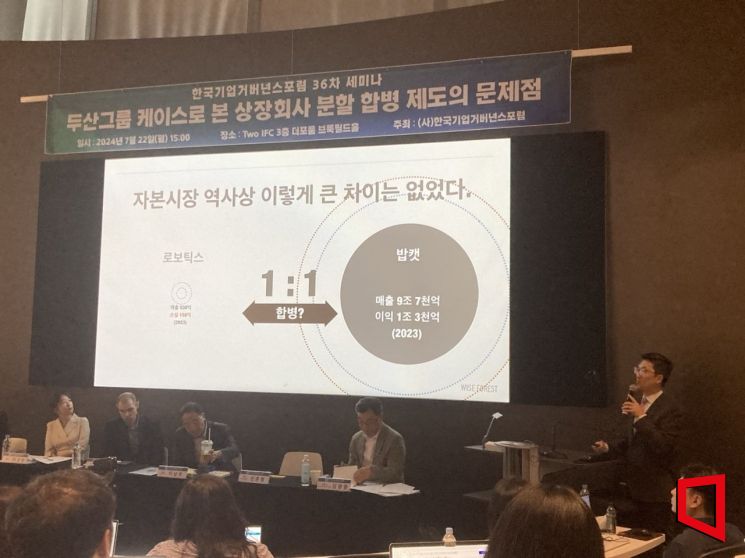 Attorney Cheon Jun-beom is presenting at the seminar titled "Issues of the Listed Company Split and Merger System Seen Through the Doosan Group Case," hosted by the Korea Corporate Governance Forum on the 22nd at The Forum, IFC Yeouido, Seoul. (Photo by Oh Hyun-gil)
Attorney Chun Junbeom (Vice Chairman of the Forum) said on the 22nd, "The boards of directors of Doosan Enerbility, Doosan Bobcat, and Doosan Robotics should reconvene, thoroughly review whether this decision benefits both the companies and the shareholders, and reconsider it."
At a seminar titled "Problems of the Listed Company Split and Merger System Seen Through the Doosan Group Case," held by the Forum at The Forum in Yeouido IFC on the same day, Attorney Chun pointed out, "The core of this merger starts from the assumption that the market capitalizations of Doosan Bobcat and Doosan Robotics, which differ by 183 times in emissions, are equal."
As of 2023, Doosan Bobcat recorded sales of 9.7 trillion KRW and operating profit of 1.3 trillion KRW, whereas Doosan Robotics posted sales of 53 billion KRW and a loss of 115.8 billion KRW. However, when calculating the merger ratio, the market capitalizations of the two companies as of the 11th were similar at 5.213 trillion KRW and 5.529 trillion KRW, respectively, and the merger ratio was set at 1 to 0.63. This means 100 shares of Bobcat stock would be exchanged for 63 shares of Robotics stock.
From the perspective of Bobcat shareholders, they must exchange their consistently profitable shares for shares of a loss-making company, and even then, the number of shares they receive decreases.
On this day, the Forum judged that the Doosan Group strengthened the controlling shareholder's power while infringing on shareholder interests and criticized this governance restructuring as a "predatory capital transaction."
Currently, the Doosan Group's governance structure is "(Doosan Co., Ltd. → Doosan Enerbility → Doosan Bobcat)," with Doosan's effective control over Doosan Bobcat evaluated at about 13.8%. If the merger proceeds as disclosed, Doosan's stake in the newly merged company will increase to 42%. Conversely, Doosan Co., Ltd.'s stake in Doosan Robotics will decrease from 68.2% to 42.3% due to dilution.
Attorney Chun said, "If the corporate value is judged based on Doosan Robotics' public offering price, Doosan Co., Ltd. would hold an 18.7% stake," adding, "Not only does the shareholding ratio decrease, but there will also be an obligation to purchase additional shares to meet the 30% mandatory holding requirement for listed subsidiaries."
He continued, "For shareholders of Doosan Enerbility and Doosan Bobcat, the key risk factor is the extreme overvaluation and potential decline of Robotics shares received through this split merger and stock exchange, but this was not properly disclosed in the securities registration statement," and requested, "Such inadequate disclosure constitutes a material omission, so the Financial Supervisory Service should conduct a strict review of the securities registration statement."
He added, "The fundamental cause of this problem lies in Article 176-5, Paragraph 5 of the Enforcement Decree of the Capital Markets Act," urging an amendment to the Capital Markets Act.
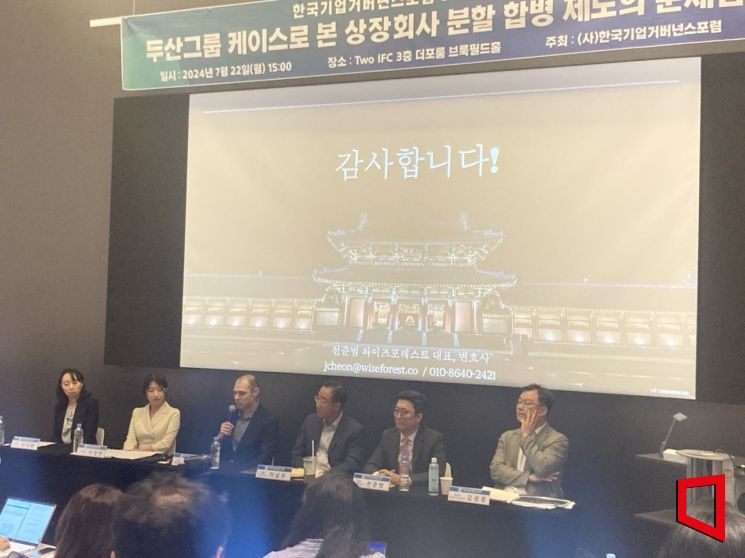 Sean Brown, director of Teton Capital Partners, is speaking at the seminar titled "Issues of the Listed Company Split and Merger System Seen Through the Doosan Group Case," hosted by the Korea Corporate Governance Forum on the 22nd at The Forum, IFC Yeouido, Seoul. (Photo by Oh Hyung-gil)
In particular, it was pointed out that if this Doosan governance restructuring proceeds, it will set a precedent for other corporate groups and may cause foreign investors to leave the Korean stock market.
Sean Brown, director of Teton Capital Partners, a major foreign investor in Doosan Bobcat, said, "I couldn't believe my eyes when I saw the merger disclosure. Since most of our shares were diluted, our fund sold most of its shares on the market immediately after seeing the disclosure."
He added, "Doosan increased its control without spending a penny, and I felt betrayed that the board approved such a decision," criticizing, "Instead of diluting shareholder ownership, the Doosan chaebol family received enormous benefits."
Earlier, on the 17th (local time), Standard & Poor's (S&P) designated Doosan Bobcat's 'BB+' long-term issuer credit rating and bond rating as 'Credit Watch' with a negative outlook, stating, "The Doosan Group's governance restructuring could lead to increased group intervention in Doosan Bobcat."
In the political arena, the Doosan governance restructuring has reignited discussions on revising the Commercial Act. On the 18th, Kim Hyunjung, a member of the Democratic Party of Korea, introduced a partial amendment bill to the Capital Markets Act aimed at strengthening the responsibility for fair merger price calculation for listed companies to prevent a recurrence of the 'Doosan Bobcat incident.'
The Doosan Group plans to hold a shareholders' meeting on September 25 to propose this governance restructuring plan. The agenda items, including split, merger, and comprehensive stock exchange, require special resolutions at the shareholders' meeting. Special resolutions require approval from at least two-thirds of attending shareholders and at least one-third of the total issued shares. Attorney Lee Junhyun said on the day, "To block this resolution, shareholders need to exercise their dissenting voting rights," but added, "Considering the controlling shareholder's minority stake and general shareholder support, it will not be an easy task."
© The Asia Business Daily(www.asiae.co.kr). All rights reserved.
![Clutching a Stolen Dior Bag, Saying "I Hate Being Poor but Real"... The Grotesque Con of a "Human Knockoff" [Slate]](https://cwcontent.asiae.co.kr/asiaresize/183/2026021902243444107_1771435474.jpg)

















