Last Month's Export Volume Doubled Compared to Early This Year
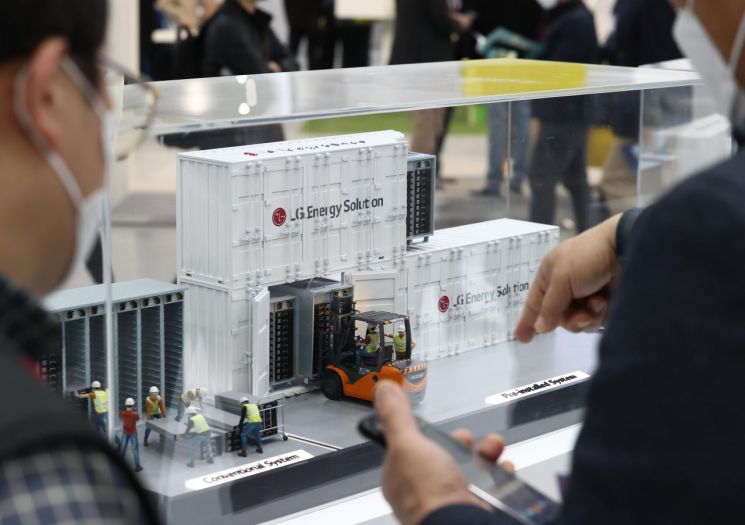
The energy storage system (ESS) sector is emerging as a new breakthrough for the Korean battery industry, which is currently facing difficulties due to a temporary stagnation in demand in the electric vehicle market. The rapid growth of the artificial intelligence (AI) industry has increased electricity demand, thereby expanding the necessity for ESS.
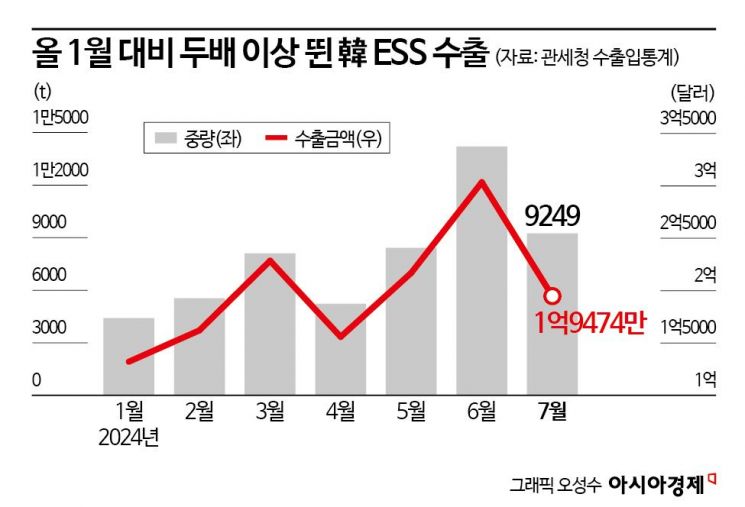
According to export-import statistics from the Korea Customs Service on the 23rd, last month's ESS export value reached $303.45 million (approximately 421.2 billion KRW), marking a 15.6% increase compared to the same period last year ($261.6 million). Compared to the previous month (May, $216.95 million), exports rose by 39.6%, and the export value more than doubled compared to January of this year. Export weight also nearly doubled to 14,204 tons from 7,402 tons last year.
Despite an overall contraction in the battery value chain due to sluggish upstream demand, the ESS sector has recorded outstanding growth. By value chain segment, during the same period, exports of cells decreased by 53%, NCM (nickel-cobalt-manganese) cathode materials by 47%, and copper foil by 56%.
The AI market’s expansion has caused a surge in demand for AI data centers, which consume massive amounts of electricity. Big tech companies are seeking renewable energy sources to power their data centers. This is because they need to secure vast amounts of electricity while also meeting the challenge of achieving carbon neutrality amid tightening global environmental regulations.
ESS is regarded as the key to overcoming the intermittency of renewable energy. Since renewable energy supply is unstable, ESS is used to store a certain amount of energy. ESS stores electricity when production is high and supplies it when demand surges. According to the International Energy Agency, the global ESS market size is expected to grow from 86 GW in 2023 to 1,200 GW by 2030.
China, a rival in the battery industry, is also experiencing a surge in ESS exports this year. As of May this year, China’s cumulative ESS export volume reached 8.4 GWh, a 50.1% increase compared to the previous year. Particularly, ESS exports in May alone surged by 664% year-on-year to 4 GWh. Since the beginning of this year, major battery companies such as CATL have reportedly secured over 32 GWh of overseas ESS orders. China’s ESS uses LFP (lithium iron phosphate) batteries, which are evaluated as cost-effective and highly stable.
Korean battery companies such as LG Energy Solution, SK On, and Samsung SDI are also preparing for this demand by converting existing production lines to ESS battery processes. Earlier this month, Samsung SDI signed a contract to supply ESS batteries worth over 1 trillion KRW to NextEra Energy, the largest power company in the United States. The total capacity of 6.3 GWh that Samsung SDI will supply to NextEra Energy corresponds to 11.5% of last year’s total ESS capacity in North America (55 GWh). SK Group, which is currently attempting a merger between SK Innovation and SK E&S through business rebalancing, is also placing great expectations on energy demand related to AI.
At a recent press conference held by the Korea Chamber of Commerce and Industry, SK Group Chairman Chey Tae-won explained the background of the merger, saying, "AI consumes tremendous amounts of energy, and the two energy companies (SK Innovation and SK E&S) can join forces to create solutions. I believe that turning the electricity used in AI data centers into solutions will become a significant business in the future."
© The Asia Business Daily(www.asiae.co.kr). All rights reserved.
!["The Woman Who Threw Herself into the Water Clutching a Stolen Dior Bag"...A Grotesque Success Story That Shakes the Korean Psyche [Slate]](https://cwcontent.asiae.co.kr/asiaresize/183/2026021902243444107_1771435474.jpg)

















