Appeal Trial Likely to Increase Sentence from '17 Years Imprisonment'
The Supreme Court has ruled that the stepmother, who was tried for abusing her 12-year-old stepson to death, should be retried with the charge of child abuse homicide.
According to the legal community on the 22nd, the Supreme Court's 3rd Division (Presiding Justice No Jeong-hee) overturned the original ruling that sentenced stepmother A (44) to 17 years in prison for child abuse resulting in death and remanded the case to the Seoul High Court. The appeal by the biological father B was dismissed, and the original sentence of 3 years in prison was upheld.
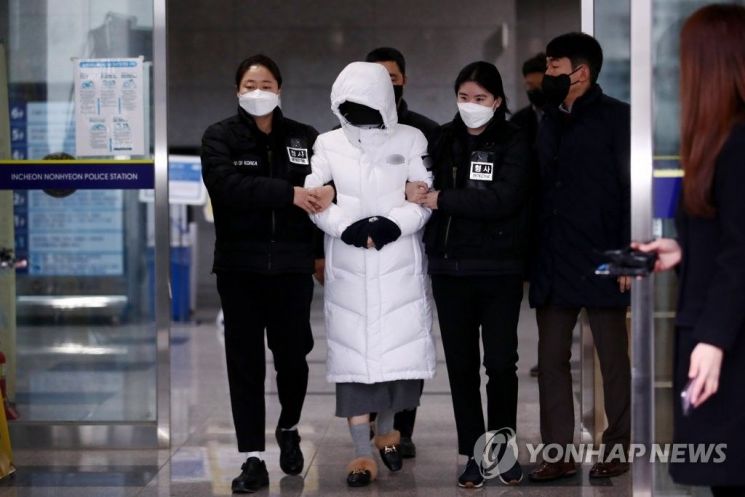 A stepmother (43) accused of continuously abusing a 12-year-old elementary school student, who died with bruises all over her body, is being transferred to the prosecution after leaving Nonhyeon Police Station in Namdong-gu, Incheon, on the morning of February 16 last year.
 [Image source=Yonhap News]
A was arrested and indicted on charges of abusing her 12-year-old stepson, the victim child, 50 times over 11 months from March 9, 2022, to February 7 of last year, at an apartment in Namdong-gu, Incheon. Husband B was also indicted on charges of abusing the victim child 15 times, including beating him with a drumstick from April 2021 to January of last year, and neglecting the abuse by his wife A despite being aware of it.
While being subjected to long-term repeated abuse by his parents, the victim child's weight dropped from 38 kg at age 10 to 29.5 kg on the day of death. Bruises and wounds were also found all over his body at the time of death.
Investigations revealed that B began cohabiting with A in May 2018 and raised the victim child, born from his previous marriage, together with her. A forced the victim child to copy the Bible by hand, and if he failed to complete it, he was not allowed to leave the room or was beaten. She also tied him to a chair for up to 16 hours and monitored him via a home camera. In particular, in the three days immediately before the death, A was found to have hit the victim child dozens of times with a shelf support rod and a plastic hanger and tied him up for about 18 hours.
The first and second trials sentenced A to 17 years in prison and B to 3 years. The prosecution argued that the heavier charge of child abuse homicide should be applied, but the court only recognized child abuse resulting in death, stating that A had no intent to kill the victim child.
The Supreme Court's judgment was different. The Supreme Court overturned the lower court ruling, stating, "There is a strong possibility that defendant A had at least indirect intent to kill through child abuse." The court judged that intent to kill was recognized based on the fact that A neglected the victim child despite seeing him unable to walk properly, collapsing, suffering pain, and unable to sleep well; that abuse continued even though urgent treatment and rescue were needed near the time of death; and that no special rescue measures were taken.
The Supreme Court stated, "Considering the victim child's age and weakened health condition, it is necessary to comprehensively judge the circumstances before and after the crime, such as whether the defendant recognized or could have foreseen the risk of death if severe abuse was inflicted again."
© The Asia Business Daily(www.asiae.co.kr). All rights reserved.
![Clutching a Stolen Dior Bag, Saying "I Hate Being Poor but Real"... The Grotesque Con of a "Human Knockoff" [Slate]](https://cwcontent.asiae.co.kr/asiaresize/183/2026021902243444107_1771435474.jpg)











