Reduced Volatility During Earnings Announcements
Short-Term Trading Opportunities
Cryptocurrency Expected to Benefit
Experts foresee that short-term volatility may persist in the domestic stock market for a while due to the issue of U.S. President Joe Biden's withdrawal from the candidacy. Although the U.S.-originated variable will affect domestic short-term supply-demand factors and investor sentiment, the duration is expected to be short, and some opinions suggest that such short-term fluctuations could actually present trading opportunities. Additionally, as the Q2 corporate earnings season kicks off in earnest, there is a forecast that volatility in the domestic stock market related to the U.S. presidential election may decrease.
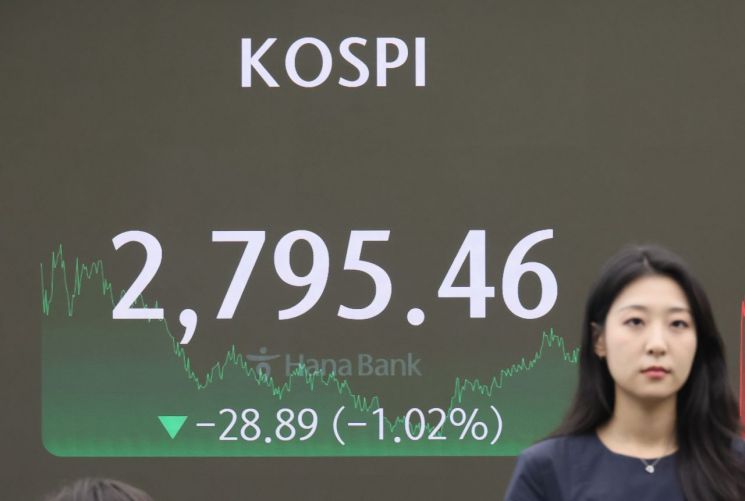
As of 9:40 a.m. on the 22nd, the KOSPI stood at 2,768.14, down 27.32 points (-0.98%) from the previous trading day. The index opened at 2,790.99, down 4.47 points (0.16%), and has been fluctuating since. Foreigners and institutions are net sellers of 55.3 billion KRW and 17.4 billion KRW respectively, while individuals are the sole net buyers with 95.2 billion KRW. At the same time, the KOSDAQ is at 816.80, down 11.92 points (-1.44%) from the previous day.
Last week (15th?19th), the KOSPI closed at 2,795.46, down 61.54 points (2.15%) for the week. The domestic stock market showed a consistently weak trend due to the impact of the attack on former President Donald Trump and weakness in U.S. semiconductor stocks, ultimately closing below the 2,800 mark.
In the securities industry, it was advised to approach the market defensively in anticipation of increased volatility just before the U.S. presidential election. Kim Dae-jun, a researcher at Korea Investment & Securities, suggested, "Generally, the stock market tends to experience increased volatility just before the U.S. presidential election, and we are currently in that process. A defensive approach to the market seems necessary for the time being."
Han Ji-young, a researcher at Kiwoom Securities, analyzed, "There is a possibility of returning from the 'Trump trading' phase, which assumed former President Trump’s election as a given, back to the previous election phase of 'uncertainty about who will win.'"
There are also opinions that the impact of the U.S. presidential election issue on the domestic stock market will be limited. Although the Democratic candidate was replaced, the possibility of overturning the election outcome is low, so short-term volatility is expected to continue but not for a long time.
Cho Joon-ki, a researcher at SK Securities, said, "The possibility of the election landscape being shaken by Vice President Kamala Harris becoming the candidate is limited, and the likelihood of former President Trump winning remains much higher." He added, "Accordingly, short-term volatility is likely to continue, and there may be periods when statements have a strong impact on the stock market." However, Cho also noted, "Although there may be periods when former President Trump's statements have a strong impact on the stock market, the duration during which they act as a reason to pull the market down will not be long."
Lee Kyung-min, head of FICC Research at Daishin Securities, said, "I believe that the influence of political issues and events on the trend and direction of global financial markets and stock markets is limited." He added, "While it is necessary to keep in mind the uncertainties related to various political issues and events until the U.S. presidential election in November, as well as the fluctuations depending on the election results, what is more important is the fundamental flow."
The securities industry pointed to the earnings season as a factor that could end the recent correction phase. Researcher Cho said, "The factor that can quickly end the current correction phase is the earnings season, which will become more active this week." Lee also forecasted, "With the arrival of the full-fledged Q2 earnings season, we expect a strong rebound overcoming last week's sharp decline."
Opinions on the Trump trade in the securities industry were divided. The Trump trade refers to the phenomenon where assets related to former President Trump show strength.
Researcher Kim said, "Last week in the U.S., IT and communication sectors, which were previously leading, experienced large declines, but sectors that could be seen as beneficiaries of the Republican Party, such as energy, finance, and industrials, performed well." He added, "The same was true in Korea. Specifically, defense industry, construction, shipbuilding, and other industrials, as well as defensive sectors like telecommunications, food and beverage, and healthcare, showed good performance."
Researcher Cho said, "In a situation where former President Trump is highly advantageous, beneficiary stock plays are likely to remain valid until the election." He identified shipbuilding, pharmaceuticals & bio, and steel & non-ferrous metals as expected beneficiary sectors.
With President Biden’s announcement of his withdrawal from the re-election race, there are forecasts that the Trump trade will weaken and the KOSPI will surpass the 2,800 mark again. It is suggested that semiconductor, automobile, and secondary battery sectors, which were the victims of the Trump trade in the domestic stock market, may attempt a rebound and push the KOSPI upward.
Lee said, "Going forward, the KOSPI will attempt to break through the 2,900 level based on support around the 2,800 level." He pointed out key sectors as semiconductor and automobile growth stocks (secondary batteries + internet), which benefit from Bidenomics and were negatively affected by Trumpnomics.
The virtual asset market is expected to benefit as former President Trump moves closer to re-election. Hi Investment & Securities said, "As Trump's election becomes more likely, the virtual asset market has recently emerged as a Trump beneficiary theme." They added, "Accordingly, contrary to the recent sharp decline in the stock market, Bitcoin showed a clear rebound trend over the weekend, surpassing the $67,000 level."
Meanwhile, the won-dollar exchange rate opened at 1,388.0 won, down 2.2 won from the previous trading day (1,390.2 won). At this time, it is recording 1,388.20 won, down 3.30 won.
© The Asia Business Daily(www.asiae.co.kr). All rights reserved.