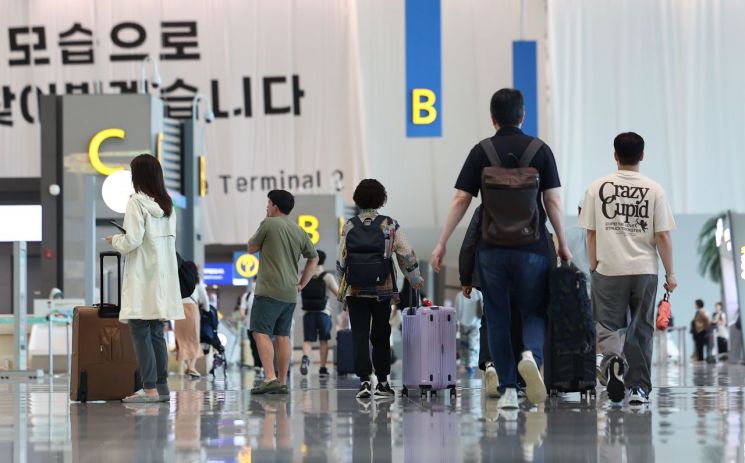
As the "index-type aircraft delay insurance," which pays out insurance benefits when flights are delayed or canceled, is expected to be launched in the third quarter, insurance companies are showing lukewarm reactions. While the product could enhance customer convenience, there are concerns about its effectiveness and whether it is practical considering the costs insurance companies must bear to develop digital infrastructure.
According to the insurance industry on the 23rd, the Korea Insurance Development Institute calculated and distributed reference pure premium rates (standards that help insurers determine how much premium to charge to avoid losses) for aircraft delay insurance to insurance companies this month. This product pays a predetermined insurance benefit when international flights are delayed or canceled, marking the first "index-type" insurance in Korea, and it will be developed as a special rider product.
Index-type insurance automatically pays out benefits when certain indicators or conditions are met, enabling quick compensation without complicated claim procedures. For example, if a flight is delayed by 2 hours, 40,000 KRW is paid, and for additional delays, 20,000 KRW per hour is paid up to a maximum cumulative amount of 100,000 KRW.
The Korea Insurance Development Institute has promoted through press releases that the product can be launched in the third quarter, emphasizing that it is the first index-type insurance. Compensation products related to flight delays already exist. However, existing products compensate only for losses incurred, such as transportation costs while waiting for the flight, within the insured amount limit. Customers must submit related documents such as boarding pass copies and receipts and file claims directly with the insurer. In contrast, index-type insurance compensates a fixed amount regardless of the actual loss and does not require separate proof submission.
According to the insurance industry, guidelines were also provided to insurers along with the insurance rates for this product. However, under the current guidelines, the product is only applicable at Incheon International Airport, indicating that improvements are needed.
There is also a viewpoint that insurers face cost burdens because they must internally develop systems that connect directly with airlines to verify flight delays or cancellations. An insurance company official said, "While the Korea Insurance Development Institute expects a reduction in insurers' loss investigation work and thus premium cost savings, insurers are not very eager to launch the product because building new infrastructure will require time and expenses."
For example, Kakao Pay Insurance, which already holds the number one market share in travel insurance, reportedly has no concrete plans to launch this special rider product. Kakao Pay Insurance is already connected to airports via systems, allowing easy notifications and claims through KakaoTalk.
Another insurance company official expressed concerns, saying, "No matter how much development is done on the mobile side, it is difficult to match the technological capabilities of digitally advanced insurers like Kakao, and it may only increase costs." This implies that the technological gap and cost burden associated with introducing new products could be a challenge for small and medium-sized insurers.
Accordingly, some insurers are expected to take a cautious approach by observing market conditions and consumer responses rather than rushing to adopt the product. The success of the new index-type insurance will likely depend on finding a balance between enhancing consumer convenience and managing insurers' technical and financial burdens.
© The Asia Business Daily(www.asiae.co.kr). All rights reserved.
![Clutching a Stolen Dior Bag, Saying "I Hate Being Poor but Real"... The Grotesque Con of a "Human Knockoff" [Slate]](https://cwcontent.asiae.co.kr/asiaresize/183/2026021902243444107_1771435474.jpg)
















