Submission of response ahead of confirmation hearing on the 22nd
September stress test to be implemented smoothly... Gradual expansion of DSR application scope
"Abolition of financial investment tax is desirable"... Departure of high-value investors shocks entire market
Financial sector accountability structure expected to prevent significant financial accidents
"Short selling IT system expected to be established by March next month"
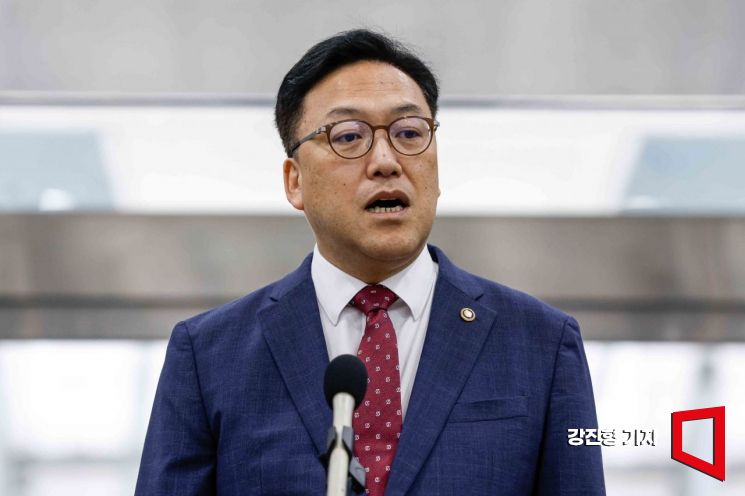 Kim Byung-hwan, the nominee for the Financial Services Commission chairman, is answering questions from the press as he arrives at the confirmation hearing office set up at the Korea Deposit Insurance Corporation in Jongno-gu, Seoul, on the 5th. Photo by Kang Jin-hyung aymsdream@
"Household loans have turned to an increasing trend, centered on bank mortgage loans and policy loans. Considering expectations of interest rate declines and the recovery of housing transactions, there are concerns about an expansion in household loan growth, so we plan to manage this proactively and aggressively in advance."
On the 21st, according to Kang Ming-guk, a member of the National Assembly's Political Affairs Committee from the People Power Party, Kim Byung-hwan, the nominee for Financial Services Commission Chairman, presented this direction for household loan management in a written response submitted to the National Assembly ahead of the confirmation hearing on the 22nd.
In particular, regarding household debt management measures, he emphasized ▲managing the 2024 household debt growth rate within the nominal Gross Domestic Product (GDP) growth rate ▲solidifying the Debt Service Ratio (DSR) system to ensure borrowing within a repayable range and establishing the practice of repaying in installments from the start ▲continuing to induce an increase in the proportion of fixed-rate and installment repayment loans to improve the qualitative structure of household debt ▲actively supporting the return to economic activities through debt restructuring for borrowers who have difficulty repaying due to excessive debt burden. The plan to solidify the DSR system includes the smooth implementation of the two-stage stress DSR from September 1 and the gradual expansion of the DSR application scope within limits that do not cause a sharp reduction in loan limits.
Regarding the abolition of the capital gains tax on securities (Geumtu Tax), he responded that considering the stability of the capital market and the impact on asset formation for 14 million individual investors, it is desirable to abolish it. In response to a question about whether the tax applies only to some and if this supports tax cuts for the wealthy, Kim said, "The departure of high-net-worth investors could shock the entire market, so it should be understood as a policy for all investors."
Regarding the effect of introducing a responsibility structure in the financial sector on preventing financial accidents such as embezzlement, he evaluated that it could prevent the occurrence of financial accidents. Kim stated, "The introduction of the responsibility structure makes CEOs and executives of financial companies clearly recognize and execute internal control over their respective duties as their own tasks," adding, "If effective internal control is achieved in the financial sector through this, it will be possible to prevent financial accidents such as embezzlement to a considerable extent."
In response to criticism that the responsibility structure is a system to punish executives when financial accidents occur, he emphasized, "Despite multiple financial accidents such as derivative-linked fund (DLF) mis-selling and embezzlement occurring consecutively, there were limitations in prevention through internal control and in holding responsible CEOs and executives accountable. Therefore, the responsibility structure was introduced to prevent financial accidents and hold CEOs or executives who neglected internal control accountable."
Regarding whether short selling will resume after improvements to the short selling system are completed, he answered that it could resume once a company-wide system to eliminate concerns about hindering fair market price formation is established.
Kim particularly addressed the possibility of delays in the resumption due to delays in building the IT system, stating, "The schedule for building the short selling IT system was presented by the Financial Supervisory Service and Korea Exchange in close consultation with various institutions and foreign investors to implement it as early as possible, and I believe it will be completed without delay by March 2025 according to the announced schedule."
© The Asia Business Daily(www.asiae.co.kr). All rights reserved.
!["The Woman Who Threw Herself into the Water Clutching a Stolen Dior Bag"...A Grotesque Success Story That Shakes the Korean Psyche [Slate]](https://cwcontent.asiae.co.kr/asiaresize/183/2026021902243444107_1771435474.jpg)
















