Haeundae Daewoo Marina Splits One Commercial Unit into 123
Commercial Unit Splitting Aimed at 'Move-in Rights', Prevention Measures Limited
Splitting Possible Before Restrictions and Rights Assessment Are Enforced
Geonsanyeon: "Supply of Units to Members at Discounted Prices Compared to Market Should Be Halted"
Concerns have been raised that the method for calculating the unit price for association members should be improved to resolve the issue of 'splitting commercial units' in order to obtain move-in rights during reconstruction projects.
On the 21st, the Korea Research Institute for Construction Industry stated in a trend briefing, "Splitting commercial units causes fairness issues, and to fundamentally improve this, it is necessary to stop supplying association members’ units at discounted prices compared to market prices."
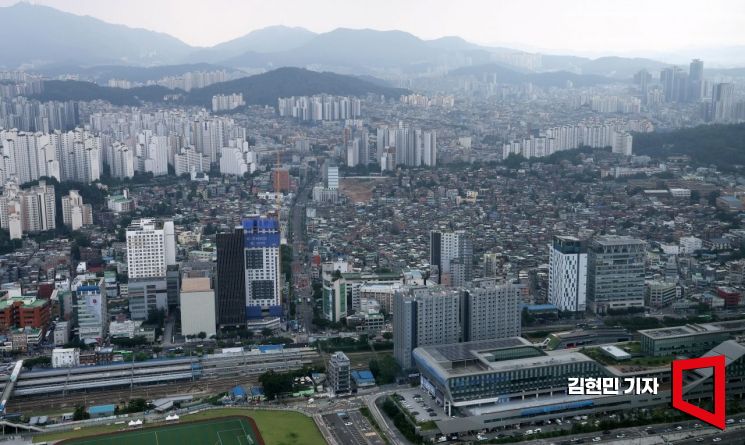 View of the Noryangjin redevelopment site in Seoul from the 63 Building observatory. Photo by Hyunmin Kim kimhyun81@
In August last year, a corporation purchased one underground commercial unit (exclusive area of 1,044㎡) in the Daewoo Marina Apartment commercial area in Haeundae-gu, Busan, then split it into 123 units of 9㎡ each and listed them for sale at around 200 million KRW each. As the number of commercial units increased from 54 to 176, residents demanded the district office to revoke the division of the commercial units.
During reconstruction, the entire commercial area is considered as one building. Commercial unit owners often use the consent requirement per building at the time of association establishment as leverage to make excessive demands. Recently, as offline commercial areas decline and housing values rise, commercial unit owners have been demanding housing move-in rights.
The Urban Maintenance Act stipulates that, as a principle, commercial unit owners should be supplied with commercial units during reconstruction project disposition, and housing supply is only allowed in exceptional cases. The enforcement decree allows for adjusting the supply conditions for commercial unit owners through ratio adjustments defined in the articles of association or similar documents. In reconstruction sites, the calculation ratio has been adjusted to expand the scope of housing allocation, enabling commercial unit owners to also receive housing units.
Most associations inevitably accept commercial unit owners’ demands for housing supply to ensure smooth project progress. The problem is that delays frequently occur, profitability decreases, and association members’ contributions increase. Increasing the number of association members through splitting undermines the association’s stability and can cause conflicts.
Earlier this year, the National Assembly and government amended the Urban Maintenance Act to restrict splitting commercial units in areas where basic plans are under public inspection or where maintenance plans are being established. The rights calculation reference date was also moved forward to the public inspection announcement date for basic plan establishment.
The issue is that this cannot be applied to maintenance projects under the Special Act on Old Planned Cities. These projects are promoted based on a separate basic plan under the Special Act on Old Cities, not the Urban Maintenance Act’s basic plan. Accordingly, Seongnam City attempted to prevent commercial unit splitting through development activity permit restrictions based on Article 63 of the National Land Planning Act in October last year.
In July, Gyeonggi Province designated most areas of the first-generation new towns, excluding residential uses, as ‘land transaction permission zones’ under Article 10 of the Real Estate Transaction Reporting Act to prevent commercial unit splitting.
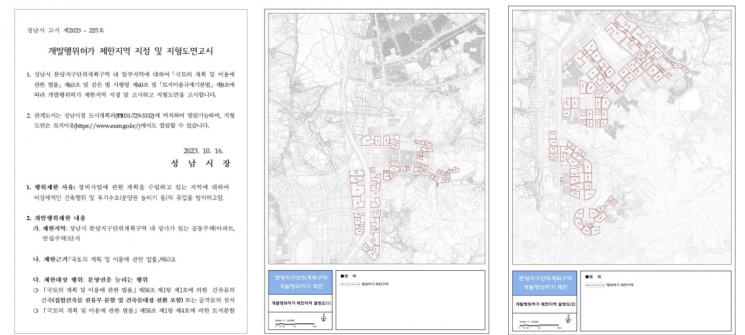 Notice of Designation of Development Activity Permit Restriction Area in Seongnam City and Topographic Map (Data=Geonsanyeon, Seongnam City)
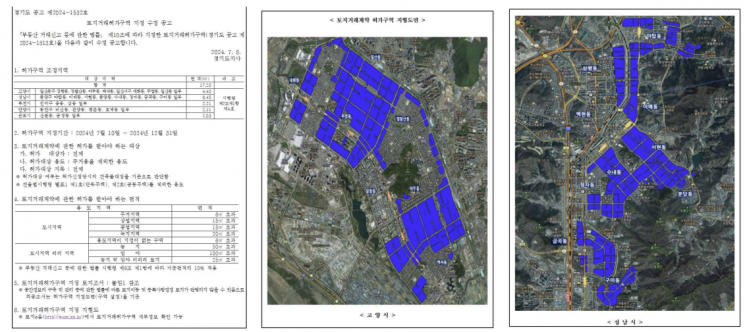 Announcement of Designation of Land Transaction Permission Zones in Gyeonggi-do and Topographic Maps (Data=Geosan Institute, Gyeonggi-do)
The Korea Research Institute for Construction Industry pointed out that although the government and local governments have employed various institutional measures to prevent commercial unit splitting, there are limitations because splitting is possible before the regulations take effect. Reconstruction commercial units have been used as a means to avoid multi-homeowner regulations and reduce gift taxes through long-term investment.
Lee Tae-hee, a senior researcher at the Korea Research Institute for Construction Industry, said, "Seongnam City’s development activity permit restriction method likely lacks effectiveness as it exceeds the scope of activity restrictions defined in the National Land Planning Act," and added, "Gyeonggi Province’s designation of land transaction permission zones also has significant limitations in preventing commercial unit splitting disguised as ‘division for normal business purposes.’"
The Korea Research Institute for Construction Industry emphasized that since the root cause of commercial unit splitting aimed at move-in rights is the 'move-in rights premium,' it should be made difficult for commercial unit owners to obtain unfair development profits. In maintenance projects, association members receive benefits such as unit prices about 10-20% cheaper than market prices, choice of preferred unit types and floors, and perks like appliances, finishing materials, and balcony expansions. The move-in rights premium gained by association members who split commercial units ultimately reduces the development profits that other members must share during general sales.
Senior researcher Lee Tae-hee explained that the practice of undervaluing post-project asset values during the post-project asset evaluation, which determines association members’ unit prices, continues. He said, "There is a need to improve the post-project asset evaluation and association member unit price calculation methods through future legal amendments," and explained, "The reason post-project asset values are generally undervalued is largely influenced by the perception among association members that since they endure hardships to carry out the project, their unit prices should be cheaper than general sales prices."
Lee added, "Changing the methods for calculating association member unit prices, development profits, and project cost distribution will create winners and losers among members and bring significant changes to maintenance projects overall," and stated, "It is necessary to carefully review related regulations and ripple effects and implement measures to mitigate side effects together."
© The Asia Business Daily(www.asiae.co.kr). All rights reserved.



















