Buffet and All-You-Can-Eat Restaurant Usage Rate This Year
Up 24.1% Compared to 2022
As high inflation continues to dampen consumer spending, visits to buffet-style restaurants are on the rise. In the midst of soaring dining-out prices, buffets, where customers can enjoy a variety of dishes in generous portions, have emerged as 'cost-effective restaurants.'
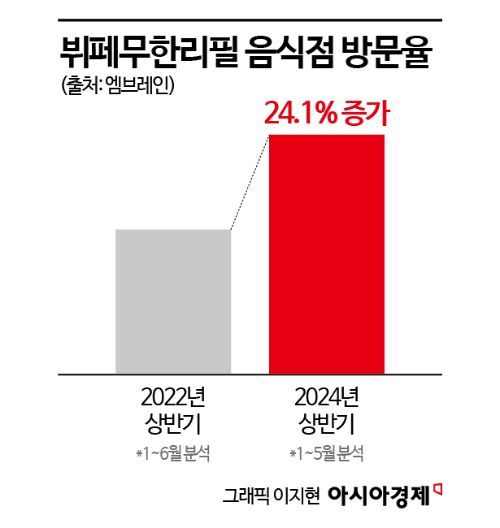
According to market research firm Macromill Embrain, the usage rate of buffet and all-you-can-eat restaurants in the first half of this year (January to May) recorded a growth rate of 24.1% compared to the average of the first half of 2022 (January to June).
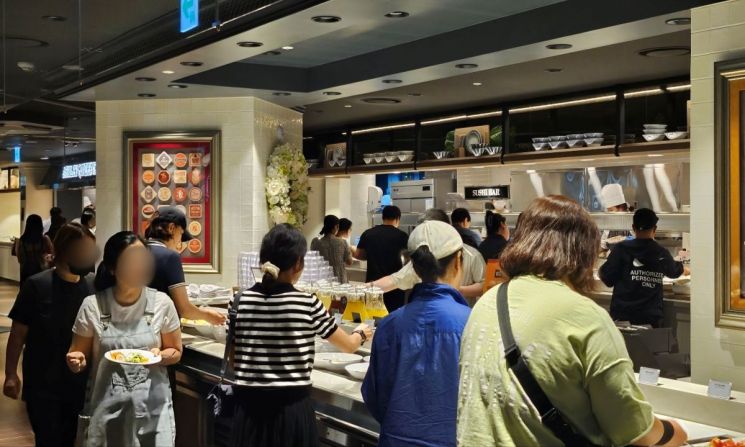
With the recent rise in dining-out prices increasing household burdens, demand for buffet-style restaurants, where people can enjoy meals to their heart's content at reasonable prices, is analyzed to be growing. According to Statistics Korea, the dining-out price inflation rate has exceeded the average overall consumer price inflation rate for 36 consecutive months since June 2021. This trend continued in the first and second quarters of this year, with dining-out prices rising faster than the average consumer price inflation.
In the first quarter, the consumer price inflation rate was 3.0%, but dining-out prices rose by 3.8%. In the second quarter, the increase in dining-out prices slowed compared to the previous year, rising 2.9% year-on-year, but still remained higher than the consumer price inflation rate of 2.7%.
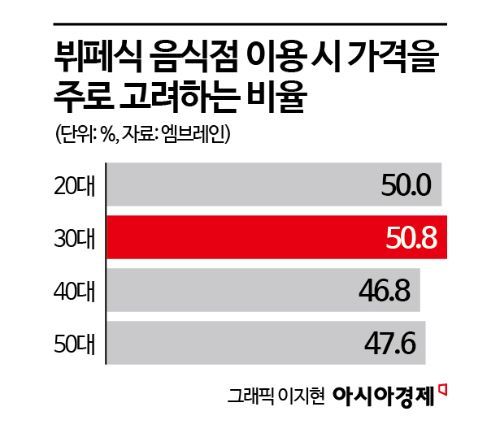
A notable point in the recent increase in usage of buffet and all-you-can-eat restaurants is the growing preference among young people in their 20s and 30s. In fact, the proportion of respondents who prioritize price when choosing buffet-style restaurants exceeded half in both the 20s (50.0%) and 30s (50.8%) age groups, which is relatively higher compared to those in their 40s (46.8%) and 50s (47.6%).
This suggests that buffet-style restaurants are seen as a reasonable choice for these generations who value 'gasimbi' (psychological satisfaction relative to price). Especially among younger generations, there is a strong preference for buffet restaurants featuring specialized menus. Given that buffet-style restaurants can be used at relatively low prices, they seem to attract the interest of these generations with relatively lower economic power.
As dining-out prices continue to rise and buffet-style restaurants gain attention, family restaurants, which had been neglected for a while due to competition from fine dining, are expanding their number of outlets and experiencing a second heyday. Ashley Queens, operated by E-Land Eats, is a representative example. The number of Ashley Queens outlets increased from 59 in 2022 to 77 last year, and as of the end of last month, it has expanded to 91 locations.
Along with the expansion in the number of outlets, performance improvements have also been achieved. According to the Financial Supervisory Service's electronic disclosure system, E-Land Eats, which operates Ashley Queens and Jayeon Byeolgok, recorded sales of 355.3 billion KRW last year, a 40.1% increase from 253.6 billion KRW the previous year, and operating profit rose 195.1% to 17.8 billion KRW. A representative from E-Land Eats said, “Ashley Queens will continue to actively increase new stores to expand contact points with customers.”
© The Asia Business Daily(www.asiae.co.kr). All rights reserved.
![Clutching a Stolen Dior Bag, Saying "I Hate Being Poor but Real"... The Grotesque Con of a "Human Knockoff" [Slate]](https://cwcontent.asiae.co.kr/asiaresize/183/2026021902243444107_1771435474.jpg)


















