Red Leaf Lettuce Soars 126% in One Month
Spinach, Cabbage, and Cheongyang Chili Also Rise
Concerns Over Consumer Price Inflation
Han Miseon (45), who runs a Sundaeguk restaurant in Yongsan-gu, Seoul, is concerned about the 'self-service corner' set up on one side of the restaurant. Recently, the rising vegetable prices have made the cost of basic side dish ingredients quite burdensome. This restaurant provides basic side dishes such as baechu kimchi, chili peppers, and seasoned bean sprouts. Han said, "During meal times, we're so busy that we don't have time to attend to customers, so we created the self-service corner for them to take freely, but there is too much leftover food. Lately, I'm seriously considering getting rid of it," adding, "My son also said that since vegetable prices have risen so much, we should try to reduce ingredient costs even a little."

Due to consecutive record-breaking heavy rains, prices of major vegetables have been fluctuating. The sharp rise in vegetable prices has raised concerns that even the consumer prices, which had barely started to slow down, could be stimulated again.
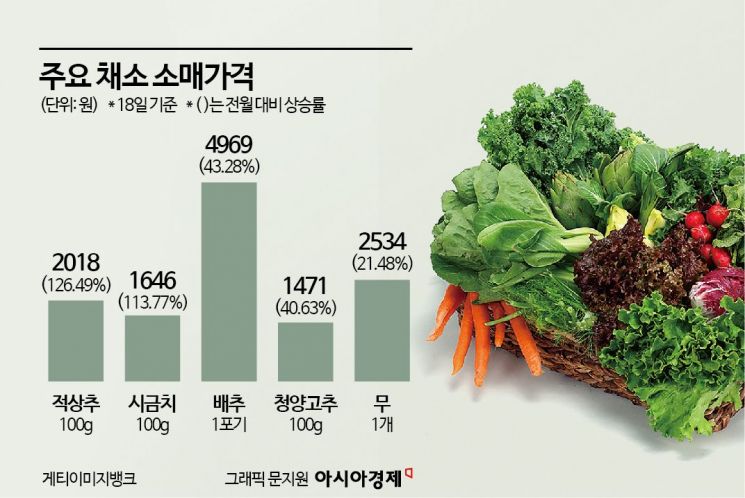
According to the Korea Agro-Fisheries & Food Trade Corporation (aT), as of the 18th, the price of red leaf lettuce (100g) was 2,018 won, a 126.49% increase in one month. Spinach (100g) was 1,646 won, up 113.77% from 770 won a month ago. Other commonly sought vegetables also saw price increases compared to a month ago: napa cabbage (one head, 4,969 won) up 43.28%, Cheongyang chili peppers (100g, 1,471 won) up 40.63%, radish (one piece, 2,534 won) up 21.48%, and perilla leaves (100g, 1,279 won) up 13.49%.
As a result, consumer prices, which had barely stabilized, are showing signs of rising again. According to the June Consumer Price Index report by Statistics Korea, last month's consumer price index was 113.84 (2020=100), marking the lowest inflation rate in 11 months since July last year (2.4%). The consumer price inflation rate rose from 2.8% in January this year to 3.1% in February and March, then has remained in the 2% range since April (2.9%). However, with vegetable prices rising due to heavy rains, changes in the consumer price inflation rate are possible.
Not only merchants but also consumers visiting supermarkets are equally worried. Hwang (34), whom we met at a large supermarket in Yongsan-gu, Seoul, said, "Prices have already risen to an unbearable level, and on top of that, heavy rains make me worry about how much more food ingredient prices will increase in the future," adding, "Every summer, heavy rains cause vegetable prices to spike repeatedly, and it's frustrating that there is no preemptive management." Another consumer, Shim (57), met at the vegetable section, said, "Nothing, whether vegetables or fruits, hasn't gone up in price," and added, "I used to buy two packs regularly, but these days I hesitate and only buy one pack to save."
The problem is that if stronger heavy rains pour down during the remaining summer, the damage could be much greater. Napa cabbage, radish, carrot, and cabbage are currently in the transition period from spring crops to summer crops, and if heavy rains occur again after the summer crops fully start, the damage could be much more severe. The Korea Meteorological Administration predicted that this summer's monsoon period will be shorter than usual but with more rainfall.
Accordingly, government authorities plan to closely monitor agricultural product prices, focusing on vegetables. The Ministry of Agriculture, Food and Rural Affairs has activated the 'Emergency Response System for Wind and Water Damage' and is monitoring agricultural product prices affected by flood damage. A representative from the Korea Rural Economic Institute said, "90% of the summer crop production areas for napa cabbage, radish, carrot, and cabbage are concentrated in Gangwon-do, and if heavy rains pour in this region, the damage could be significant," adding, "Because these crops are vulnerable to hot and humid climates and the cultivation areas have decreased, the situation could vary depending on the extent of damage during the remaining monsoon period."
© The Asia Business Daily(www.asiae.co.kr). All rights reserved.
![Clutching a Stolen Dior Bag, Saying "I Hate Being Poor but Real"... The Grotesque Con of a "Human Knockoff" [Slate]](https://cwcontent.asiae.co.kr/asiaresize/183/2026021902243444107_1771435474.jpg)













