Final Day of US Republican National Convention, Candidate Acceptance Speech
"Make America Great Once Again."
Former U.S. President Donald Trump officially accepted the Republican Party nomination ahead of the November presidential election, declaring his third bid for the presidency. This week's Republican National Convention, held shortly after he survived an assassination attempt, was widely regarded as a 'Trump coronation.' Standing at the podium with a bandage on his ear, he emphasized American 'unity' domestically while proclaiming 'America First' policies abroad, summarized by protectionism.
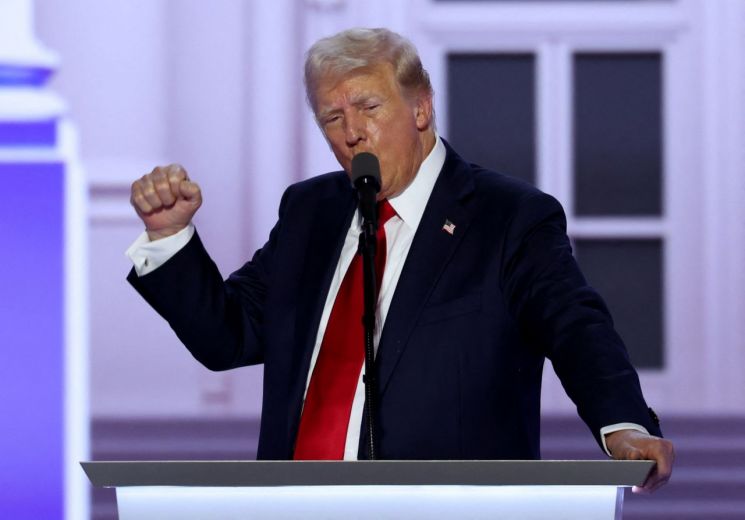
On the final night of the Republican National Convention, the 18th (local time), Trump delivered his acceptance speech at the Fiserv Forum in Milwaukee, Wisconsin. He said, "We will either rise together or fall together," adding, "I am running to be the president of all America. Not half of America. Being the president of half of America is not a victory."
The speech marked a significant moment as Trump was officially nominated as the Republican presidential candidate, launching his third presidential campaign. Notably, it was his first public address since being shot during a campaign event in Pennsylvania on the 13th.
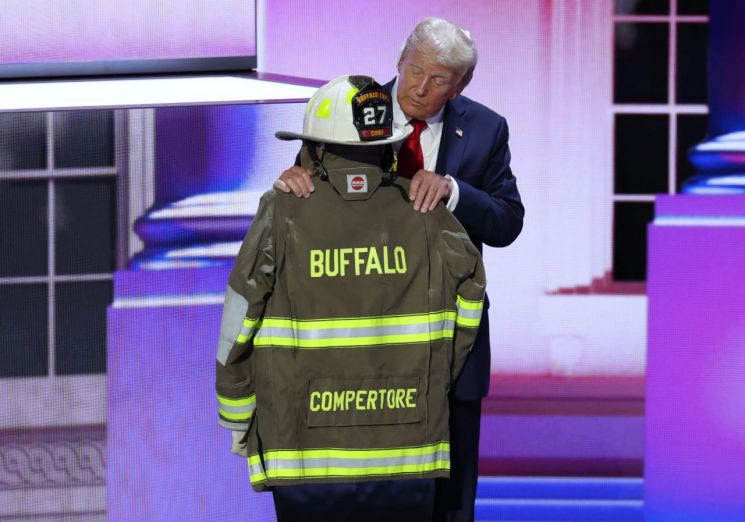
Trump drew attention by appearing on stage wearing a firefighter's jacket that belonged to Cory Comperatore, a victim of the shooting who served as a volunteer fire chief. During the speech, he observed a moment of silence and kissed the helmet in tribute.
This was interpreted as part of efforts to emphasize 'unity' in the U.S. following the shooting incident. Originally, the acceptance speech was to focus on criticism of President Joe Biden and the Democratic Party but was scrapped and rewritten with unity as the theme after the shooting. Trump raised his voice, saying, "Discord and division in American society must be healed."
Trump’s emphasis on American unity in his acceptance speech is seen as a sign that he believes the shooting incident has given him an advantage in the presidential race. Major foreign media, including The Guardian, noted that unlike previous conventions, speakers did not prominently promote conspiracy theories such as the 2020 election fraud claims. Amid ongoing reflection on political violence and division in the U.S., the Republican Party appears to have toned down extreme rhetoric to appeal to moderate voters. The New York Times (NYT) reported, "Trump has become more interested in unity since the shooting," adding, "He may be seen as a more acceptable candidate to moderates and women."
Criticism of the Biden administration’s policies was also present. Trump lamented, "We are a declining nation," saying, "We face an inflation crisis that makes life unaffordable, devastates household incomes, and tramples on the people." He blamed the soaring inflation on the Biden administration, stating, "There was no inflation during my time." He also disparaged the administration’s green industrial policies, including support for electric vehicles, calling them a "meaningless green new scam," and vowed to "end the ridiculous waste of taxes that fuels the inflation crisis." Regardless of the Federal Reserve’s political independence, he also hinted at plans to lower interest rates during the speech.
On foreign policy, Trump reiterated his 'America First' stance, as in his previous two campaigns. He emphasized universal tariffs, demands for allied countries including South Korea to share security costs, and a tough stance on illegal immigration and crime. This approach was also echoed in the previous day’s speech by vice-presidential candidate J.D. Vance, who declared, "No more freeloading."
Trump asserted, "If you want to sell products in America, they must be made in America," claiming, "This simple formula will create a tremendous number of jobs, and we will take back control of the auto industry." He explained that by maintaining high tariffs on Chinese goods and preventing the establishment of auto plants in relatively low-cost countries like Mexico and China, jobs would be revived domestically.
Regarding border policy, he promised, "On my first day in office, I will close the southern border," and warned, "We will launch the largest deportation operation in our country's history." On North Korea, he boasted, "I got along well with them and stopped their missile launches," adding, "Kim Jong-un will miss me." He also blamed the Biden administration for the wars in Ukraine and Gaza, saying, "Our opponents (Democrats) inherited a peaceful world but turned it into a world of war."
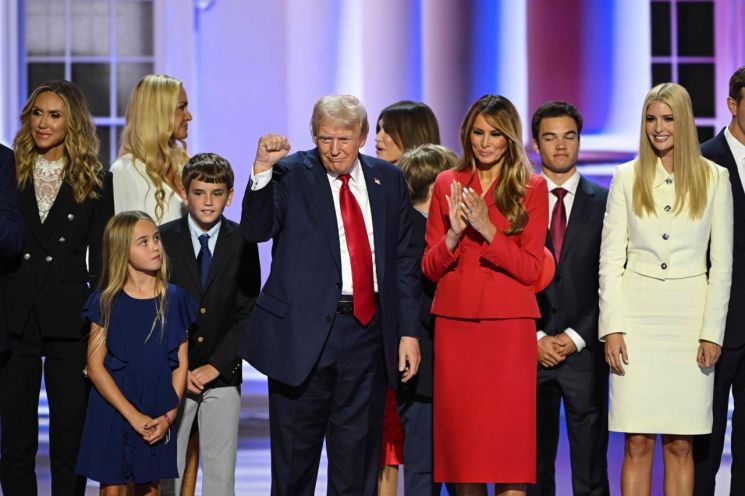
After the originally scheduled 90 minutes, Trump concluded his acceptance speech with the promise, "Simply put, we will make America great again, very quickly." Delegates erupted in applause, and Melania Trump, who had not appeared for the past three days, joined him on stage. Other family members, including Donald Trump Jr., followed, and about 100,000 red, blue, and white balloons were released from the ceiling of the venue.
Despite the unexpected gunshot wound, Trump showed his resilience by attending the convention throughout (from the 15th to the 18th) with a bandage on his ear. He showed no signs of fatigue even during the speech that lasted over 90 minutes into the night. This contrasts sharply with President Biden, who faces pressure to resign due to age concerns and has been isolating after testing positive for COVID-19 again shortly after resuming campaigning.
Polls conducted after the shooting incident indicate that Trump’s lead has widened. A poll conducted by CBS News and YouGov from the 16th to the 18th and released on the day showed Trump’s approval rating at 52%, five percentage points ahead of Biden’s 47%. This extends his previous narrow 2-point lead within the margin of error from a poll on the 3rd. In battleground states such as Arizona, Georgia, and Michigan, Trump led with 51% compared to Biden’s 48%. Additionally, 26% of respondents said they began supporting Trump after the shooting incident.
Meanwhile, as Trump’s chances of returning to power increase, countries around the world are accelerating preparations. The NYT highlighted the moves of major countries, noting that South Korea is seeking to quickly finalize the cost-sharing agreement for U.S. Forces Korea in anticipation of increased defense cost demands. The paper also added that China, as during Trump’s first term, is concerned about the possibility of a trade war.
© The Asia Business Daily(www.asiae.co.kr). All rights reserved.



















