Jeonbuk Future Industry Discussion Public Forum Held
Supporting Industry and Easing Regulations for Agricultural Innovation
Basic Plan for Fostering Smart Agriculture to Be Established Within the Year
The government is promoting industrial support and deregulation to develop the rural industrial structure in the Jeonbuk region into an information and communication technology (ICT)-based convergence type. It plans to redefine the concept of farmers, establish the concept of agribusiness, and include these in related legislation. To further expand the National Food Cluster, a preliminary feasibility study will be applied for by November.
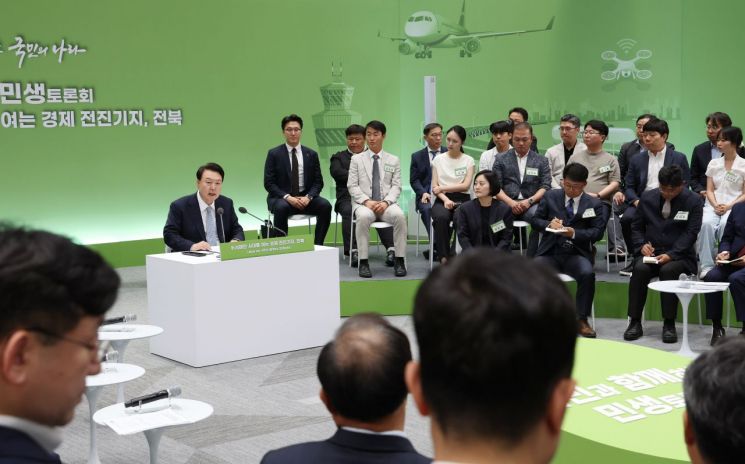 On the 18th, the 27th Public Livelihood Discussion with the People, "Jeonbuk, the Economic Forward Base Opening the New West Coast Era," was held at JB Group Aurum Campus in Jeongeup-si, Jeonbuk. [Image source=Yonhap News]
On the 18th, the government held the 27th Public Discussion Forum in Jeongeup, Jeonbuk, under the theme "Jeonbuk, the Economic Forward Base Opening a New West Coast Era." The forum was conducted under three themes: ▲ Jeonbuk as a core hub of advanced industries ▲ Jeonbuk as a special autonomous province blending culture and welfare ▲ Jeonbuk as a hub for future agricultural life industries.
At the forum, the government discussed reforms in systems and regulations for Jeonbuk agriculture and future agricultural and rural development. Young entrepreneurs, food venture companies, local governments, and public institution officials participating in the discussion proposed directions for smart farms, vertical farms, startup infrastructure, farmland deregulation, and the National Food Cluster policy. Song Miryung, Minister of Agriculture, Food and Rural Affairs, presented support plans for Jeonbuk’s bio-agriculture industry and innovation measures for agricultural and rural structures.
Through this discussion, the government decided to support region-specific development based on the "Jeonbuk Special Act," strengthen cultural and welfare support in Jeonbuk through youth sports complexes, the establishment of an integrated rehabilitation hospital in the Jeonbuk area, and the cultural content industry. Additionally, by advancing vertical farms and smart agriculture, revitalizing bio-agriculture industrial zones, developing the second phase of the National Food Cluster, and supplying water to Saemangeum bio-agriculture land, Jeonbuk will be nurtured as a successful case of future agricultural industry hub and rural spatial reorganization.
The Ministry of Agriculture, Food and Rural Affairs will prepare bold support measures for the development of Jeonbuk’s bio-agriculture industry. It will reflect the opinions of farmers and convergence-type business stakeholders in policies and foster the National Food Cluster and advanced analysis systems for green bio-materials as models for future bio-agriculture industry development.
Furthermore, reflecting the forum results, structural reforms will be accelerated to make agriculture a "future growth industry" and rural areas "spaces of opportunity open to all citizens." To innovate the three major structures of agriculture and rural areas?production (generation), industry, and rural spatial structure?regulations will be eased, and institutional innovation and inter-ministerial cooperation will be promoted.
Specifically, to shift the agricultural production structure from traditional labor-centered to ICT and other advanced technology-centered, institutional innovation will be implemented. Support for related industries and deregulation will also be added to transform the rural industrial structure from a production-centered primary industry structure to a convergence-type industrial structure. Additionally, to restructure the rural spatial structure from an individual and scattered development pattern to an integrated district and zone-centered structure, the rural spatial planning system will be concretized.
Kang Hyungseok, Director of Planning and Coordination at the Ministry of Agriculture, Food and Rural Affairs, said, "We plan to newly establish the concept of agribusiness in the Framework Act on Agriculture and Rural Areas to systematically and integrally foster upstream and downstream industries such as production, distribution, food processing, and agricultural materials." He added, "We are also considering redefining the concept of farmers, easing farmland use regulations for joint farming, and expanding the scope of work for agricultural corporations to innovate smart farms."
He further explained, "The basic plan for fostering smart agriculture will be established by the end of this year." Regarding the transition of the rural industrial structure to a convergence-type industrial structure, he said, "We will complete the plan for utilizing leftover farmland by August this year and announce measures to rationalize farmland use to enhance utilization such as convergence by the end of this year."
To develop the second phase of the National Food Cluster, a preliminary feasibility study will be applied for by November. Kang explained that it will take more than 5 to 6 years for full-scale development after passing the feasibility study and designation as a national industrial complex. He said, "Once companies are attracted to the industrial complex, there will be effects such as job creation and regional economic revitalization," adding, "We are currently in the stage of preparing the report for the feasibility study."
© The Asia Business Daily(www.asiae.co.kr). All rights reserved.

















