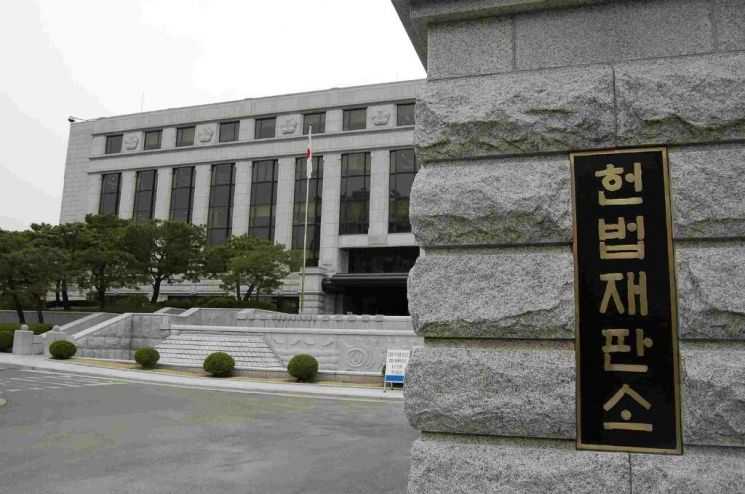
The Constitutional Court has ruled that the provision in the Court Organization Act that prohibits appointment as a judge if one has joined a political party as a party member within the past three years is unconstitutional.
On the 18th, in the constitutional complaint case filed by lawyer A, the Constitutional Court ruled by a 7 (unconstitutional) to 2 (partially unconstitutional) decision that the part of Article 43, Paragraph 1, Subparagraph 5 of the Court Organization Act, which prohibits appointment as a judge within three years from the date of losing party membership status under the Political Parties Act, violates the petitioner’s right to hold public office and is unconstitutional.
Article 43 (Disqualification) Paragraph 1 of the Court Organization Act stipulates the disqualification criteria for judicial appointments by stating, "A person who falls under any of the following subparagraphs shall not be appointed as a judge." Subparagraph 5 disqualifies "a person who is a member of a political party under Article 22 of the Political Parties Act or a person who has lost party membership status within three years" from being appointed as a judge.
The Constitutional Court stated, "Setting all party membership experience within the past three years as a disqualification for judicial appointment excessively restricts opportunities for public office even in cases where there is no close connection to political neutrality and judicial independence," and judged that it violates the principle of proportionality and infringes on the right to hold public office.
It further pointed out, "The constitutional civil servant system is based on meritocracy and equal opportunity, so using factors unrelated to the job performance ability required for the public office as criteria for appointment can infringe on the right to hold public office."
The Constitutional Court recognized that institutional measures already exist to ensure judges’ political neutrality and maintain judicial independence.
The Court explained, "To guarantee political neutrality, incumbent judges are prohibited from joining political parties and engaging in political activities, and violations are subject to disciplinary action, criminal punishment, and removal through impeachment proceedings," adding, "Moreover, if a judge’s past experience unfairly influences a specific case, it can be resolved through recusal, disqualification, or avoidance."
It continued, "Through the appellate system and collegial panels, the objectivity and fairness of trials are maintained regardless of individual judges’ inclinations," and added, "In particular, the Chief Justice and Supreme Court Justices must undergo a personnel hearing process in the National Assembly followed by a plenary session vote, ensuring a more rigorous verification of political neutrality than for ordinary judges."
Contrary to the majority opinion, Justices Eun Ae Lee and Young Jin Lee expressed a partial unconstitutionality opinion, stating that "the provisions concerning the Chief Justice and Supreme Court Justices are not unconstitutional, but the provisions concerning ordinary judges are unconstitutional."
Lawyer A joined a political party on December 18, 2017, and left the party on March 15, 2021.
A passed the legal document drafting evaluation for appointment as a criminal law judge in 2021, but during the subsequent procedures, was disqualified from applying for judicial appointment due to the "party membership within the past three years" disqualification, and thus filed a constitutional complaint.
© The Asia Business Daily(www.asiae.co.kr). All rights reserved.

















