MFDS, MAFRA, and MFDS Collaboration
Overcoming EU Food Safety Regulatory Barriers
Establishing Momentum for K-Food Overseas Expansion
The Ministry of Agriculture, Food and Rural Affairs, the Ministry of Oceans and Fisheries, and the Ministry of Food and Drug Safety announced on the 18th that, as a result of responding to the European Union (EU)'s strengthened import measures related to antibiotics in animal-derived foods initiated in December 2022, the eligibility for exporting domestic animal-derived foods to the EU will be maintained. Animal-derived foods refer to heat-treated chicken products (Samgyetang, etc.), seafood and seafood-containing foods (kimchi, ramen, etc.), honey products, and others.
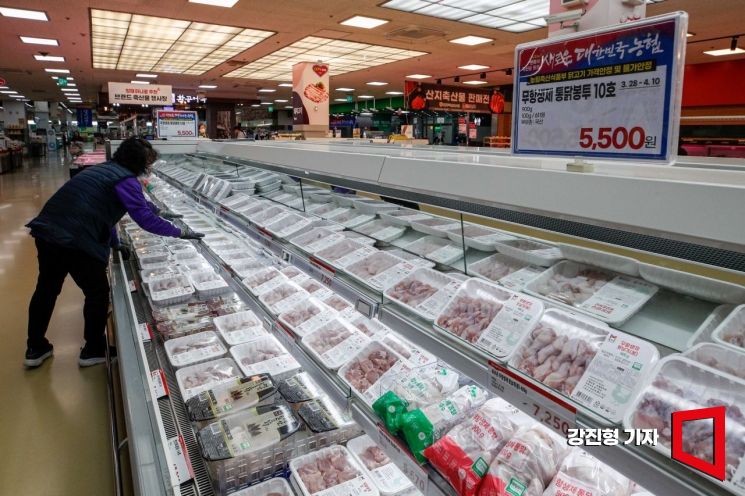 Chicken being sold at Hanaro Mart Yangjae branch in Seocho-gu, Seoul. Photo by Jinhyung Kang aymsdream@
In June, the EU notified the World Trade Organization (WTO) member countries of the first list of approved import countries (72 countries), including South Korea. The first list is scheduled to be finalized in September, and from September 2026, only countries included in the approved import list will be able to export animal-derived foods to the EU.
Previously, to reduce antibiotic resistance through food, the EU established regulations prohibiting the use of human antibiotics and growth-promoting antibiotics in edible animals, which are raw materials for animal-derived foods exported from countries outside the EU to the EU. The EU notified WTO member countries of this in December 2022 and announced related details in February last year. From May of that year, the EU began evaluating antibiotic safety management systems targeting existing approved import countries (98 countries), including South Korea.
Our government, through a joint effort of related ministries (Ministry of Food and Drug Safety, Ministry of Agriculture, Food and Rural Affairs, Ministry of Oceans and Fisheries), submitted data on domestic food and antibiotic safety management systems and current status to the EU five times by April, demonstrating the excellence of domestic safety management capabilities. Additionally, based on world-class antibiotic resistance management capabilities, South Korea has twice served as the chair country of the Codex Alimentarius Commission’s Antibiotic Resistance Task Force (TFAMR) and played a leading role in adopting related international standards in 2021, which was also emphasized.
This achievement is another example of South Korea successfully overcoming the EU’s stringent food safety regulatory barriers, following the first export of Samgyetang to the EU in May. It may also serve as an opportunity for K-Food to expand into overseas markets beyond the EU. Furthermore, it is expected to help secure a favorable position in Korea-EU negotiations for exporting other animal-derived foods such as beef and pork.
Going forward, the government will strengthen regulatory diplomacy efforts with major trading countries to support the activation of exports by the domestic food industry. It plans to proactively respond to changes in the international trade environment through close communication with the industry.
© The Asia Business Daily(www.asiae.co.kr). All rights reserved.

















