2030 Seoul Urban and Residential Environment Maintenance Basic Plan
Approval of Amendments to Urban Maintenance-Type Redevelopment Project Section
Floor Area Ratio Incentive Reduced When Public Open Space Exceeds Requirement
Floor Area Ratio Incentive Expanded to Increase Downtown Hotel Supply
Building Coverage Ratio Relaxed to 60% or Less to Encourage Low-Rise Openness
Redeveloping downtown commercial and office facilities to build hotels rated three stars or higher will be granted floor area ratio (FAR) incentives. For a 20-story building, up to three additional floors can be constructed. The introduction of senior welfare housing for residential use will also become possible.
 On the 24th, when rain was forecast mainly for the southern regions and Jeju Island, dark clouds covered the urban sky as seen from Namsan in Jung-gu, Seoul. Photo by Jinhyung Kang aymsdream@
On the 18th, the Seoul Metropolitan Government held the 10th Urban Planning Committee meeting and announced the approval of the amendment to the 2030 Seoul City Urban and Residential Environment Maintenance Basic Plan (Urban Maintenance-type Redevelopment Project section).
The urban maintenance-type redevelopment project refers to a project that supplies commercial and office spaces by expanding parks, roads, and other facilities to restore the deteriorated functions of the downtown area.
Seoul established the 2030 Seoul City Urban and Residential Environment Maintenance Basic Plan in February last year. Recently, reflecting improvement opinions on open green spaces, floor area ratio, building coverage ratio, and height plans, the city has promoted amendments to the basic plan. The amendment includes measures to improve incentives for open green spaces and to strengthen public interest by encouraging the introduction of facilities needed in the area.
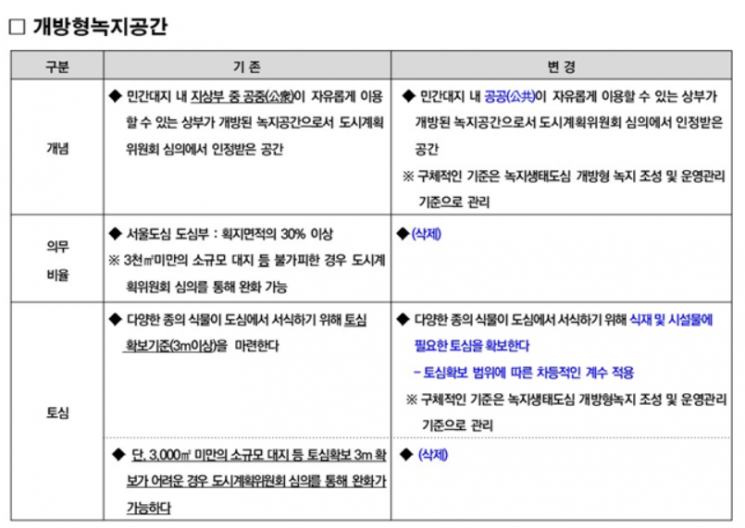
The concept of open green spaces has been redefined and standards changed to induce the creation of more effective green spaces. Open green spaces refer to green areas open to the public within the city. Through this plan amendment, green spaces created on rooftops or other non-ground areas will also be recognized as open green spaces. Three-dimensional green spaces must have a soil depth of at least 1 meter and secure separate access routes.
The mandatory ratio for open green spaces was previously set at 30% or more, but now the recognition limit for open green spaces will be set between 25% and 45% depending on the site area. This adjustment allows for planning appropriate heights and other factors.
In response to an aging society, the introduction of senior welfare housing will be allowed in urban maintenance-type redevelopment projects. Management will follow the office-tel management measures outlined in the 2030 basic plan. When senior welfare housing is included in redevelopment, mandatory facilities according to related laws must be installed. While resident convenience facilities are mandatory, considering the special nature of senior welfare housing, adjustments can be made through committee review.
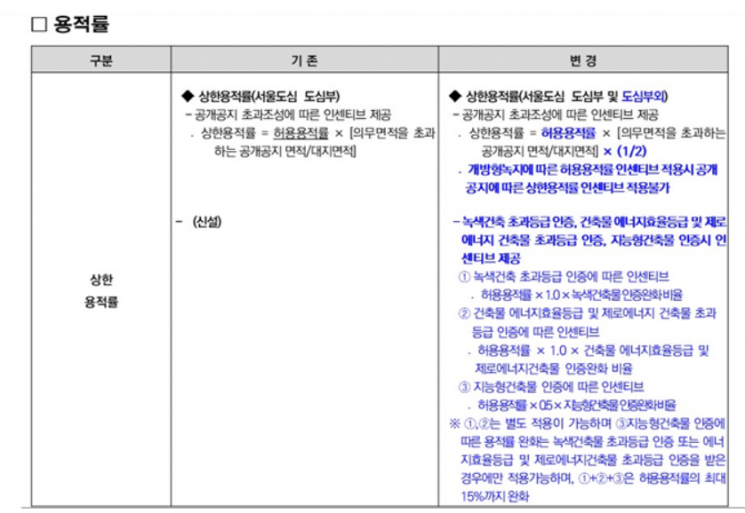
The floor area ratio incentive plan has also been adjusted to encourage the construction of facilities needed in the area, such as cultural facilities and living SOC (Social Overhead Capital). To expand accommodation facilities in the downtown area, a maximum 100% floor area ratio incentive will be applied when introducing hotels rated three stars or higher. In downtown redevelopment sites, when constructing 20-story commercial and office facilities (based on a 50% building coverage ratio), up to three additional floors can be built.
Considering concerns that excessive incentives might be granted under the public open space plan in downtown Seoul, the incentive for creating public open spaces will be reduced by half. The maximum floor area ratio is calculated by multiplying the allowable floor area ratio by the excess area, which will now be halved. To resolve overlapping incentives between open green spaces and public open spaces, only one of the two can be selected.
To encourage the opening of lower floors and introduce street activation uses, the building coverage ratio, which was previously mandatorily applied at 50% or less, has been relaxed to 60% or less. The building coverage ratio is the ratio of building area to site area; a higher ratio means higher building density.
Additionally, height planning standards for the Gwanghwamun area and downtown Seoul have been established. The item that relaxed height restrictions when providing excess public open spaces has been removed, and an item that relaxes height restrictions when providing public land has been added. Considering the public nature of the plan and regional characteristics, additional height adjustments can be made through the Urban Planning Committee review.
Special planning zones under district unit plans can now be proposed as maintenance planned zones. This applies only when urban maintenance-type redevelopment projects are pursued to strengthen central functions, renovate aging areas, and promote regional balanced development within special planning zones located in regional centers or commercial areas near transit stations (within 500 meters of subway stations). Regional centers include Dongdaemun, Mangu, Mia, Seongsu, Sinchon, Mapo, Gongdeok, Yeonsinnae-Bulgwang, Mokdong, Bongcheon, Sadang-Isu, Suseo-Munjeong, and Cheonho-Gildong.
For districts where redevelopment projects were completed over 30 years ago, new construction was only allowed if the safety inspection grade was D or higher, but this has been changed to allow reconstruction and expansion through committee review.
The Seoul Metropolitan Government stated, "With this amendment, we expect to enhance urban competitiveness by implementing effective green space expansion to create a pleasant green city, introducing rational building plans and uses that promote urban revitalization, and realizing eco-friendly policies."
© The Asia Business Daily(www.asiae.co.kr). All rights reserved.
![Clutching a Stolen Dior Bag, Saying "I Hate Being Poor but Real"... The Grotesque Con of a "Human Knockoff" [Slate]](https://cwcontent.asiae.co.kr/asiaresize/183/2026021902243444107_1771435474.jpg)


















