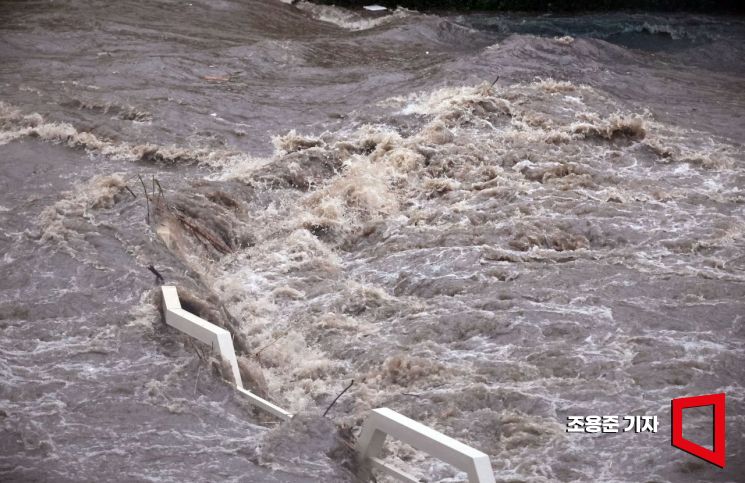
 On the 17th, when heavy rain fell in northern Gyeonggi Province including Seoul, the Hongjecheon walking trail in Seodaemun-gu, Seoul was flooded and access was restricted. The Korea Meteorological Administration issued a heavy rain advisory for Seoul. Photo by Jo Yongjun jun21@
The government announced on the 17th that it has secured a flood control capacity of 5.3 billion cubic meters by releasing water from 20 multipurpose dams.
On the same day, Han Hwajin, Minister of Environment, chaired an emergency situation inspection meeting with related agencies at the Hangang Flood Control Office in response to the heavy rainfall. The inspection meeting included the Watershed (Local) Environmental Offices under the Ministry of Environment, the Flood Control Office, the Korea Meteorological Administration, the Korea Water Resources Corporation, the Korea Environment Corporation, and the Korea National Park Service. The flood control capacity secured through dam releases will be utilized considering future rainfall conditions.
The heavy rain is expected to continue until the 18th in the metropolitan area including northern Gyeonggi Province. Some areas are forecasted to receive more than 200mm of rain. The Ministry of Environment has identified a risk of flooding in urban streams with narrow widths such as Dorimcheon in Seoul and Mokgamcheon in Gwangmyeong due to the heavy rainfall. Five regions?Yeongdong in Chungbuk, Nonsan and Seocheon in Chungnam, Wanju in Jeonbuk, and Yeongyang in Gyeongbuk?have already been declared special disaster zones due to the heavy rainfall from the 7th to the 10th.
Minister Han stated, “With river water levels rising and river embankments weakened due to recent heavy rains, a more thorough response is necessary,” adding, “We will mobilize all available resources to minimize flood damage despite the consecutive heavy rains.”
© The Asia Business Daily(www.asiae.co.kr). All rights reserved.

















