Results to be announced on the 22nd
Altman CEO warns of AI job threats
"No equal opportunity without universal basic income"
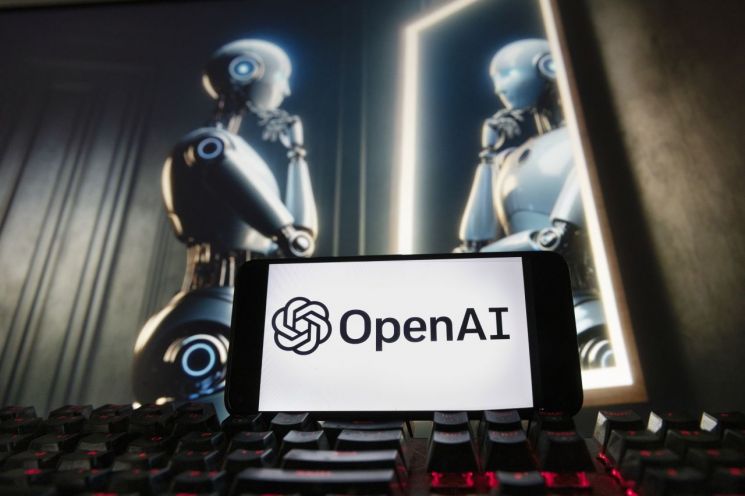
Sam Altman, CEO of OpenAI, is set to release the results of Silicon Valley's universal basic income experiment he led, according to a report by The New York Times (NYT) on the 16th (local time). As Altman predicted, attention is focused on whether universal basic income can be the answer to the job threats posed by artificial intelligence (AI).
According to the report, over the past few years, Silicon Valley's IT community has conducted an experiment providing $500 or $1,000 (approximately 1.38 million KRW) monthly unconditionally to people in difficult situations. Some of the locations where the experiment took place are in the heart of Silicon Valley, where the rent for a one-bedroom apartment approaches $3,000 (about 4.15 million KRW) per month.
The experiment originated from Altman’s idea. Altman has emphasized the necessity of guaranteed income in the AI era, which threatens human jobs, stating, "True equality of opportunity is impossible without some form of guaranteed income." In 2019, he invested $60 million in his nonprofit research organization, Open Research, to start an experiment to understand how unconditional cash payments affect consumers' behavior, stress levels, and job choices. At that time, 3,000 residents of Texas and Illinois with annual incomes below $28,000 were selected as participants and received monthly payments ranging from $50 to $1,000. The results of the experiment are scheduled to be announced on the 22nd.
Altman is not the only prominent supporter of universal basic income. Elon Musk, CEO of Tesla; Jack Dorsey, co-founder of Twitter; and Marc Benioff, CEO of Salesforce, are also notable advocates. During the 2020 Democratic presidential primary, Andrew Yang, then a candidate, drew attention by making "Freedom Dividend," a policy to pay $1,000 monthly to every American aged 18 and over, his flagship pledge. The NYT explained, "Despite concerns that universal basic income recipients might squander money on lotteries and alcohol, reviewing existing universal basic income programs shows that cash payments have significantly helped families on the brink of collapse."
Although cases proving the effectiveness of universal basic income are emerging, many hurdles remain before political consensus can be reached. Recently, Texas filed a lawsuit to prevent public funds from being used for Houston’s basic income program. Republican parties in Iowa, Idaho, and South Dakota have also banned similar programs. However, some progress has been made. Oregon plans to hold a resident vote this fall on a basic income program. The plan involves funding through a 3% tax on companies with annual revenues exceeding $25 million and providing $750 annually per resident.
Georgetown University philosophy professor Carl Withersquist stated, "All wealthy individuals and corporations should support universal basic income, but the tech industry bears a particularly special responsibility. They use our data to create products but do not pay for it. They will disrupt the economy and produce unemployment."
© The Asia Business Daily(www.asiae.co.kr). All rights reserved.
![Clutching a Stolen Dior Bag, Saying "I Hate Being Poor but Real"... The Grotesque Con of a "Human Knockoff" [Slate]](https://cwcontent.asiae.co.kr/asiaresize/183/2026021902243444107_1771435474.jpg)
















