If Obstacles Arise, Robots Pause to Work and Assist by Moving Between Worksites and Collection Centers
Nongjincheong Expects Rapid Deployment to Solve Rural Labor Shortages and Improve Farmer Safety
The Rural Development Administration (RDA) announced on the 17th that it has developed a robot capable of autonomous driving in orchards to perform tasks such as weeding, transportation, and pest control, and will promote its commercialization to rapidly distribute and expand its use among farmers.
Lee Seung-don, Director of the National Institute of Agricultural Sciences at RDA, explained, "Rural areas are entering a super-aged society faster than urban areas, creating a need for mechanization to replace labor loss. Accordingly, the RDA has developed a robot that uses high-precision satellite navigation systems, laser sensors, and imaging devices to follow preset routes in orchards of apples, pears, peaches, and perform agricultural tasks such as weeding, transportation, and pest control."
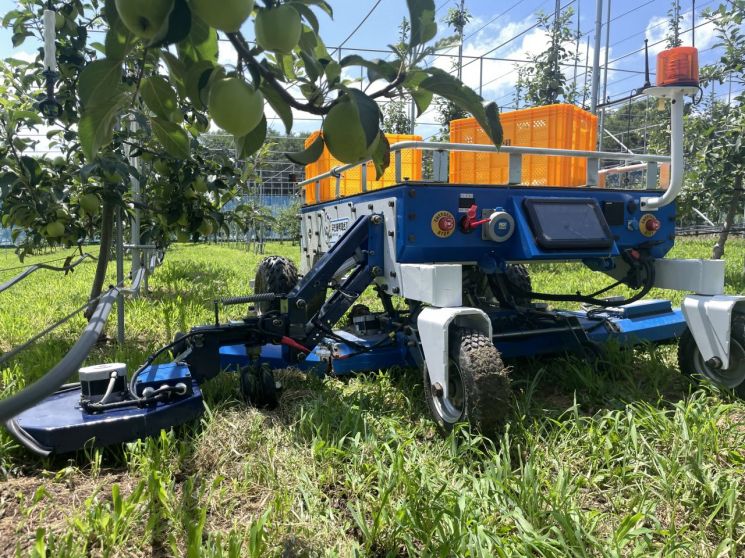
The RDA utilized laser sensors so that if obstacles such as fruit trees or workers are detected within 1.5 meters of the weeding robot, it stops at about 10 cm away and resumes weeding once the obstacle is removed. Additionally, a contact-type stop device is attached to the underside of the weeding robot to immediately halt the robot upon contact with any object.
Both the weeding robot and the transportation robot are equipped with cushioning devices like pneumatic springs to minimize shocks from the ground and flexibly adapt to uneven terrain. The weeding robot has space secured on top to also serve as a transportation robot capable of carrying items.
The transportation robot normally follows the worker, performing tasks such as transporting harvested crops or farming tools, and is equipped with a shuttle function that allows the worker to send the robot from its current location to a designated place such as a collection point as needed. When the worker activates the transportation function during harvesting, the robot moves to the pre-designated location to carry out tasks like transporting harvested crops and then returns to the worker. This reduces the time the worker spends traveling back and forth to the collection point.
The RDA plans to add a function to the transportation robot to transfer pesticides needed by the pest control robot to intermediate points for coordinated work between robots. This technology allows the transportation robot to load pesticides and depart when notified that the pest control robot is running low, replenishing pesticides along the pest control robot’s route. The RDA expects that adding this technology will reduce the time and battery consumption required for the pest control robot to move for pesticide refills, thereby improving work efficiency.
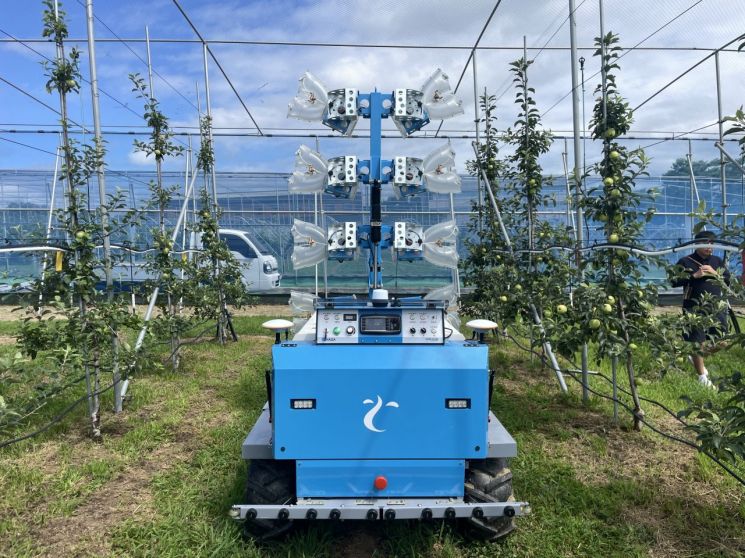
The Rural Development Administration has been promoting a five-year field demonstration support project for agricultural robots from last year through 2027 to commercialize agricultural robots and verify improvements in farm productivity, safety accident minimization, and work convenience.
Through this, multiple and various types of robots will be deployed throughout the entire cultivation process including planting, weeding, pest control, and harvesting, based on rural production cluster hubs. Currently, robots related to digital automation, robotic farming tasks, pest and disease monitoring, and water stress management are being tested for effectiveness in locations such as Hamyang (onion), Dangjin (rice), Geochang (apple), Okcheon (peach), Yeoncheon (soybean), and Gimje (wheat). Based on these results, the plan is to enable unmanned farming not only in orchards but also in food crops and vegetable sectors. Additionally, from 2025, a new technology pilot distribution project will be launched to supplement and improve agricultural robot technology. The weeding robot will be applied at 7 sites, the transportation robot at 5 sites, and the electrified pest control robot will undergo field demonstration research in 2025 and be applied at 3 sites in 2026.
Alongside this, inter-agency cooperation will be promoted to enable agricultural robots to be utilized in other fields. For example, in May, an agreement was signed with the Korea Water Resources Corporation to pilot the use of weeding robots to manage the extensive green areas around water treatment plants managed by the corporation.
Director Lee said, "With a shortage of workers due to population decline, robot technology has become not a choice but a necessity to ensure food security. We will continue to develop robots needed for agriculture and rural areas and strive to rapidly distribute and expand them among farmers to increase farm income, provide convenience, and improve the quality of life for farmers."
© The Asia Business Daily(www.asiae.co.kr). All rights reserved.
![Clutching a Stolen Dior Bag, Saying "I Hate Being Poor but Real"... The Grotesque Con of a "Human Knockoff" [Slate]](https://cwcontent.asiae.co.kr/asiaresize/183/2026021902243444107_1771435474.jpg)

















