3-Year Korean Treasury Bond Hits Year-Round Low
US Anticipates Early Reflection of South Korea's Base Rate Cut Expectations
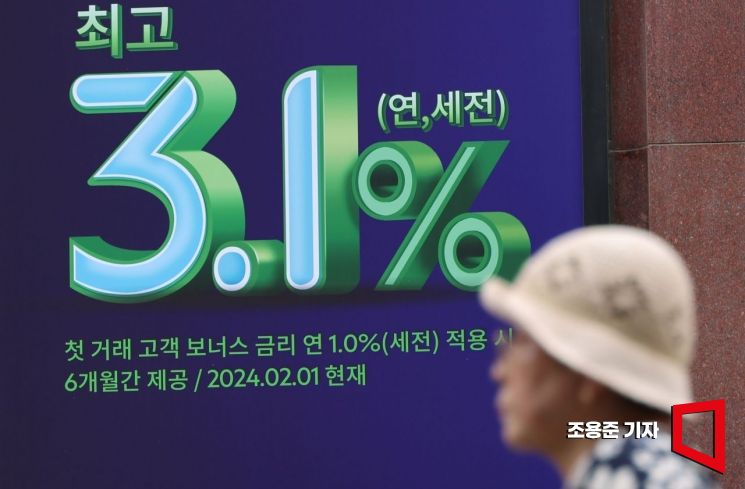 An interest rate notice is posted on the exterior wall of a bank in Namdaemun, Seoul. Photo by Yongjun Cho jun21@
Despite warnings from Lee Chang-yong, Governor of the Bank of Korea, that market expectations for a base interest rate cut are moving too quickly, market interest rates continue to decline. It is analyzed that the growing expectations for interest rate cuts in both the U.S. and Korea are being rapidly reflected in market interest rates.
On the 17th, in the Seoul bond market, the 3-year government bond yield was trading at 3.047% as of 10:14 a.m., up 1.2 basis points (1bp = 0.01 percentage points) from the previous trading day.
The previous day, the 3-year government bond yield closed at 3.035%, down 4.1 basis points from the previous trading day, marking the lowest level of the year. This is also the lowest level in 1 year and 11 months since it recorded 3.012% on August 2, 2022. Compared to the base interest rate of 3.5%, the market interest rate is reflecting about two rounds of rate cuts.
The government bond yield had sharply risen on the 11th after the Bank of Korea kept the base rate unchanged and no dissenting opinions for a rate cut emerged. At a press conference following the rate freeze, Governor Lee said, "Market interest rates are somewhat excessively reflecting expectations for a rate cut," and added, "Considering the current inflation and financial stability situation, the rate cut expectations formed in the market are somewhat excessive," which influenced market interest rates.
However, despite the Governor's warning remarks, government bond yields began to fall from the next day, with the 3-year yield declining for three consecutive days from the 12th to the previous day.
This is interpreted as a result of renewed market expectations for a base interest rate cut. In particular, the domestic market has recently been more influenced by the possibility of a U.S. interest rate cut than Korea's.
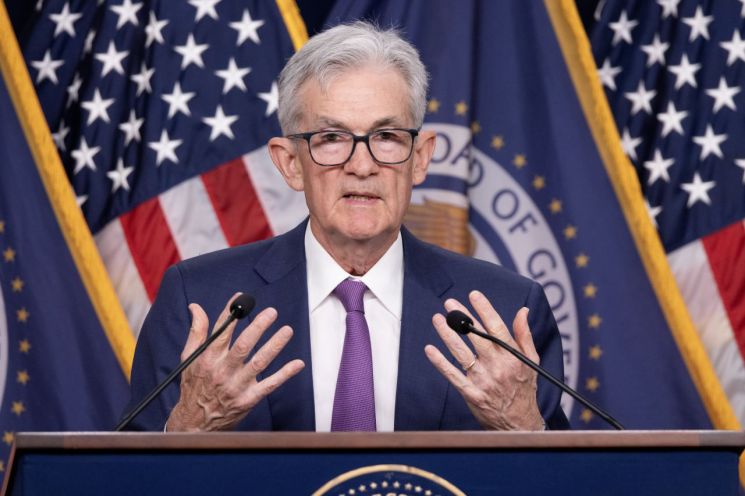
Jerome Powell, Chair of the U.S. Federal Reserve (Fed), has recently made several remarks suggesting a rate cut as U.S. inflation is coming under control. At an Economic Club discussion held in Washington D.C. on the 15th, Powell said, "I am confident that inflation is slowing," and added, "Waiting until inflation reaches 2% could mean waiting too long." He also stated at a House hearing on the 10th that "rate cuts should not be delayed too much."
Following Powell's remarks, the market is confident about a U.S. base interest rate cut in September. According to the Chicago Mercantile Exchange (CME) FedWatch, the futures market sees a 100% probability that the Fed will cut the base rate at the September monetary policy meeting.
The expectation of a U.S. interest rate cut is spreading to the domestic bond market as well. Baek Yoon-min, Senior Research Fellow at Kyobo Securities, explained, "The possibility of three rate cuts by the Fed within this year has increased, solidifying the likelihood of rate cuts, and domestic bond yields have fallen in line with these external factors."
Researcher Ahn Ye-ha from Kiwoom Securities also said, "Considering recent U.S. economic indicators slowing down, inflation easing, and Powell's remarks, the possibility of rate cuts within this year is increasing," adding, "There is even talk of three cuts within the year in the U.S., and domestic bond yields have fallen in tandem, making Korea's rate cut more certain."
Although the expected timing of the Bank of Korea's rate cut has been pushed back, the possibility of a rate cut within this year remains, which is a factor behind continued bond buying, especially by foreign investors. Researcher Ahn analyzed, "Although the timing of domestic rate cuts has been delayed, the Governor did not deny the possibility of a cut within this year, and subsequent buying mainly by foreigners influenced the sharp drop in government bond yields."
© The Asia Business Daily(www.asiae.co.kr). All rights reserved.


















