Seongdong-gu Operates Care Service for Disaster-Vulnerable Households... Mapo-gu Praised for Transparent Flood Barriers Made of Polycarbonate Ensuring Safety and Aesthetics... Dobong-gu Inspects 781 Semi-Basement Homes with Flood Barrier Installation
The full-scale rainy season has begun.
Up to 70mm of heavy rain per hour is expected in the Seoul metropolitan area. The metropolitan area is on high alert for heavy rain over the next ten days.
Vulnerable groups living in low-lying semi-basement houses have spent sleepless nights worrying about flooding.
Accordingly, districts such as Seongdong-gu, Mapo-gu, and Dobong-gu in Seoul are implementing various measures, including installing water barriers to prevent flooding in semi-basement houses and operating care teams for disaster-vulnerable households.
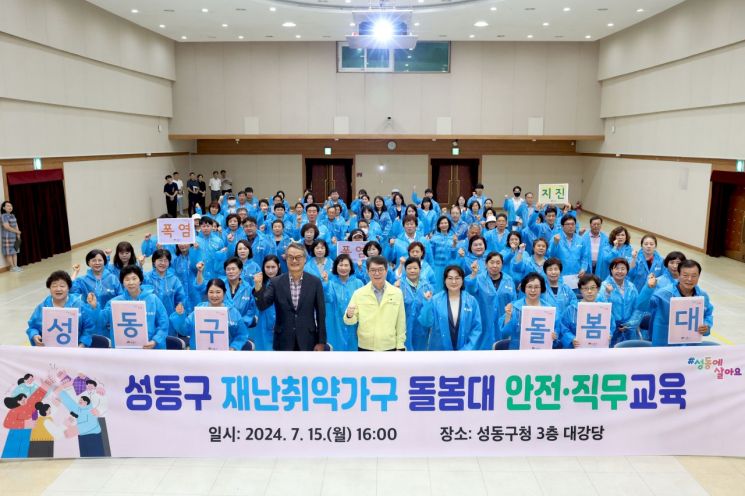
Seongdong-gu, Seoul (Mayor Jeong Wono) operates the ‘Seongdong-gu Disaster-Vulnerable Household Care Team’ to support evacuation of disaster-vulnerable households such as semi-basement houses in case of flood risk.
Recently, sudden heavy rains caused by climate change have frequently resulted in flooding of semi-basement houses and other areas, sometimes leading to casualties due to missed golden hours.
In response, in early July, the district conducted a full survey of 622 households, including flood-prone semi-basement households identified through the SWIMM method (100mm/h) and local residents such as community leaders. Among them, 46 households who applied for assistance due to difficulty in self-evacuation were selected as disaster-vulnerable households eligible for support.
This is the first time a local government has expanded the eligibility criteria of Seoul’s Donghaeng Partner, a care service for flood-vulnerable semi-basement households, to include not only severely disabled persons and households with flood history but also those who find self-evacuation difficult.
Additionally, the district formed the ‘Disaster-Vulnerable Household Care Team’ to support evacuation of vulnerable households in case of flooding.
The ‘Disaster-Vulnerable Household Care Team’ consists of 78 members, including community leaders, residents living in the same building as the supported households, neighbors living on adjacent streets, and care public officials. Since early response is crucial during flooding, the plan is to actively utilize the interest and help of neighbors living nearby.
When the Seoul Metropolitan Government Disaster and Safety Countermeasures Headquarters issues a flood forecast (20mm/15 minutes or 55mm/1 hour) and the Seongdong-gu Disaster and Safety Countermeasures Headquarters issues a flood warning (after CCTV and on-site confirmation if necessary), care officials activate the emergency contact system to relay the situation to the ‘Disaster-Vulnerable Household Care Team.’ The team then promptly visits the matched vulnerable households, checks the surroundings, and if signs of flooding are detected, assists the households in evacuating to designated shelters.
Before full-scale activities, on the 15th, the district conducted safety duty training for the ‘Disaster-Vulnerable Household Care Team,’ covering the definition of disasters, disaster response, basic flood and wind disaster prevention education, and the team’s duties and roles.
Jeong Wono, Mayor of Seongdong-gu, said, “I am grateful to the ‘Disaster-Vulnerable Household Care Team’ for participating in protecting the safety of neighbors, and I believe they will form a strong foundation for making Seongdong-gu safer from natural disasters.” He added, “We will pay even closer attention to establishing a flawless safety net in the daily lives of all residents.”
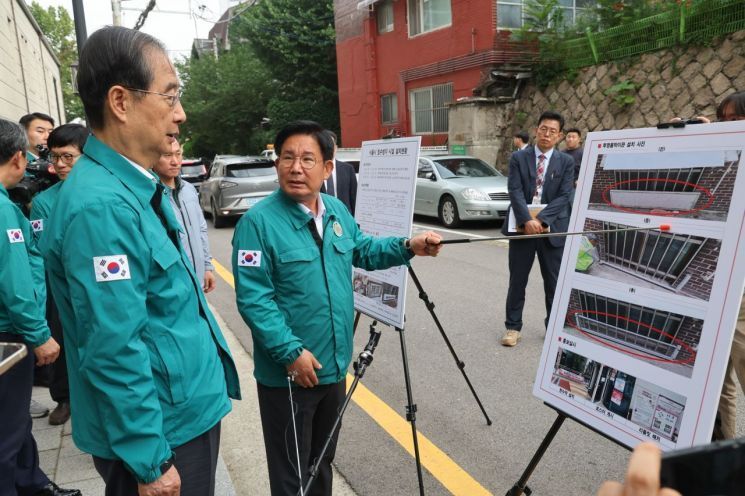 Prime Minister Han Duck-soo visited Mapo-gu on the 11th and received an explanation about the flood barrier board from Park Kang-soo, the mayor of Mapo-gu.
Park Gang-su, Mayor of Mapo-gu, visited the Hapjeong-dong area on the morning of the 11th with Prime Minister Han Deok-su to inspect flood-prone residential areas. Before the full inspection, Mayor Park explained the transparent water barriers installed in semi-basement houses.
The transparent water barriers introduced by Mapo-gu last year are made of polycarbonate material, ensuring safety as well as aesthetics, receiving favorable reviews from both building owners and tenants. Additionally, the installation cost is about 80,000 KRW lower than opaque water barriers, effectively saving budget.
With applications for transparent water barriers this year increasing 2.4 times compared to last year, Mapo-gu plans to expedite installations and make every effort to prevent flood damage.
Prime Minister Han Deok-su also encouraged Mapo-gu’s Donghaeng Partners and care public officials who support disaster-vulnerable groups such as severely disabled and child households that cannot evacuate independently.
Furthermore, anticipating more rain than usual this year, Mapo-gu is conducting special inspections until the 22nd to prevent safety accidents caused by sidewalk subsidence and damage during the rainy season.
The inspection covers a total of 132.5 km of sidewalks, including 80.2 km of city roads and 52.3 km of district roads. Seven road excavation supervisors and 22 private volunteer street monitoring members are participating alongside the district inspection teams (three groups).
The inspection focuses especially on heavily trafficked crosswalks, subway station entrances, bus stop surroundings, and other multi-use areas.
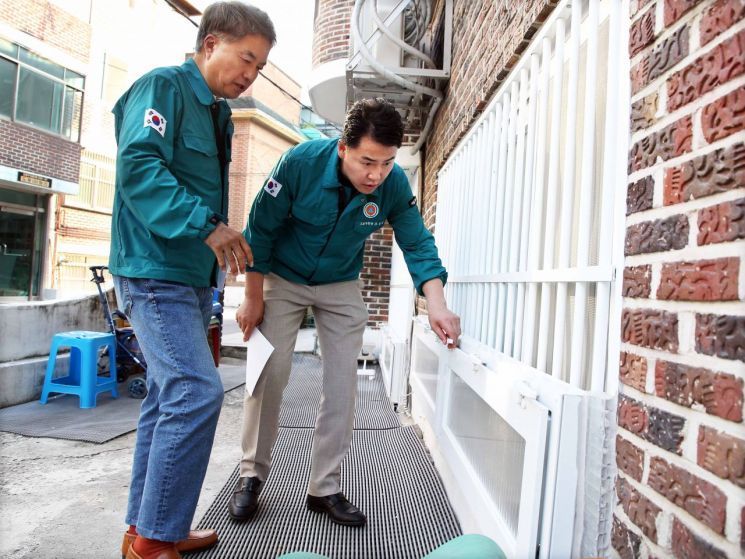
Dobong-gu (Mayor Oh Eon-seok) is making every effort to install water barriers to prevent flooding accidents in semi-basement houses caused by heavy rain.
At the beginning of this month, the district established an inspection plan for water barriers in semi-basement houses and is inspecting 781 households with installed water barriers.
Ten people, including district employees and installation company personnel, are conducting the inspections according to a detailed daily plan. The inspections will continue throughout July.
The main inspection items include water barriers’ ▲loss or damage ▲deformation ▲abnormalities in support joint parts. Minor issues are addressed immediately on-site, and if the barrier loses its function, it is reinstalled.
Along with the inspection, the district is also focusing on public awareness. Currently, the district is providing information on water barrier inspections and flood prevention methods through IPTV at the district office and community centers, as well as through community leader meetings.
© The Asia Business Daily(www.asiae.co.kr). All rights reserved.



















