June Retail Sales Steady Month-on-Month
Stronger-than-Expected Consumer Spending Fuels US Economic Soft Landing Outlook
'Dovish' Powell Remarks Also Boost September Pivot Expectations
The three major indices of the U.S. New York stock market were rising in early trading on the 16th (local time). The June retail sales data exceeded expectations, spreading hopes for a soft landing of the U.S. economy and stimulating investor sentiment. The previous day's dovish remarks by Jerome Powell, Chairman of the U.S. Federal Reserve (Fed), also bolstered expectations for a rate cut in September.
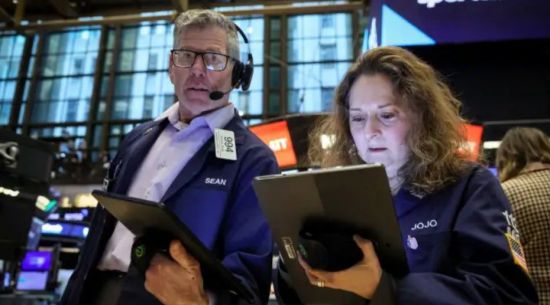
As of 11:05 a.m. at the New York Stock Exchange (NYSE) on the day, the Dow Jones Industrial Average was up 1.45% from the previous close, standing at 40,794.54. The S&P 500, which focuses on large-cap stocks, rose 0.42% to 5,655.04, while the tech-heavy Nasdaq index was trading slightly up by less than 0.1% at 18,472.61.
By individual stocks, Bank of America (BoA) and Morgan Stanley rose 4.89% and 2.21%, respectively, after reporting earnings that exceeded market expectations. BoA announced that net interest income would increase through the end of the year. Amid expectations of rate cuts, a rotation from large-cap to small- and mid-cap stocks has emerged, with the Russell 2000, which tracks U.S. small-cap stocks, rising about 2%. Meanwhile, Nvidia fell 1.19%.
Investors focused on the June retail sales data released that morning. According to the U.S. Department of Commerce, retail sales last month totaled $704.3 billion, holding steady compared to the previous month ($704.5 billion). The market had initially forecast a 0.3% decline but the actual figure exceeded expectations. Retail sales had increased by 0.3% in May. Excluding automobiles and gasoline, retail sales rose 0.8%, marking the largest increase since 2023. This surpassed both expert forecasts (0.2%) and May's figure (0.3%). Among the 13 retail categories, only three showed declines: gas stations (-3%), automobile and parts dealers (-2%), and sporting goods, music, and bookstores (-0.1%). This trend contrasts with the recent slowdown in consumption due to high interest rates and a cooling labor market. It is interpreted as a sign that the U.S. economy is still holding up despite growing expectations for a Fed rate cut in September.
Lubila Faruki, Chief U.S. Economist at High Frequency Economics, said, "Consumption and economic activity have slowed considerably so far this year," but added, "The situation has not deteriorated enough to be considered a recession." She further predicted, "The combination of improved spending, growth indicators, and inflation data is likely to support monetary policy easing."
Brett Kenwell, U.S. investment analyst at eToro, commented, "Seeing strong retail sales data is positive, even if it brings short-term volatility to rate cut expectations," and analyzed, "It is much better to see the Fed cut rates as inflation declines rather than lowering rates to support a weakened economy."
Powell's remarks the previous day also fueled market expectations that a rate cut is imminent. At a discussion with David Rubenstein, Chairman of the U.S. private equity firm Carlyle Group, held at the Economic Club of Washington D.C., Powell said regarding the slowdown in inflation, "We did not gain additional confidence in the first quarter, but three indicators from the second quarter (April to June) somewhat increased our confidence." He added, "Inflation has now declined, and the labor market has actually cooled. We will look at both, and these two are in a much better balance." Regarding the timing of rate cuts, Powell said, "We will decide at each meeting," but the market has largely priced in a cut in September.
According to the CME FedWatch on the Chicago Mercantile Exchange (CME) on the day, the federal funds futures market is fully pricing in a more than 0.25 percentage point rate cut by the Fed at the September Federal Open Market Committee (FOMC) meeting. This is up from 61.5% the previous day. The probability of a 0.5 percentage point or greater cut in November is 64.5%, and the chance of a 0.75 percentage point or greater cut in December is 57.7%.
The market is watching this week's Republican National Convention while digesting corporate earnings announcements. The previous day, the Republican Party officially nominated former President Donald Trump as its presidential candidate. The Republican vice-presidential candidate was decided as Senator J.D. Vance of Ohio.
U.S. Treasury yields were slightly lower. The 10-year U.S. Treasury yield, a global benchmark for bond yields, moved down 2 basis points (1 bp = 0.01 percentage point) from the previous trading day to around 4.2%. The 2-year U.S. Treasury yield, sensitive to monetary policy, traded steady at about 4.46%.
International oil prices declined amid concerns over weakening demand from China, the largest oil importer. West Texas Intermediate (WTI) crude fell $1.41 (1.72%) to $80.50 per barrel, while Brent crude, the global oil price benchmark, dropped $1.31 (1.54%) to $83.54 per barrel.
© The Asia Business Daily(www.asiae.co.kr). All rights reserved.
![Clutching a Stolen Dior Bag, Saying "I Hate Being Poor but Real"... The Grotesque Con of a "Human Knockoff" [Slate]](https://cwcontent.asiae.co.kr/asiaresize/183/2026021902243444107_1771435474.jpg)
















