It has been revealed that eight countries have expressed support for the Carbon-Free Energy (CFE) initiative led by South Korea. The government plans to form a CFE working-level council with Japan and launch a global task force in October.
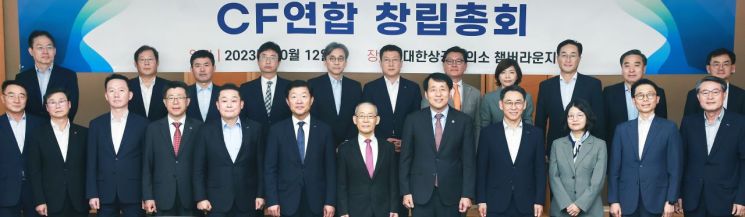
On the 16th, the Ministry of Trade, Industry and Energy held a 'CFE Initiative Expert Meeting' at the Trade Tower in Gangnam, Seoul, attended by Minister An Deok-geun, to review the achievements and plans of the CFE initiative. The meeting was also attended by Lee Hoe-sung, Chairman of the CF Alliance, and representatives from related companies including Samsung Electronics, POSCO, GS Energy, Hanwha Solutions, and Doosan Enerbility.
The CFE initiative is a global campaign to promote carbon neutrality by utilizing carbon-free energy sources such as not only renewable energy but also nuclear power and hydrogen. South Korea proposed this to the international community through President Yoon Suk-yeol's keynote speech at the United Nations General Assembly last September. According to the Ministry of Trade, Industry and Energy, the CFE initiative has so far secured support from eight countries: the United Kingdom, France, Japan, the Netherlands, Saudi Arabia, the United Arab Emirates (UAE), Romania, and Cambodia.
Today, the ministry plans to jointly host an international climate industry expo in Busan with the International Energy Agency (IEA) on the theme of CFE. The IEA agreed in February on a joint declaration reflecting the need for various carbon-free energy sources tailored to each country's conditions.
South Korea also plans to separately conduct the 'Korea-Japan CFE Working-Level Council' with Japan, which has similar industrial characteristics. Subsequently, the government plans to launch the 'CFE Global Task Force' with major countries at the 'Clean Energy Ministerial' held in Brazil in October to establish the overall 'CFE implementation system,' including the specific scope of carbon-free energy and methods for procurement and certification.
Professor Park Jong-bae of Konkuk University, who gave the first presentation at the meeting, emphasized, "Expansion of CFE supply is necessary in three dimensions: supply stability, economic feasibility, and environmental friendliness," adding, "Expanding CFE leads to a reduction in carbon emissions from electricity, which helps respond to carbon regulations and enhances competitiveness across export products such as semiconductors and batteries."
Kim Seong-duk, Director of the National Clean Production Support Center at the Korea Institute of Industrial Technology, evaluated, "The CFE initiative is a campaign created jointly by the public and private sectors, which has the advantage of immediately reflecting private sector demands related to carbon neutrality in government support (systems and infrastructure). Especially, it is differentiated from other campaigns in that various carbon reduction efforts in high-emission industrial processes (Scope 1) such as steel, cement, and petrochemicals are also recognized."
Companies attending the meeting stated, "It is necessary to establish a CFE implementation system that is accepted internationally through public-private cooperation and inter-country solidarity," and urged, "As international carbon regulations such as the Carbon Border Adjustment Mechanism (CBAM) and global companies' demands for carbon reduction intensify, a prompt launch of the global task force is needed."
Lee Hoe-sung, Chairman of the CF Alliance, emphasized, "Since the CFE initiative promotes the comprehensive use and development of various carbon-free energies, it can lead the participation of manufacturing-developed countries like South Korea and developing countries, thereby accelerating global carbon neutrality at minimal cost."
Minister An Deok-geun said, "It is often said that South Korea's manufacturing-centered industrial structure is an obstacle to achieving carbon neutrality, but through overcoming difficulties, technologies, products, and systems that can lead the world can be developed first," adding, "We will swiftly establish a CFE initiative implementation system that can secure the competitiveness of our advanced and key industries while achieving carbon neutrality together and lead effective global climate response."
© The Asia Business Daily(www.asiae.co.kr). All rights reserved.
![Clutching a Stolen Dior Bag, Saying "I Hate Being Poor but Real"... The Grotesque Con of a "Human Knockoff" [Slate]](https://cwcontent.asiae.co.kr/asiaresize/183/2026021902243444107_1771435474.jpg)
















