Removing Cancerous Tissue by Burning with High-Frequency Current
Minimally Invasive, Less Physical Burden, and Shorter Recovery Time
Limited Effectiveness for Large or Multiple Tumors
A 56-year-old man, Mr. Kim, was able to detect liver cancer at an early stage during a health checkup. Fortunately, the tumor was small, but it was located in a spot that made surgery difficult.
As a result, the medical team recommended the 'radiofrequency ablation' treatment. Mr. Kim underwent this procedure, and the cancerous tumor was completely removed.
Afterwards, Mr. Kim was able to quickly return to his daily life, and no signs of cancer recurrence were found during regular checkups. Ultimately, radiofrequency ablation played a decisive role in helping Mr. Kim overcome liver cancer.
Radiofrequency ablation (RFA) is one of several options for treating liver cancer and is gaining attention as a non-surgical method with many advantages.
In particular, it shows a high success rate as an effective treatment for patients in the early stages of liver cancer. This procedure is typically carried out through collaboration between specialists in liver disease and radiology at hospitals.
According to statistics from the Health Insurance Review and Assessment Service, the number of liver cancer patients receiving medical care in Korea increased from 74,848 in 2018 to 78,405 in 2022.
▲Principle and Procedure
Son Ilwan, head of the Department of Radiology at Centum General Hospital, explained, "This treatment uses radiofrequency current to heat and destroy cancer tissue at high temperatures," and described the main procedure as follows.
First, under local anesthesia, the patient undergoes ultrasound or CT guidance to accurately insert a radiofrequency electrode (a needle-shaped probe) into the cancer tissue. When the radiofrequency current is delivered through the electrode, the water molecules in the tissue vibrate, generating frictional heat. This heat raises the temperature of the cancer cells above 60 degrees Celsius, destroying them. After the cancer cells are destroyed by the heat, the electrode is removed and the patient is moved to the recovery room. The entire process usually takes several tens of minutes.
▲Main Advantages
Han Sangyoung, director of the Liver Center at Centum General Hospital and a leading authority on liver disease, stated, "Radiofrequency ablation is a minimally invasive approach that destroys cancer tissue without surgery, reducing the physical burden on the patient. Additionally, the recovery period after the procedure is short, allowing for a quick return to daily life."
It is especially notable for its precision. With image-guided equipment, the electrode can be accurately positioned in the cancer tissue, minimizing damage to surrounding healthy tissue. Furthermore, it boasts a high success rate for small tumors less than 3 cm in size.
Radiofrequency ablation is suitable for patients with early-stage liver cancer, those for whom surgery is difficult, and those with poor liver function. It can be a good alternative for elderly patients who cannot tolerate surgery or those for whom surgery poses significant health risks.
▲Disadvantages and Limitations
First, the applicability of this treatment is limited by the size and location of the tumor. It may be less effective for large tumors over 3 cm or for multiple tumors.
Additionally, tumors located in certain parts of the liver may be difficult to access. There is also the possibility of recurrence. In some patients, cancer may recur after treatment, requiring ongoing monitoring and additional therapy. It is also important to note that this treatment may not be suitable for patients with severely impaired liver function.
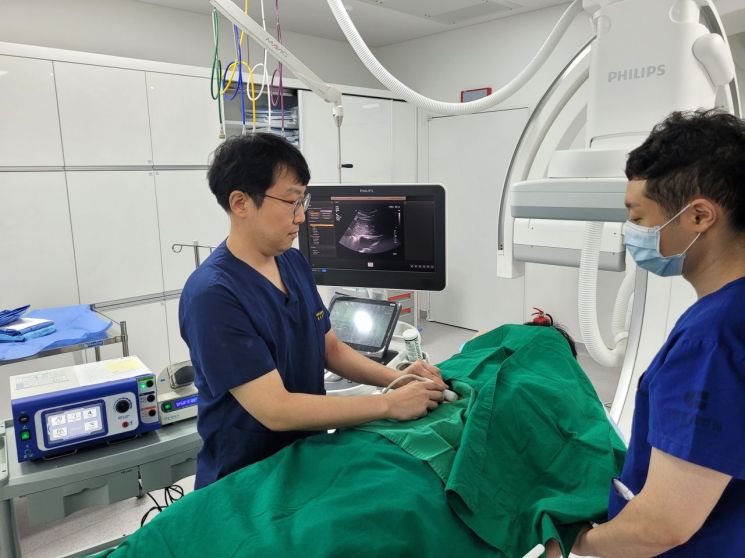 Son Ilwan, head of the Department of Radiology at Centum General Hospital (left), performing a "radiofrequency thermal therapy" procedure.
Han Sangyoung, director of the Liver Center at Centum General Hospital, said, "Radiofrequency ablation has established itself as a very effective method for patients in the early stages of liver cancer. Thanks to its minimally invasive and precise approach, the recovery period is short and it can greatly improve quality of life. However, since the applicability depends on factors such as the size and location of the tumor and the patient's liver function, it is important to consult with a specialist to develop a treatment plan tailored to the individual and to determine the optimal treatment method."
© The Asia Business Daily(www.asiae.co.kr). All rights reserved.
![Clutching a Stolen Dior Bag, Saying "I Hate Being Poor but Real"... The Grotesque Con of a "Human Knockoff" [Slate]](https://cwcontent.asiae.co.kr/asiaresize/183/2026021902243444107_1771435474.jpg)











