Realized 'Carbon Neutrality' Trade Barriers
Steel Industry with High Carbon Emissions Faces Crisis
Germany Invests 10 Trillion, Japan 4 Trillion
Korea's Support Only 200 Billion Won
It has been observed that if POSCO fails to comply with the European Union (EU)'s Carbon Border Adjustment Mechanism (CBAM), it may incur costs of up to 1 trillion won. As environmental regulations tighten, some companies have already notified that it would be difficult to conduct transactions unless steel with low carbon emissions is supplied. Since major countries are pouring full support into 'eco-friendly steel,' there are calls for the Korean government to boldly back domestic companies as well.
On the 15th, Kim Hee, Head of POSCO's Carbon Neutrality Policy Office, attended a seminar titled “Strengthening the Role of Finance for Carbon Neutrality,” jointly hosted by the Carbon Neutral Green Growth Committee and the Korea Institute of Finance at the Banking Hall in Jung-gu, Seoul. He stated, “If we do not comply with CBAM, POSCO expects to bear costs ranging from 200 billion won to up to 1 trillion won.” CBAM is a measure that imposes tariffs based on the carbon emissions of products imported into Europe, and steel is also subject to this.
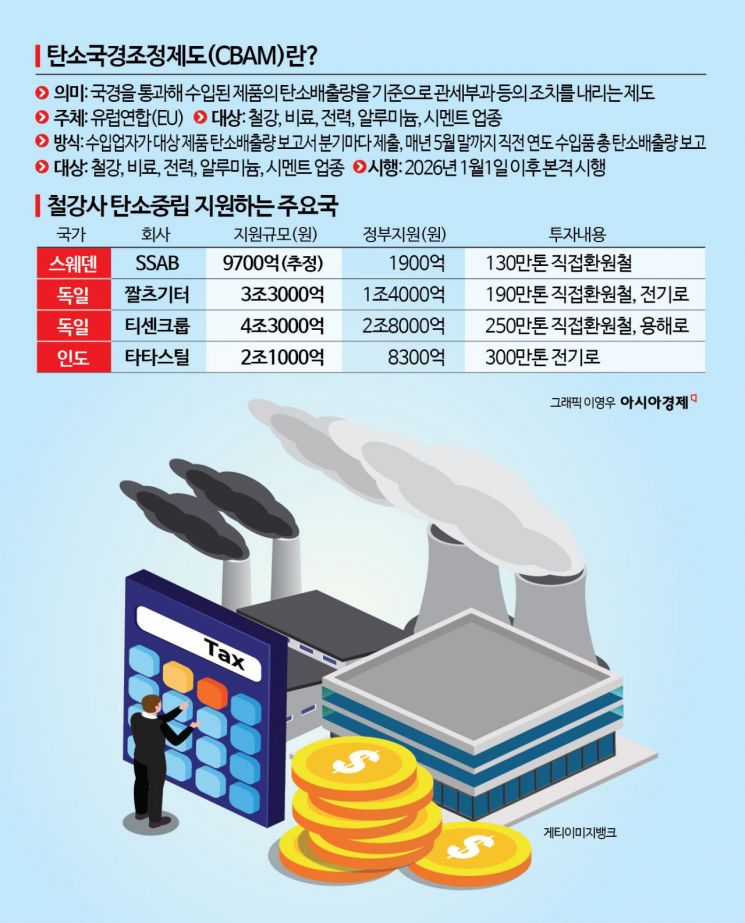
Although CBAM will be fully implemented in 2026, various trade barriers have already become a reality in the industry. Kim explained, “Among POSCO’s major customers, global automobile companies have said they would restrict orders unless products with 30% reduced carbon emissions are supplied,” adding, “(Environmental) disclosures are already being checked by investors at every annual investor relations (IR) meeting, so compliance is unavoidable.”
For POSCO, realizing carbon neutrality is essential not only for the environment but also for survival. POSCO plans to invest 20 trillion won by 2050 solely in the 'hydrogen reduction steelmaking' process, which uses hydrogen instead of fossil fuels that emit large amounts of carbon dioxide to produce steel. The total cost for achieving carbon neutrality is estimated at 40 trillion won. Kim emphasized, “This is not just improving the steel industry but completely rebuilding it from scratch,” calling it “not a transition but a second founding.”
Germany Provides 10 Trillion Won in Support, Korea Only About 0.2 Trillion Won
The problem lies in the grossly insufficient government support. Major countries are injecting various subsidies and budgets into steelmakers to accelerate carbon neutrality. According to the “Future of Green Steel” report released last month by the domestic environmental group Climate Solutions, public subsidies invested in developing low-carbon steel production technologies in Korea amount to 268.5 billion won. This is only 1/37th of Germany’s 10.2 trillion won investment. The gap is also significant compared to Japan (4.0491 trillion won), the United States (2.01 trillion won), and Sweden (1.4471 trillion won).
Overseas steelmakers competing with POSCO are accelerating decarbonization with government support. Swedish steelmaker SSAB has set the most ambitious carbon neutrality goals in Europe. They advanced their carbon reduction plan by 15 years and pledged to have carbon-neutral cars launched by 2030. This is backed by Sweden and the EU’s exceptional research and development (R&D) and facility investment support. By 2026, they plan to build 1.3 million tons of direct reduced iron (DRI) facilities, with total support estimated at 970 billion won.
German steelmaker Salzgitter, despite being a high carbon-emitting industry, has declared its intention to become a leading company in the circular economy sector. Investments in 1.9 million tons of DRI and electric furnace facilities will be made by 2026, with support amounting to 3.3 trillion won. Of this, government support reaches 1.4 trillion won. Indian steelmaker Tata Steel received 2.1 trillion won in subsidies to build 3 million tons of electric furnaces. Nippon Steel and JFE are also benefiting as their “low-carbon technology development and hydrogen reduction steelmaking expansion support” has increased from 2 trillion won to 4.5 trillion won.
The industry is urging the Korean government to actively support decarbonization as well. In March, Cho Young-jun, Director of the Korea Chamber of Commerce and Industry’s Sustainability Management Center, released a report on the status and challenges of carbon neutrality response, stating, “It is urgent to establish comprehensive support policies such as enacting a special law to support industrial transition to carbon neutrality, expanding direct investment and tax credits, and infrastructure expansion.” Among companies surveyed in the report, 72.8% responded that support for ‘carbon-free energy infrastructure’ is insufficient, and 67.2% said financial support such as subsidies and tax benefits is lagging.
The government’s stance is that it must review both the scale of support and the industry’s self-help efforts. Kim Sang-hyup, Chair of the Carbon Neutrality Committee, said, “The government announced it would provide an enormous amount of green funds, but if leading companies do not feel the impact, this is an issue that needs to be examined,” adding, “However, we also need to consider whether our industry actually needed that level of green support.”
© The Asia Business Daily(www.asiae.co.kr). All rights reserved.
![Clutching a Stolen Dior Bag, Saying "I Hate Being Poor but Real"... The Grotesque Con of a "Human Knockoff" [Slate]](https://cwcontent.asiae.co.kr/asiaresize/183/2026021902243444107_1771435474.jpg)
















