Reservation Brokerage Fee 8~17%
Average Monthly Advertising Cost 1,079,300 KRW
As a few applications (apps) dominate the lodging industry, self-employed business owners are suffering from high commission fees. Lodging operators complain that after platforms take about 20% of total sales, there is practically nothing left.

At around 1 p.m. on the 15th in Seongdong-gu, Seoul, Kim (57), who has been running a lodging business for seven years, sighed, "The lodging apps charge millions of won in advertising fees every month and take a 10% commission on each transaction, so about 15-20% of total sales go out as platform fees. Since transactions through apps account for 80% of total sales, we have no choice but to keep listing and paying commissions."
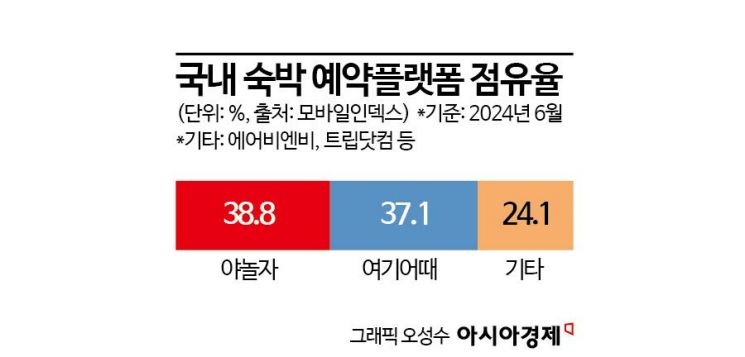
In fact, the top two lodging apps hold a market share of 75% overall. According to Mobile Index, as of last month, Yanolja accounted for 38.8% of the domestic travel platform market share, and Yeogi Eottae held 37.1%. Han (63), who runs a lodging business in Yeongdeungpo-gu, Seoul, lamented, "If we don't list on the apps, business doesn't work, so we are forced to sign up, which is difficult."
According to the Korea Federation of Small and Medium Business's "2024 Online Platform Listing Small Business Transaction Survey," lodging operators pay up to 8-17% in reservation brokerage commissions to apps and spend an average monthly advertising fee of 1,079,300 won. In the case of lodging apps, 74% responded that legislation is needed to regulate unfair trade and wrongful practices.
Jung Kyung-jae, president of the Korea Lodging Business Association, pointed out, "In the early stages of the service, platforms attract members by charging low basic advertising fees, but after securing a certain number of members, they gradually increase commissions and induce businesses to choose expensive advertising plans costing over 1 million won to issue coupons to customers, a widespread abuse of power."
Lee Joo-han, a lawyer at Law Firm Wimin, said, "Online platforms initially offer excessive discounts to attract consumers, but once they achieve a dominant market position, they impose burdens on listed businesses to recoup previous losses. The online platform monopoly regulation law currently being promoted in the National Assembly differs from the existing Fair Trade Act in that it designates dominant market operators and recognizes violations without the operator's rebuttal, making it an effective means to respond more promptly."
© The Asia Business Daily(www.asiae.co.kr). All rights reserved.


















