Animal Organizations Expose Rearing Conditions at Some Domestic Farms
On the 15th, marking Chobok, the first of the three hottest days known as Sambok, animal protection organizations came forward to expose the reality of the domestic chicken industry. They revealed that chickens used as ingredients for Samgyetang are mass-raised in poor and unsanitary conditions before being slaughtered.
Animal groups such as 'Animal Liberation Wave' and 'Last Chance for Animals' (LCA) released a press statement on the day, disclosing the results of an undercover investigation at some Samgye farms. The farms they infiltrated were located in Chungcheong and Jeolla provinces. All these farms reportedly supply Samgye to major domestic chicken corporations.
First, the groups pointed out the breed of chicken raised in Korea called 'Baeksemi.' Baeksemi is said to be a hybrid breed created by crossing broilers (meat-producing chickens) and layers (egg-producing chickens). They explained, "This breed is unprecedented outside of Korea" and "It has been selectively bred to reach an average weight of 800?850g in about a month, making it suitable for Samgyetang production."
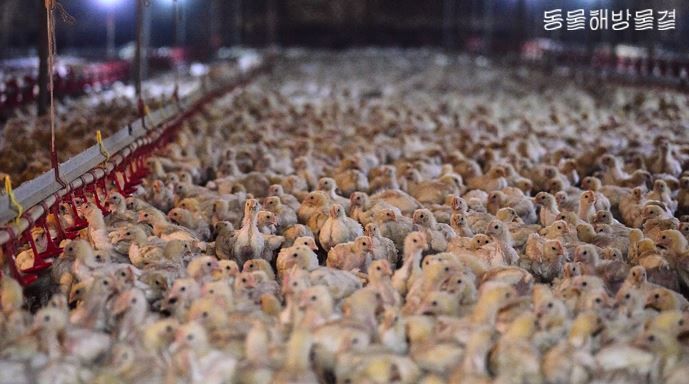 Animal protection organizations have come forward to expose the poor breeding conditions of the 'Baeksemi' chicken breed, which is used as an ingredient in Samgyetang in Korea. [Image source=Animal Liberation Wave]
According to data from the Animal and Plant Quarantine Agency and Statistics Korea, Baeksemi chickens are slaughtered in particularly large numbers during the Samgyetang consumption season. Last July, twice as many Baeksemi chickens were raised and slaughtered compared to usual.
The groups especially criticized the mass rearing of these chickens in filthy environments. They stated, "They are densely packed and endure horrific pain and abuse during transportation to slaughterhouses." Due to the high temperature, humidity, and unsanitary conditions in the farms, most chickens have lost their feathers, and their footpads suffer from dermatitis.
Cannibalism (the phenomenon of animals attacking or preying on members of the same species) frequently occurs, and infections from various viruses and bacteria are common. They also claimed that sick chickens are left untreated and die.
High concentrations of ammonia gas, dangerous enough to threaten the chickens' lives, are generated inside the farms. At one farm, a large number of red mites were found. Red mites are parasites that injure the chickens' skin and are also a cause of bacterial infections such as Salmonella and E. coli.
Additionally, there were cases where live chickens were forcibly culled, or culled chickens were disposed of illegally in violation of the current Livestock Epidemic Prevention Act and Waste Management Act. Improper disposal of animal carcasses can cause soil and water pollution and may transmit livestock diseases to nearby wildlife.
The groups emphasized, "Chickens raised in unsanitary environments that threaten public health are disguised as 'Samgyetang,' a health-boosting dish, and served on consumers' tables." They added, "Overseas, including Europe and the United States, there is a movement to abolish intensive farming systems that violate animal rights."
On the same day, the groups held the ‘2024 Boknal Memorial Action’ in front of Boshingak in Jongno to protest the deaths of chickens. At the rally, a large banner showing densely raised chickens was displayed, and a ritual dance and picketing performance mourning the dead chickens were conducted. Citizens participating in the rally planned to march through the streets near Boshingak and Gwanghwamun, calling for a transition to Boknal without animal suffering.
© The Asia Business Daily(www.asiae.co.kr). All rights reserved.
![User Who Sold Erroneously Deposited Bitcoins to Repay Debt and Fund Entertainment... What Did the Supreme Court Decide in 2021? [Legal Issue Check]](https://cwcontent.asiae.co.kr/asiaresize/183/2026020910431234020_1770601391.png)















