Causes such as being outside the district, low voter turnout, and difficulty in differentiation
Power struggle continues within Gwangju City Party Committee Chairman position
The Democratic Party confirmed 8 out of 13 preliminary candidates for the Supreme Council member position as official candidates for the main election. Among the 8 preliminary candidates from the Democratic Party's pro-Lee Jae-myung faction organization, the "Democratic Party National Innovation Council (Innovation Council)," only 3 survived. Starting as an external organization, the Innovation Council rapidly rose to become the largest faction within the party by producing 31 members of the National Assembly in the 22nd general election.
At the August 18 National Party Members' Convention to elect the next leadership of the Democratic Party, the 8 candidates running for Supreme Council member were finalized as Kim Byung-joo, Kang Sun-woo, Jeong Bong-ju, Min Hyung-bae, Kim Min-seok, Lee Eon-ju, Han Jun-ho, and Jeon Hyun-hee (in order of ballot number). The preliminary election followed a rule reflecting 50% votes from central committee members and 50% from party members with voting rights. Among the candidates, only Kang Sun-woo (re-elected, Seoul Gangseo-gu Gap), Min Hyung-bae (re-elected, Gwangju Gwangsan-gu Eul), and Jeon Hyun-hee (three-term, Seoul Jung-gu Seongdong-gu Gap) belong to the Innovation Council. First-term lawmaker Lee Seong-yoon and four external preliminary candidates were cut off.
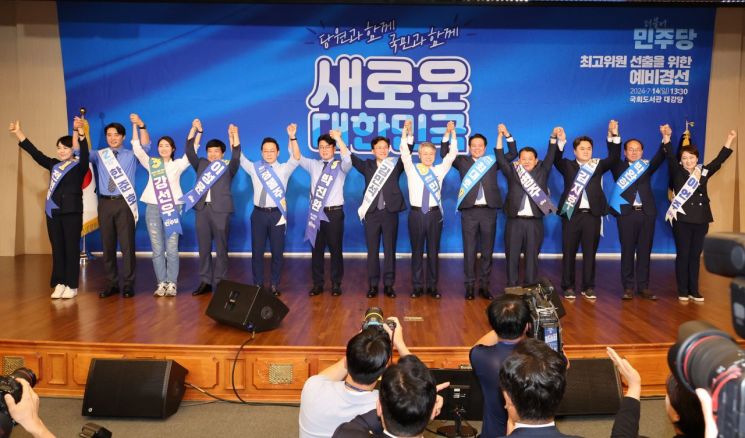
All 8 candidates selected for the Supreme Council member position are re-elected or higher, and the eliminated preliminary candidates are evaluated as having failed to overcome the recognition gap between inside and outside the National Assembly. Park Jin-hwan, a standing committee member of the Innovation Council who tasted defeat after running as a preliminary candidate, said in a phone interview, "Isn't there a difference in recognition inside the National Assembly?" and added, "Party members are advocating direct democracy as an innovation measure, but this time we saw the limits again." The only external candidate is former lawmaker Jeong Bong-ju, who is not affiliated with the Innovation Council.
Low voter turnout among party members with voting rights may also have been a cause for the Innovation Council's preliminary candidates' underperformance. During the preliminary election the day before, about 380,000 out of approximately 1,242,000 party members with voting rights participated, recording a turnout rate of 30.6%. For the central committee electorate, 327 out of 395 members voted, corresponding to 82.78%. Additionally, since most candidates flaunted their closeness to former leader Lee Jae-myung or pledged to lead the fight against the ruling party, engaging in a 'clarity competition,' it was likely difficult to show a marked difference.
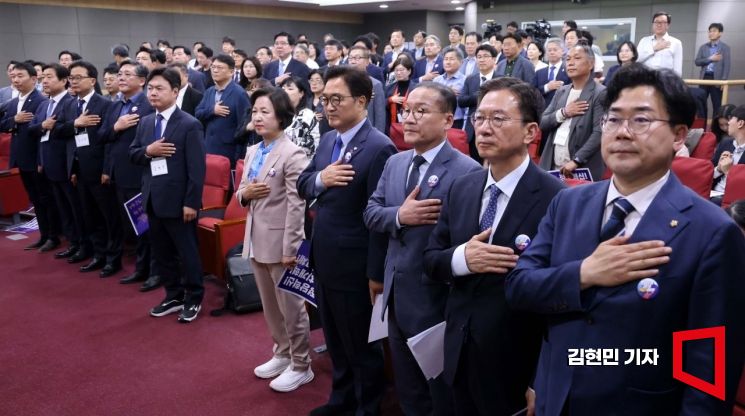 On April 29, attendees are performing the national ceremony at the Democratic Party of Korea National Innovation Meeting's discussion session on the general election evaluation and organizational outlook held at the National Assembly Members' Office Building. At that time, Chu Mi-ae, Woo Won-shik, Kang Wi-won, Jung Sung-ho, and Park Chan-dae attended. (Titles omitted) Photo by Kim Hyun-min kimhyun81@
However, a power struggle continues in the elections for city and provincial party chairpersons. The Innovation Council raised an issue with the 8 National Assembly members from the Gwangju region jointly nominating one lawmaker for the Gwangju Metropolitan City Party Chairperson election. Through a public inquiry letter, the Innovation Council argued, "A city party chairperson nominated by the agreement of lawmakers is likely to act according to the demands of those lawmakers," and "Local election nominations may also be decided according to lawmakers' preferences rather than party members' demands." City and provincial party chairpersons exercise nomination rights in local elections.
The root of the conflict lies in the 'different dreams while supporting the same candidate.' The 8 National Assembly members from the Gwangju region nominated lawmaker Yang Bu-nam as the Gwangju City Party Chairperson last month. On the other hand, the Innovation Council announced on the 10th that it would 'fully support' external candidate Kang for the Gwangju City Party Chairperson position. A National Assembly member from the Gwangju region commented, "It would be good to have figures from outside the National Assembly, but not all inside are vested interests." Candidate Kang emphasized upon declaring his candidacy, "If we remain complacent with old vested interests and fail to change, the people will not entrust the Democratic Party with national governance."
© The Asia Business Daily(www.asiae.co.kr). All rights reserved.
![Clutching a Stolen Dior Bag, Saying "I Hate Being Poor but Real"... The Grotesque Con of a "Human Knockoff" [Slate]](https://cwcontent.asiae.co.kr/asiaresize/183/2026021902243444107_1771435474.jpg)

















