Real Wages Up 22% Since 2011
Minimum Wage Soars 6 Times Faster
Policy Wages Distorted into Negotiated Wages
"Revamp Decision-Making Structure" in Unison
While real wages reflecting inflation rose by 22%, the minimum wage soared by 123%. Critics argue that market distortions caused by excessive increases in the minimum wage compared to inflation and wages are alienating low-wage workers who should benefit from the minimum wage hike. To avoid repeated reckless increases in the minimum wage that ignore reality, voices calling for a fundamental reform of the minimum wage decision-making structure, which currently resembles a power struggle between labor and management, are gaining strength.
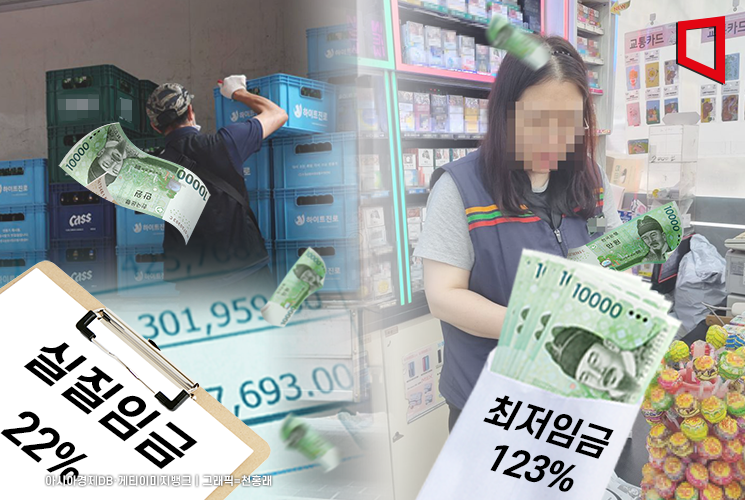
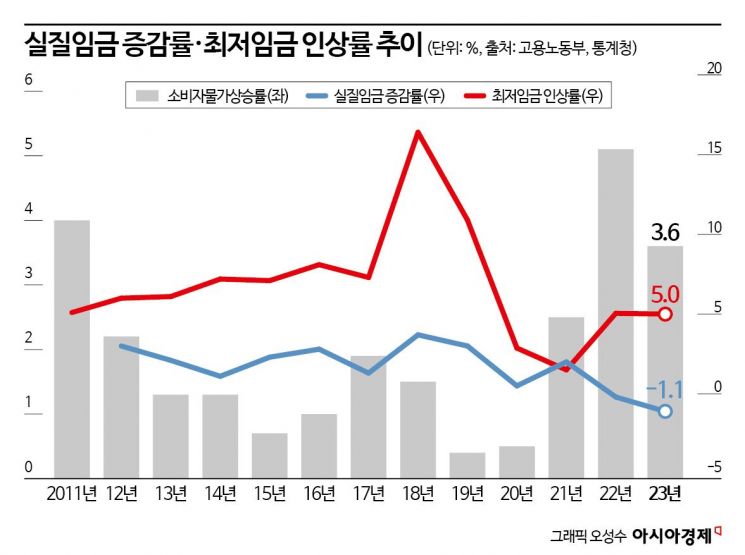
According to the Ministry of Employment and Labor and related agencies on the 17th, the average monthly real wage per worker, adjusted for inflation, was 3,554,000 KRW last year, up 22.47% from 2,902,000 KRW in 2011, when related statistics began to be compiled. During this period, the statutory minimum wage sharply increased from 4,320 KRW to 9,620 KRW, with a rise rate of 122.69%.
The policy wage, the minimum wage, surged at a pace six times faster than the real wages received by all workers. The minimum wage increased by more than 10% for two consecutive years, rising 16.4% in 2018 and 10.9% in 2019 during the early years of the Moon Jae-in administration, with a total increase of 41.57% over five years, and it rose 9.50% under the Yoon Suk-yeol administration. During this period, the consumer price inflation rate was generally in the low 2% range, except for a sharp 5.1% spike in 2022 immediately after the COVID-19 pandemic.
Due to the rapid increase, South Korea's minimum wage is already higher than that of major advanced countries. In terms of the "minimum wage relative to median wage" ratio, which is used as an international benchmark for minimum wage comparison, South Korea stood at 60.9% as of the end of June 2022, significantly higher than Japan (45.6%) and Germany (52.6%), which rank third and fourth in economic size. Other major countries implementing minimum wages, such as Belgium (40.9%), Ireland (47.5%), the United Kingdom (58%), and Australia (53.6%), remain in the 40-50% range.
The negative impact of the rapid minimum wage increase is concentrated on low-wage workers who should benefit from the system. According to an analysis by the Korea Employers Federation, the number of workers earning less than the minimum wage in the labor market last year was 3,011,000. The proportion of workers earning below the minimum wage (minimum wage underpayment rate) also rose by 1 percentage point in one year to 13.7%. This is more than three times the 4.3% recorded in 2001.
In particular, minimum wage underpayment was concentrated in vulnerable industries such as agriculture, forestry, and fisheries (43.1%) and accommodation and food services (37.3%). Among employees working in small-scale businesses with fewer than five employees, 3 out of 10 (32.7%) earned less than the minimum wage, compared to 2.2% in large and medium-sized enterprises. The increase in the minimum wage underpayment rate is attributed to the cumulative effect of high minimum wage increase rates over time, with the Korea Employers Federation analyzing that the level of economic development and the current labor market situation cannot keep pace with the rapid increase in the minimum wage.
 On the 6th, at the 13th plenary session of the Economic, Social and Labor Council (ESLC) under the President, held in the ESLC main conference room in Jongno-gu, Seoul, Lee Jeong-sik, Minister of Employment and Labor, delivered a greeting. Photo by Heo Young-han younghan@
The situation is expected to worsen after next year. The Minimum Wage Commission, the deliberation and resolution body for the minimum wage, raised next year's minimum wage by 1.7% to 10,030 KRW from this year's 9,860 KRW on the 12th. Although the increase rate was the second-lowest since 2021 (1.5%), the minimum wage exceeded 10,000 KRW for the first time in history due to the accumulated high increase rates relative to inflation and wages. Economic organizations expressed regret that the minimum wage was not frozen or lowered and criticized the unrealistic minimum wage decision-making process.
Voices from academia and elsewhere call for reforming the outdated minimum wage system itself. Introduced in 1988 amid the democratization wave, the minimum wage system was expected to establish mature labor-management relations through consensus at the time of its introduction. However, it has repeatedly become a power struggle between labor and management, like wage negotiations, with hasty votes by government-appointed public interest commissioners deciding the outcome. In this process, the policy wage set by the government as the minimum threshold workers should receive and the upper limit of employers' payment capacity has been distorted into a negotiated wage. There are calls to restore the distorted minimum wage system to its original form, which currently guarantees and supports high wage increases for relatively high-income organized workers (unionized workers).
Professor Kang Sung-jin of the Department of Economics at Korea University pointed out, "The current minimum wage system has a structural limitation in that labor and management, whose interests sharply conflict, act as the main negotiators, making it difficult to reach a smooth consensus." He added, "The decision-making structure between labor and management should be broken, and the system should be reformed so that expert groups can lead the determination of the minimum wage based on objective calculation grounds."
© The Asia Business Daily(www.asiae.co.kr). All rights reserved.



















