US-ROK Alliance Maintained Regardless of Trump Re-election
Han-Russia Relations Depend on How Russia is Handled
North Korea Supplying Weapons to Russia Increases South Korea's Intelligence Awareness
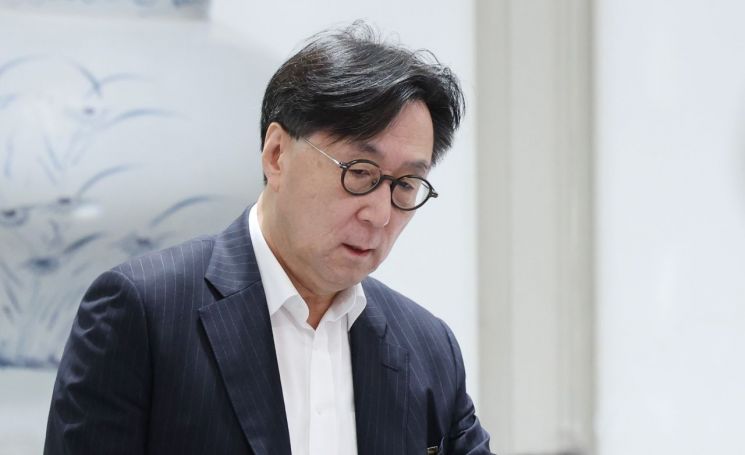 Jang Ho-jin, Director of the National Security Office, is attending the Cabinet meeting held on the 2nd at the Yongsan Presidential Office building in Seoul. [Image source=Yonhap News]
Jang Ho-jin, Director of the National Security Office, said regarding the growing prospects of former U.S. President Donald Trump's re-election, "Regardless of whether he is re-elected, a strong South Korea-U.S. alliance will be maintained."
On the afternoon of the 13th, Jang appeared on Yonhap News TV and stated, "Although we are close allies, it is not appropriate to speculate on the election results of another country," but emphasized, "One thing is clear: there is a solid base of support for the South Korea-U.S. alliance across both parties in the U.S."
He added, "People in the Trump camp have also told us not to worry too much about the alliance or that it will be further strengthened," and explained, "There may be different variables depending on the issues if he actually takes office, so we are continuously monitoring and preparing accordingly."
Regarding the prospect that if the Trump administration returns, it might either allow South Korea to develop its own nuclear weapons or, conversely, further strengthen the U.S. nuclear umbrella over the Korean Peninsula, Jang said, "Since opinions differ slightly among people within the Trump camp, I don't think it is necessary to make assumptions in either direction."
On the recently deteriorated South Korea-Russia relations, Jang said, "It depends on what Russia does."
He stated, "The recent close ties and military cooperation between Russia and North Korea break the framework of South Korea-Russia relations and are regressive," adding, "Therefore, we announced our own stern countermeasures and sent a message to Russia, and after President Putin's visit to North Korea, Russia has started dialogue with us again, reopening diplomatic space."
He continued, "How Russia will manage South Korea-Russia relations going forward and what trends will emerge between Russia and North Korea will inevitably be important variables determining the direction of South Korea-Russia relations," and concluded, "So ultimately, it depends on what Russia does."
Regarding President Yoon Suk-yeol's warning to Russia to "think carefully about which side is more important, South Korea or North Korea," Jang explained, "We are a neighbor that Russia necessarily needs for developing the Far East or advancing into the Asia-Pacific region."
On South Korea's decision to reconsider weapons support to Ukraine in response to the close ties between North Korea and Russia, he emphasized, "So far, we have mainly provided humanitarian aid and some security support focused on non-lethal weapons such as mine detectors, but depending on Russia's trends in its relations with North Korea, changes could be made in this area."
Jang said, "For example, if Russia and North Korea engage in weapons trade, military technology transfers, or strategic material transfers beyond a certain level, we will naturally reconsider."
He also mentioned the expansion of information sharing on North Korean weapons between South Korea and NATO, which was agreed upon during his recent NATO tour.
He said, "If we provide NATO with the basic data on North Korean weapons, NATO will analyze the actual results when those weapons are used in Ukraine and share the analysis with us," adding, "The more weapons North Korea supplies to Russia, the better we will understand North Korean weapons."
Regarding the 'South Korea-U.S. Joint Operational Guidelines for Nuclear Deterrence on the Korean Peninsula' signed during the NATO summit, he explained, "It is a guideline on what kind of military readiness posture to maintain under a structure that combines U.S. nuclear forces and South Korea's conventional forces," and added, "Military readiness here naturally includes both defense and strike capabilities."
He further stated, "As North Korea's nuclear missile threat becomes more advanced and given the trends of cooperation between Russia and North Korea, we plan to continue strengthening and developing cooperation across three areas: South Korea-U.S.-Japan policy consultations, intelligence sharing, and trilateral exercises."
© The Asia Business Daily(www.asiae.co.kr). All rights reserved.