4 Cases Including Automatic Wheelchair Rearview Lock Device and Customized Hospital Services for Transportation-Disadvantaged
As services for transportation-vulnerable individuals increase recently, their use of low-floor buses and hospital transportation will become easier. In the future, transportation-vulnerable individuals will be able to secure wheelchairs not only in the direction of bus movement but also in the opposite direction when using low-floor buses. Additionally, hospital transportation services for transportation-vulnerable individuals will be expanded as these services become possible without a platform transportation business license.
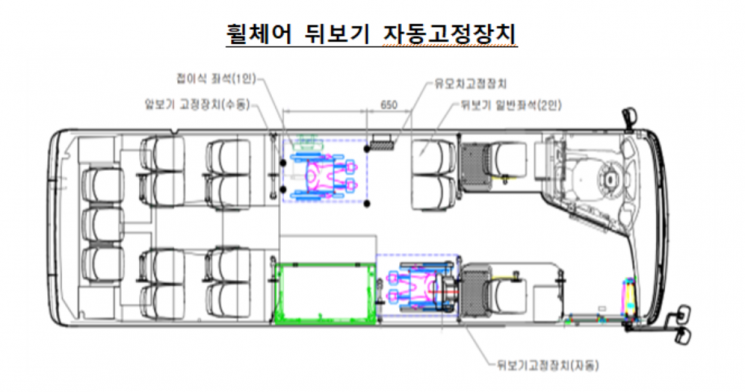 Automatic Wheelchair Rearview Locking Device. [Provided by the Ministry of Land, Infrastructure and Transport]
The Ministry of Land, Infrastructure and Transport announced on the 12th that it held the 2nd Mobility Innovation Committee meeting and granted regulatory exemptions for four mobility services, including automatic wheelchair rear-view fixation devices and customized hospital services for transportation-vulnerable individuals.
The Innovation Committee was established under the 'Mobility Innovation Act' to deliberate and decide on important policies in the advanced mobility sector, including regulatory sandbox demonstration exemptions.
According to the review results, Hyundai Motor Company will be able to install automatic wheelchair rear-view fixation devices on low-floor buses. Under the 'Transportation Vulnerable Act,' wheelchairs on low-floor buses were only allowed to face forward in the direction of vehicle movement, and there were no safety standards for wheelchair fixation devices. Through regulatory exemptions, transportation-vulnerable individuals will be able to secure wheelchairs facing both forward and backward on low-floor buses. Furthermore, installing automatic wheelchair fixation devices will enhance their safety.
Transportation-vulnerable individuals will also be able to be transported to hospitals without a platform transportation business license. Haengboki-eum Cooperative and Modu & Company provide customized hospital services for transportation-vulnerable individuals. According to the 'Passenger Car Act,' a platform transportation business license is required when transporting transportation-vulnerable individuals to hospitals using specially modified vehicles. The Ministry of Land, Infrastructure and Transport designated an exemption for hospital transportation services, judging that there is a shortage of transportation means for transportation-vulnerable individuals.
In addition, mobile services that provide vehicle diagnostic work and recall campaign tasks using vehicle diagnostic devices outside of vehicle maintenance workshops will become possible. This business was applied for by Mercedes-Benz Korea. Under the 'Automobile Management Act,' vehicle inspection or maintenance outside registered maintenance workshops is prohibited. However, the Ministry of Land, Infrastructure and Transport actively interpreted that there are no regulations on mobile vehicle maintenance services and granted regulatory exemptions.
Minister of Land, Infrastructure and Transport Park Sang-woo said, "We must boldly remove outdated regulations through regulatory sandboxes while accelerating the discovery of lifestyle-oriented businesses to advance mobility innovation. We will support creating results that satisfy both the public and companies and ensure the continuous growth of the mobility industry."
© The Asia Business Daily(www.asiae.co.kr). All rights reserved.
![Clutching a Stolen Dior Bag, Saying "I Hate Being Poor but Real"... The Grotesque Con of a "Human Knockoff" [Slate]](https://cwcontent.asiae.co.kr/asiaresize/183/2026021902243444107_1771435474.jpg)











