US-ROK Alliance Elevated from Conventional to 'Nuclear-Based'
First and Only Bilateral Discussion on Nuclear Operations with the US
'Immediate Consultation' Documented... Integrated Nuclear and Conventional Training
Defense Ministry: North Korean Nuclear Threat Evolved from 'Deterrence' to 'Response'
South Korea and the United States have elevated their alliance, which was centered on conventional forces, to a 'nuclear-powered' alliance. Along with the trend of expanding the deployment intensity of U.S. strategic assets to the level of permanent stationing of U.S. nuclear forces on the Korean Peninsula, a 'ROK-U.S. nuclear and conventional integrated exercise' is being promoted. Among all non-nuclear countries worldwide, South Korea is the first and only case to have directly discussed 'nuclear operations' with the U.S. at the bilateral level.
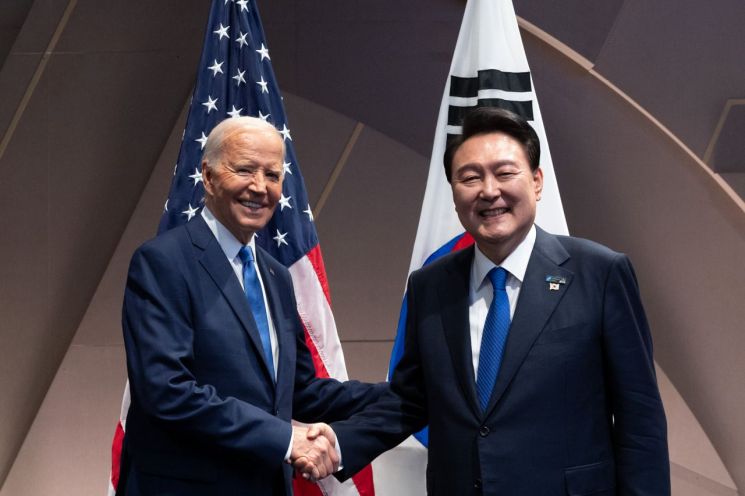 President Yoon Suk-yeol, attending the North Atlantic Treaty Organization (NATO) summit, shakes hands with U.S. President Joe Biden during the South Korea-U.S. summit held on the 11th (local time) at the Walter E. Washington Convention Center in Washington, D.C.
The Ministry of National Defense announced on the 12th that the 'ROK-U.S. Joint Guidelines on Nuclear Deterrence and Nuclear Operations on the Korean Peninsula (hereinafter Joint Guidelines),' adopted during the summit between President Yoon Suk-yeol and U.S. President Joe Biden on the 11th (local time) in Washington D.C. at the NATO summit, contains such content. The ROK and the U.S. have agreed to expand the sharing of sensitive nuclear-related information and information necessary for nuclear and conventional integration (CNI) in the event of a North Korean nuclear crisis. They also decided to establish procedures and systems that guarantee immediate consultations between the leaders, and plan to build a secure communication system for this purpose.
Regular in-depth U.S. nuclear deterrence education will be provided to relevant personnel across various South Korean government departments related to extended deterrence. In particular, annual tabletop exercises at the whole-of-government and defense/military levels will be conducted applying the ROK-U.S. nuclear and conventional integration measures and nuclear consultation procedures.
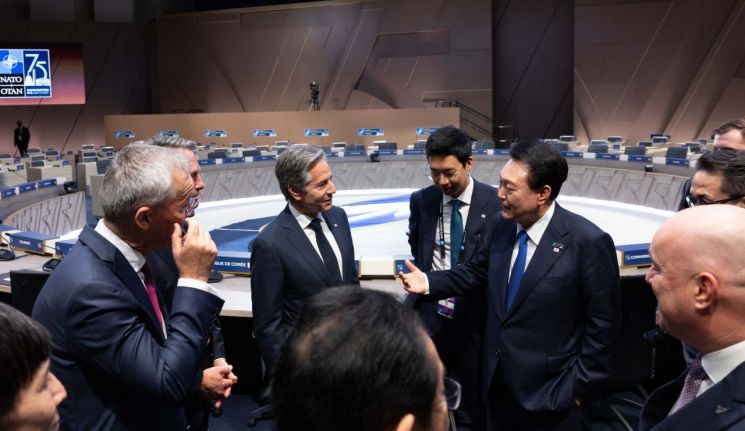 President Yoon Suk-yeol, attending the North Atlantic Treaty Organization (NATO) summit, is seen on the 11th (local time) at the Walter E. Washington Convention Center in Washington DC, USA, engaging in conversation with the leaders of the four countries?South Korea, Japan, Australia, and New Zealand (IP4)?as well as U.S. Secretary of State Antony Blinken during the IP4 leaders' meeting.
A Ministry of National Defense official explained, "If the existing U.S. extended deterrence commitment was declarative and focused on deterring North Korea's nuclear weapons, the Joint Guidelines include, for the first time, 'response' to North Korean nuclear threats," adding, "It is a level of assurance that U.S. nuclear assets will be assigned missions on the Korean Peninsula during both wartime and peacetime." While the previous extended deterrence strategy aimed to prevent North Korea from considering nuclear use through the mere presence of U.S. nuclear forces, it is now interpreted as strengthening readiness to prepare for situations where North Korea actually uses nuclear weapons.
The official said, "If the previous extended deterrence was decided and provided by the U.S., now South Korea, as a partner, discusses joint planning and execution of nuclear and conventional integration with the U.S.," adding, "Our role in the U.S. nuclear operation process has been expanded." He continued, "We have completed the foundation of integrated extended deterrence together with the U.S., upgrading the ROK-U.S. alliance, which was previously based on conventional forces, to a solid 'nuclear-based alliance,'" emphasizing, "This is the first and only case of a non-nuclear country directly discussing nuclear operations with the U.S. at the bilateral level."
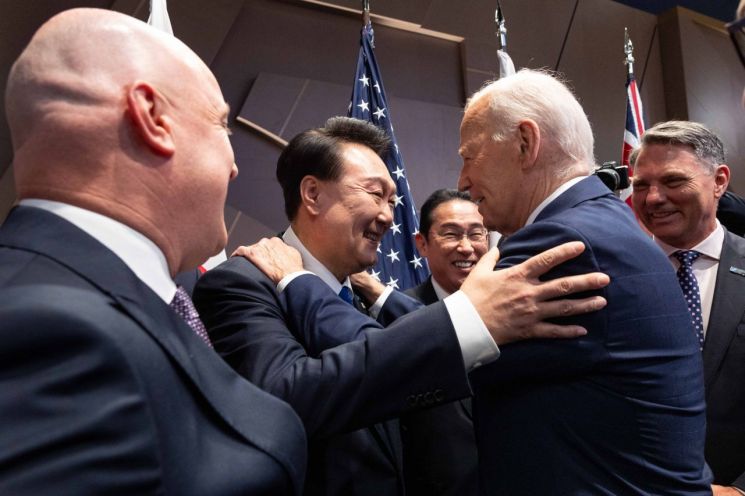 President Yoon Suk-yeol, attending the North Atlantic Treaty Organization (NATO) summit, embraced U.S. President Joe Biden at the Korea-Japan-Australia-New Zealand (IP4) leaders' meeting held on the 11th (local time) at the Walter E. Washington Convention Center in Washington, D.C.
A Ministry of National Defense official drew a line against the frequently raised 'self-nuclear armament theory,' stating, "We have established an alliance nuclear and conventional integrated system that can effectively deter and respond to North Korean nuclear threats without self-nuclear armament or redeployment of U.S. nuclear weapons."
He explained, "While the military alliance based on conventional forces effectively deterred North Korea's conventional threats, U.S. nuclear operations were limited to the U.S.'s sovereign domain during extended deterrence consultations for North Korean nuclear threats," and "As the North Korean nuclear threat intensified and the international situation changed, the public became concerned about the credibility of U.S. extended deterrence, and institutional measures were needed to ensure the practical operation of U.S. extended deterrence in a North Korean nuclear crisis."
The ROK-U.S. leaders established the Nuclear Consultative Group (NCG) through the 'Washington Declaration' adopted in April last year. The ROK and the U.S. have concretized discussions through three NCG meetings to prepare institutional measures that have borne fruit with the newly announced Joint Guidelines.
© The Asia Business Daily(www.asiae.co.kr). All rights reserved.
![Clutching a Stolen Dior Bag, Saying "I Hate Being Poor but Real"... The Grotesque Con of a "Human Knockoff" [Slate]](https://cwcontent.asiae.co.kr/asiaresize/183/2026021902243444107_1771435474.jpg)


















