OECD Recommends South Korea Rate Cut in Second Half
BOK Signals Rate Cut
October Cut Likely Due to Housing Prices, Household Debt, and Exchange Rate Issues
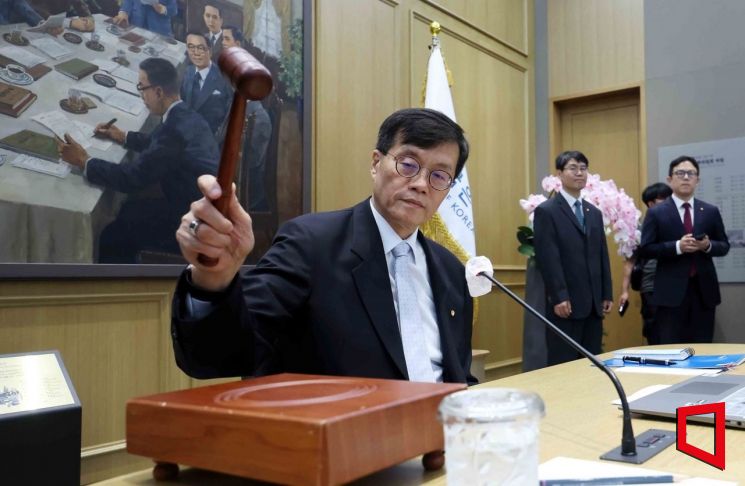 Lee Chang-yong, Governor of the Bank of Korea, is striking the gavel at the Monetary Policy Committee meeting held at the Bank of Korea in Jung-gu, Seoul on the 11th. Photo by Joint Press Corps
The Organisation for Economic Co-operation and Development (OECD) has recommended a cut in the base interest rate, anticipating that inflation in South Korea will gradually stabilize. However, the market expects the Bank of Korea to lower the base rate not next month but around October, considering financial stability.
On the 11th, the OECD, through its '2024 Korea Economic Report,' slightly lowered its forecast for South Korea's consumer price inflation rate this year from 2.6% predicted in May to 2.5%.
The OECD stated, "Inflation in South Korea will gradually ease and reach the target by the end of this year," adding, "Domestic demand is expected to strengthen from the second half of this year." It further suggested, "With prices stabilizing, there is a need to ease monetary policy in the second half of this year."
The market anticipates that the Bank of Korea will cut the base interest rate around October. Following the decision to keep the base rate steady at 3.50% per annum during a morning meeting, Bank of Korea Governor Lee Chang-yong said at a press conference, "We are preparing to change the direction (of interest rates) at an appropriate time."
This has been interpreted as the Bank of Korea signaling a potential rate cut. Kang Seung-won, a researcher at NH Investment & Securities, analyzed, "Governor Lee evaluated that a rate cut is possible based solely on inflation and has effectively turned on the signal for a rate cut."
Governor Lee also revealed, "Two members of the Monetary Policy Committee expressed opinions that the possibility of a base rate cut within the next three months should be kept open." In May, only one member supported a rate cut within three months in the forward guidance, but this month the number increased to two.
However, since there was no dissenting opinion for a rate cut this time, the possibility of a rate cut next month is interpreted as low. Experts who had predicted a rate cut in August are now pushing the expected timing to October. There is no Monetary Policy Committee meeting in September to decide on rates.
Shin Eol, a researcher at Sangsangin Securities, said, "Considering financial stability factors such as exchange rates, housing prices in the metropolitan area, and household debt, the expected dissenting opinion for a rate cut did not appear at this Monetary Policy Committee meeting," adding, "The Bank of Korea's expected timing for a rate cut has been revised from August to the fourth quarter."
Baek Yoon-min, senior researcher at Kyobo Securities, also explained, "The conditions for a rate cut from a fundamentals perspective, such as inflation, have not changed significantly, and although the number of MPC members keeping the possibility of a rate cut within three months open increased to two, the expected dissenting opinion for a rate cut did not appear," adding, "Due to increased financial imbalance risks, the forecast for the timing of a base rate cut has been revised from August to October."
With the likelihood of the United States cutting its base interest rate in September increasing, the speculation about the Bank of Korea cutting rates in October gains more weight. The U.S. Consumer Price Index (CPI) for June, released the previous day, rose 3.0% year-on-year, below the market expectation of 3.1%. Following Federal Reserve Chair Jerome Powell's statement on the 10th that monetary policy could be eased depending on circumstances even before inflation reaches the Fed's 2% target, the favorable CPI data has further increased the possibility of a U.S. rate cut in September.
Jo Yong-gu, a researcher at Shin Young Securities, analyzed, "The U.S. is expected to cut the base rate in September, and the Bank of Korea will likely follow with a rate cut in October," adding, "The Bank of Korea will consider chronic issues such as the won's depreciation pressure due to the widening Korea-U.S. interest rate gap, household debt, and real estate."
© The Asia Business Daily(www.asiae.co.kr). All rights reserved.

















