Minimum Wage 10,000 Won Era... Set at 10,030 Won
Final Labor-Management Proposal Voted Without Mediation
Some Democratic Labor Union Members Walk Out Refusing to Vote
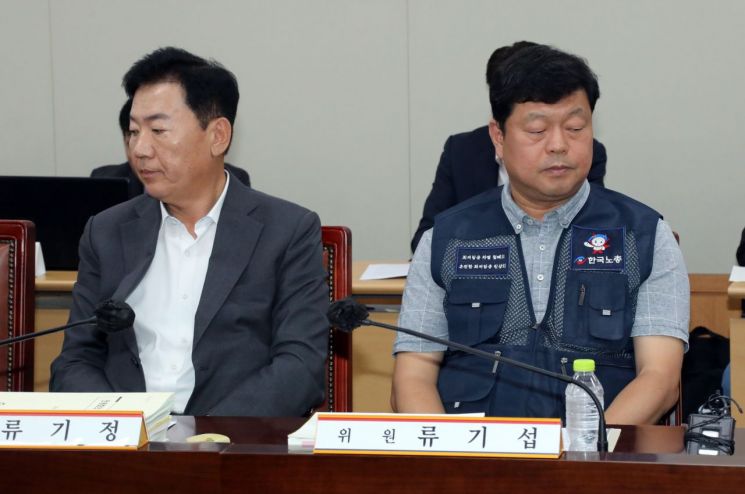
53 days of deliberation, 11 plenary meetings, 5 revised proposals submitted, and the minimum wage surpassing 10,000 won.
The Minimum Wage Commission decided on the minimum wage for next year at 10,030 won after an overnight meeting spanning two days on the 12th. This is a 1.7% increase from this year's minimum wage (9,860 won), marking the first-ever "10,000 won minimum wage" era since the introduction of the minimum wage system in 1988. This year as well, without labor-management agreement, the final labor and management proposals were put to a vote based on the standard proposal prepared by the public interest commissioners.
Public Interest Commissioners Set 'Deliberation Promotion' Range as Negotiations Stalled
At the 10th plenary meeting held the previous day, the labor side proposed a 9.9% increase from this year's minimum wage with a revised 4th proposal of 10,840 won, while the management side proposed a 0.8% increase at 9,940 won. With a 900 won gap that was not easily bridged, both sides judged that further revised proposals were meaningless and requested mediation from the public interest commissioners.
The public interest commissioners proposed a deliberation promotion range of 10,000 to 10,290 won (an increase rate of 1.4% to 4.4%) around 1 a.m. The lower limit of the deliberation promotion range, 10,000 won, is a 1.4% increase from this year's minimum wage of 9,860 won, based on 60% of the median wage of workers and the labor side's final proposal during last year's deliberation.
The upper limit of 10,290 won represents a 4.4% increase from this year, calculated by adding this year's economic growth rate (2.6%) and consumer price inflation rate (2.6%) and subtracting the employment growth rate (0.8%). The figures for economic growth rate, consumer price inflation rate, and employment growth rate were averages of forecasts from major institutions such as the Ministry of Economy and Finance, the Bank of Korea, and the Korea Development Institute (KDI).
No Agreement Again This Year... Labor Side 'Dissatisfied' with Management Proposal Selection
At around 2 a.m., both labor and management presented their final proposals of 10,120 won and 10,030 won per hour, respectively, and the commission put these to a vote. The commission consists of 27 members: 9 worker representatives from the labor side, 9 employer representatives from the management side, and 9 public interest commissioners appointed by the government.
However, just before the vote, 4 worker representatives from the Korean Confederation of Trade Unions (KCTU) boycotted the vote in protest against the deliberation promotion range proposed by the public interest commissioners, resulting in only 23 members participating. Among them, the management proposal prevailed with 14 votes to 9. It appears that among the 9 public interest commissioners, 4 voted for the labor proposal and 5 for the management proposal.
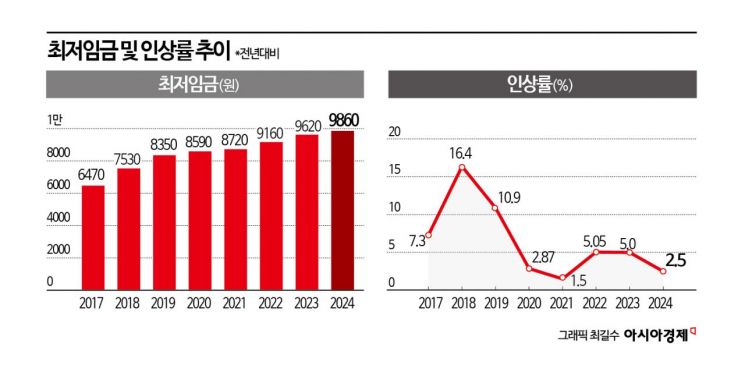
Once again this year, the minimum wage was decided by a vote based on the standard proposal prepared by the public interest commissioners without labor-management agreement. After the deliberation ended, Chairperson Lee In-jae of the Minimum Wage Commission expressed regret over "the failure to reach an agreement despite the proposals from both sides narrowing significantly at the end," and added, "It is also regrettable that physical clashes occurred related to the vote on sector-specific application as discussions became overheated."
At the meeting held on the 2nd, during the voting process on whether to apply sector-specific differentiation as requested by the management side, some worker representatives attempted to block the vote by seizing the gavel and tearing up ballots, leading to a strong opposition from employer representatives and a clash that caused the meeting to end prematurely without further progress.
The labor side expressed dissatisfaction with the outcome. The Korean Confederation of Trade Unions (KCTU), through spokesperson Jeon Ho-il, stated in a press release, "The deliberation promotion range proposed by the public interest commissioners neither reflects the purpose of the minimum wage system nor is it based on solid grounds," and added, "We cannot accept the public interest commissioners' 'pre-determined answer' recommendation, which nullifies the discussion, as the basis for deciding the minimum wage."
The Federation of Korean Trade Unions (FKTU) expressed dissatisfaction in a statement after the vote, saying, "From the beginning of the main deliberations, we had no choice but to make very limited selections amid abnormal circumstances such as claims for sector-specific differential application and the appointment of employer-biased public interest commissioners."
© The Asia Business Daily(www.asiae.co.kr). All rights reserved.
![Clutching a Stolen Dior Bag, Saying "I Hate Being Poor but Real"... The Grotesque Con of a "Human Knockoff" [Slate]](https://cwcontent.asiae.co.kr/asiaresize/183/2026021902243444107_1771435474.jpg)

















