South Korea Inflation Forecast Lowered to 2.5% by 0.1%p
"Recommendation for Monetary Policy Easing"
The Organisation for Economic Co-operation and Development (OECD) maintained South Korea's economic growth forecast at 2.6% on the 11th. The consumer price inflation forecast was slightly lowered from 2.6% in May to 2.5%.
In the '2024 Korea Economic Report' released that day, the OECD stated, "The Korean economy has emerged from a temporary slowdown and growth has resumed," adding, "Despite the accumulated effects of high inflation and high interest rates, domestic demand is expected to strengthen from the second half of this year."
The OECD maintained South Korea's real Gross Domestic Product (GDP) growth forecast at 2.6% for this year and 2.2% for next year. This is the same as the significant upward revision from 2.2% to 2.6% made in May. This forecast aligns with those of the government and the Korea Development Institute (KDI), and is slightly higher than the Bank of Korea's forecast of 2.5%.
The basis for economic growth was attributed to strong semiconductor exports. The report diagnosed, "Global trade volume is increasing, and both the quantity and price of semiconductor exports are recovering. Exporters' sentiment has bottomed out, and the current account balance has returned to a solid surplus."
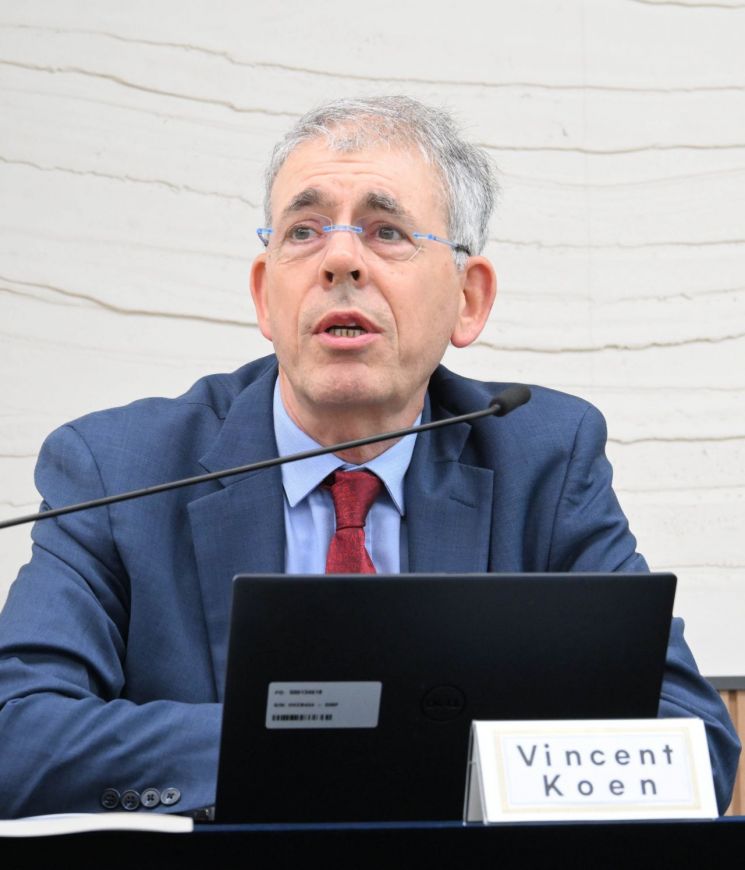
The consumer price inflation forecast was set at 2.5%. The report predicted, "Inflation will gradually ease and reach the target by the end of this year," and "Domestic demand will show strength from the second half of this year." The OECD's forecast for private consumption growth is 1.4% this year and 2.4% next year.
With price stability, the OECD also suggested the need to ease monetary policy in the second half of this year. It projected that exports of goods and services will increase by 6.9% this year and adjust to 2.4% next year. Imports are expected to grow by 1.2% this year and 2.4% next year.
The OECD identified risks to the Korean economy including supply chain disruptions due to US-China trade conflicts and reduced trade with China. The report analyzed, "China remains a key partner in the value chain of Korean companies," and "Since a significant portion of South Korea's exports to China are semiconductors, trade restrictions could have an impact." It added, "Trade dependence is a major risk that needs to be addressed."
Concerns about project financing (PF) defaults due to falling real estate prices were also mentioned, with a warning that "serious consequences could result depending on policy responses." North Korea was also cited as a risk factor for the Korean economy, including concerns about border clashes arising from inter-Korean tensions.
Additionally, the OECD proposed policy recommendations focusing on South Korea's medium- to long-term challenges in this report, including creating a fair competitive environment to improve small and medium-sized enterprises' productivity, reducing carbon emissions, and responding to population decline.
© The Asia Business Daily(www.asiae.co.kr). All rights reserved.
![Clutching a Stolen Dior Bag, Saying "I Hate Being Poor but Real"... The Grotesque Con of a "Human Knockoff" [Slate]](https://cwcontent.asiae.co.kr/asiaresize/183/2026021902243444107_1771435474.jpg)
















