The Smell of Rotten Eggs Increases the Possibility of Life Formation
Similar to Jupiter in the Solar System... Temperature Approaching 1000 Degrees Celsius
A planet emitting the smell of rotten eggs in its atmosphere has been discovered. This finding was derived by astrophysicists analyzing data from the James Webb Space Telescope, revealing that the planet's temperature rises up to 1000 degrees Celsius.
British broadcaster BBC cited a report from Johns Hopkins University, which led the study, stating, "Planet HD 189733 b has temperatures and precipitation as if molten glass were pouring down," the report said.
A notable aspect of this planet is the unique foul odor emanating from its atmosphere. This is because hydrogen sulfide, which has also been detected on Jupiter, makes up most of the atmosphere. This gas is also found in the flatulence emitted by living organisms.
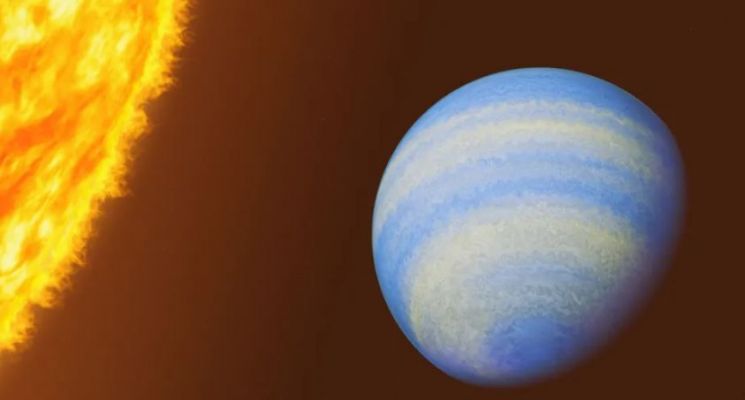
Dr. Poo, an astrophysicist at Johns Hopkins University, told the media, "If our noses could function properly even in an environment of 1000 degrees Celsius, we would be able to smell the planet's atmosphere," adding, "It is similar to the smell of rotten eggs."
The reason scientists are interested in this planet is also because of hydrogen sulfide. Planets containing hydrogen sulfide have a high possibility of harboring primitive organic life. However, the likelihood of living organisms existing on planet HD 189733 b is considered very low. This planet is a gas giant like Jupiter, and its temperature is too high.
Instead, scientists emphasize that this study provides an important clue to understanding how planets in the universe have been formed. By analyzing the chemical substances of distant planets with the James Webb Telescope, it is possible to infer the origins of those planets.
Dr. Poo described the James Webb Telescope as a "game changer that has revolutionized the field of astronomy," explaining, "It has not only delivered all the promised functions but in some ways has exceeded our expectations."
The James Webb Telescope was planned in 1996, began construction in 2006, and finally became operational in 2021. The project cost 10 billion dollars (approximately 13.8 trillion won), and was developed through cooperation among NASA, the European Space Agency (ESA), the Canadian Space Agency, and other countries.
Following Hubble and Spitzer, James Webb is regarded as opening new possibilities for humanity's space observation technology. It can capture numerous wavelengths pouring from space with 10 to 100 times higher resolution and sensitivity than the previous generation Hubble Telescope. It is also reported to be capable of observing wavelengths from the early universe about 200 million years after the Big Bang.
© The Asia Business Daily(www.asiae.co.kr). All rights reserved.
![Clutching a Stolen Dior Bag, Saying "I Hate Being Poor but Real"... The Grotesque Con of a "Human Knockoff" [Slate]](https://cwcontent.asiae.co.kr/asiaresize/183/2026021902243444107_1771435474.jpg)
















