K-Chips Act and Other Major Bills Fail to Pass Relevant Subcommittee
High-Level Radioactive Waste and Power Grid Expansion Special Laws Not Discussed
More than a month has passed since the 22nd National Assembly convened, but major economic bills are still adrift. Urgent livelihood bills are not even being discussed, pushed aside by partisan bills such as the special prosecutor law for Chae Sang-byeong. Some bills have not even been submitted for consideration due to delays in forming subcommittees within standing committees. As the processing of livelihood bills is delayed, concerns are growing that this could become the worst 'plant parliament' in history.
According to the National Assembly Legislative Information System on the 10th, major economic bills have not passed the review stage of the relevant subcommittees. This means that bills proposed with the consent of more than 10 lawmakers have not moved beyond the opinion-gathering process of the relevant standing committees. For a bill to pass in the National Assembly, it must go through the process of referral to the relevant standing committee → submission to the full standing committee meeting → review and resolution by the bill examination subcommittee → resolution by the full standing committee meeting → systematic and textual review by the Legislation and Judiciary Committee → resolution by the plenary session of the National Assembly. The ruling and opposition parties have not even sat at the same table to discuss urgent bills.
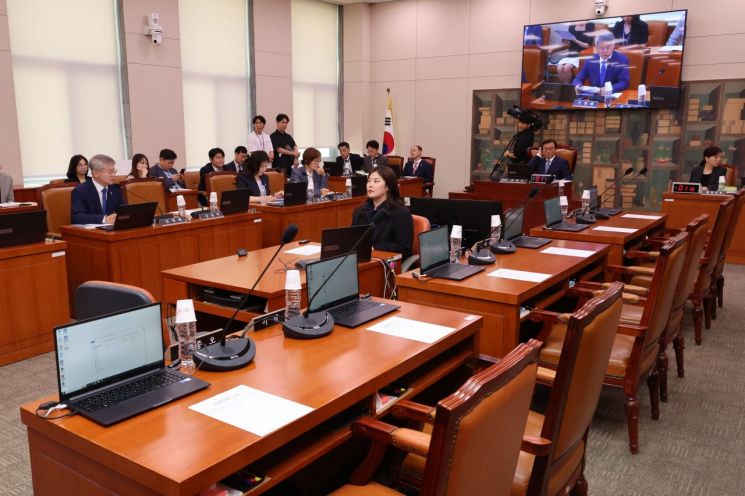
Consensus between ruling and opposition on the K-Chips Act... Disagreements over tax credit period
The 'Special Act on Strengthening and Protecting the Competitiveness of the National Semiconductor Industry (K-Chips Act)' and the 'High-Level Radioactive Waste Special Act (High-Level Radioactive Waste Disposal Site Act)', which were discarded just before the expiration of the 21st National Assembly's term, are representative examples. The K-Chips Act aims to raise the tax credit rate for investment in national strategic technology facilities such as semiconductors from 8% to 15% for large corporations and from 16% to 25% for small and medium enterprises. However, it is set to expire at the end of this year. To maintain the tax credit benefits, urgent legislative revision is necessary. Currently, four related bills have been submitted to the relevant standing committee.
While both ruling and opposition parties agree on extending the sunset clause of the K-Chips Act, they have not made progress in negotiating the details. Kim Tae-nyeon, a member of the Democratic Party of Korea, has proposed raising the semiconductor technology investment tax credit rate by 10 percentage points to 25% for large corporations and 35% for small and medium enterprises. The proposal also includes extending the tax credit related to facility investment for 10 years until 2034. On the other hand, Park Soo-young, a member of the People Power Party, has proposed extending the existing 10-year carryover period for tax credits to 20 years. Since both parties have reached a consensus on the semiconductor special law, it is expected that the bill can be processed in the National Assembly in the second half of this year. However, some negotiations may be prolonged due to controversies over credit rates and tax cuts favoring the wealthy.
Ruling party leads High-Level Radioactive Waste Disposal Site Act... Opposition proposes joint processing with Offshore Wind Power Special Act
The High-Level Radioactive Waste Disposal Site Act is also included in the People Power Party's top priority party package, and ruling party lawmakers have actively submitted bills. Without a high-level radioactive waste disposal site, nuclear power plants will have to be sequentially shut down starting six years from now. Currently, high-level radioactive waste is accumulating within nuclear power plants, and it is expected that temporary nuclear waste storage facilities at multiple plants, starting with Hanbit Nuclear Power Plant in 2030, followed by Hanul and Kori, will reach saturation within 10 years. Considering that it takes at least seven years to install dry storage facilities, there are calls to start installation immediately at Hanbit and Kori Nuclear Power Plants, where saturation is expected to occur first.
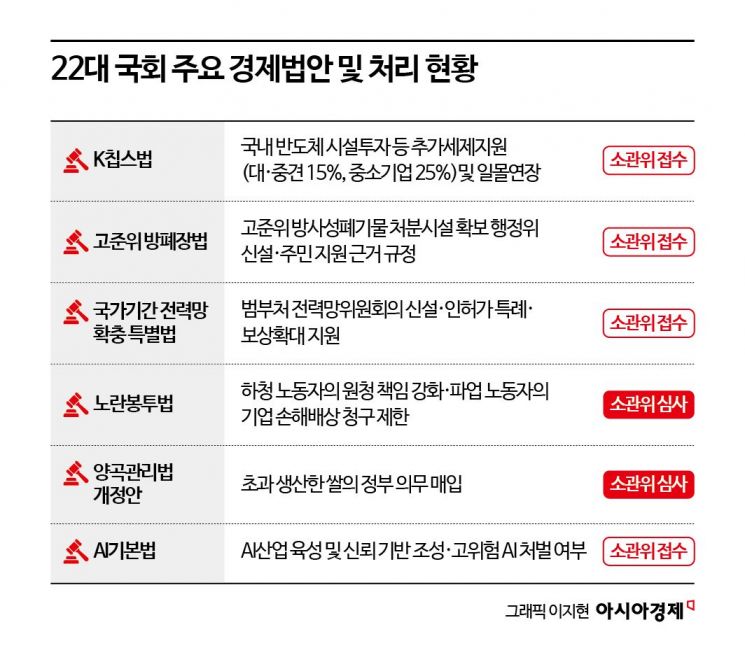
Accordingly, People Power Party lawmakers from the Yeongnam region, where nuclear power plants are densely located, are leading the bill proposals. On May 30, the opening day of the 22nd National Assembly, 12 lawmakers including Kim Seok-ki submitted the Special Act on the Management of High-Level Radioactive Waste and Support for Hosting Areas, and on the same day, Lee In-seon submitted the Special Act on the Management of High-Level Radioactive Waste. On June 5, 11 lawmakers including Kim Seong-won proposed the Special Act on the Installation, Operation, and Resident Support of High-Level Radioactive Waste Management Facilities, and on June 20, 20 lawmakers including Jeong Dong-man proposed the Special Act on High-Level Radioactive Waste Management Facilities. The opposition has proposed processing the High-Level Radioactive Waste Disposal Site Act together with the Offshore Wind Power Special Act.
National Power Grid Expansion Act and AI Basic Act fail to pass submission stage
The Special Act on National Power Grid Expansion is also a major concern for the ruling party. Kim Seong-won, chairman of the People Power Party's Energy Special Committee, and Lee In-seon, the committee's secretary, have each submitted bills. The two bills aim to protect key domestic industries such as power generation, steel, and petrochemicals in a timely manner by expanding the power grid to implement the national energy mix, including timely commissioning of new nuclear power plants and accommodating renewable energy generation. The bills include policy and institutional support measures such as improving licensing procedures for speedy project implementation, special provisions for development activities and compensation for losses, and compensation and support systems for local residents to minimize public harm.
Regarding AI-related bills such as the Artificial Intelligence (AI) Basic Act, the ruling and opposition parties are competing in bill proposals. Since Ahn Cheol-soo, a member of the People Power Party, introduced the Act on Fostering the AI Industry and Securing Trust on May 31, a total of six related bills have been submitted by lawmakers from both parties. These bills include provisions for fostering the industry and creating a trust foundation to respond to technological developments such as generative AI. The bill passed the subcommittee of the National Assembly's Science, Technology, Information and Broadcasting Committee in February last year but was stalled for over a year and eventually discarded as the 21st National Assembly's term ended. Civic groups argue that the law must include punitive provisions such as fines for problems arising from high-risk AI, while the industry insists that it should include content to protect domestic industries. As opinions diverge, discussions are expected to take some time.
The Industry, Trade and Energy Committee has not yet even begun discussions on the High-Level Radioactive Waste Special Act and the Power Grid Expansion Special Act. This is because the schedule for forming the standing committee itself was delayed due to conflicts between the ruling and opposition parties over committee organization. The Industry, Trade and Energy Committee held its first full meeting yesterday and appointed Park Seong-min of the People Power Party as the ruling party's secretary. Also, unlike the K-Chips Act, only the ruling party has proposed related bills, so if there are disagreements between the parties, legislative progress may be delayed. Although the People Power Party holds the chairmanship of the Industry, Trade and Energy Committee, the Democratic Party has 17 members while the People Power Party has 11. However, Lee Cheol-gyu, chairman of the Industry, Trade and Energy Committee, told Asia Economy on the day, "Standing committee activities have started," and "Once the subcommittee is formed soon, bill review will begin."
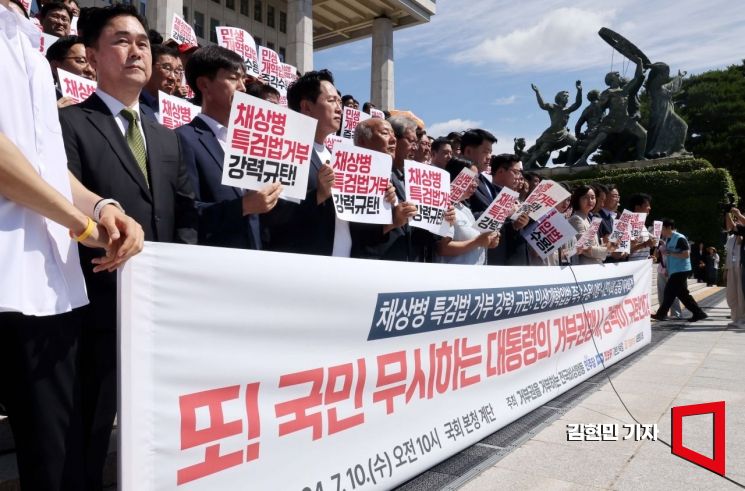 The Democratic Party of Korea and six opposition parties, along with civil society representatives, are holding a press conference on the steps in front of the National Assembly main building on the 10th, condemning the rejection of the Special Investigation Law for Fallen Marines and demanding the acceptance of livelihood reform legislation. Photo by Hyunmin Kim kimhyun81@
Disagreements in bill review of the Yellow Envelope Act... No resolution
The Yellow Envelope Act (Amendments to Articles 2 and 3 of the Labor Union Act) is currently under review by the Employment and Labor Law Review Subcommittee of the Environment and Labor Committee. The Yellow Envelope Act is a labor union law amendment that strengthens the responsibility of primary contractors for subcontracted workers. It also includes provisions limiting companies' claims for damages against striking workers. Although the bill passed the National Assembly plenary session at the end of last year under opposition leadership, it was discarded after President Yoon Seok-youl exercised his veto power. The Environment and Labor Committee conducted a review of the bill at the subcommittee yesterday but failed to reach a resolution. The key issue is that limiting union responsibility for illegal strikes could have significant side effects. Even if workers occupy workplaces and cause damage through violence, companies would not be able to claim damages from the workers. The People Power Party expressed concerns that the Yellow Envelope Act would impose burdens on workers, employers, and the public, potentially leading to disaster.
Representative contentious bill, the Grain Management Act... Submission of agenda fails
The amendment to the Grain Management Act is a highly contentious bill between the ruling and opposition parties and has not even been submitted to the subcommittee. The relevant standing committee, the National Assembly Agriculture, Food, Rural Affairs, Oceans and Fisheries Committee, planned to submit the agenda yesterday, but the submission failed due to the absence of a subcommittee. The Grain Management Act is a representative contentious bill in the National Assembly. The main issue is mandating the purchase of rice when the price falls below a certain level, which was previously discretionary. Discussions intensified following the rice price crash in 2021. The bill was discarded in the 21st National Assembly after President Yoon exercised his veto power. The Democratic Party argues that government control of rice prices causes market failure and leads to agricultural product price crashes. In contrast, the government and ruling party counter that the rice price decline is due to structural oversupply. They worry that mandating purchases could lead to excess supply and worsen the price crash. Although the Grain Management Act is currently under review by the relevant standing committee, it is unlikely to reach agreement soon.
© The Asia Business Daily(www.asiae.co.kr). All rights reserved.



















