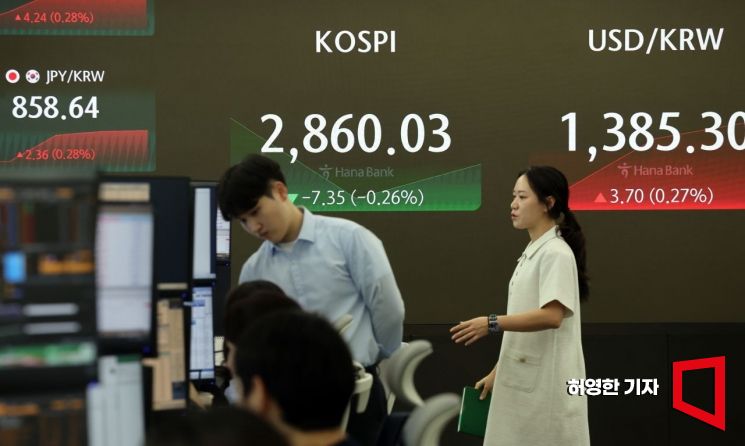
 Various indices are displayed on the electronic board in the dealing room of the Seoul Hana Bank headquarters. Photo by Huh Younghan younghan@
As expectations for an improvement in the semiconductor industry grow, foreign investors' net purchases of domestic stocks have continued for eight consecutive months.
According to the "International Finance and Foreign Exchange Market Trends since June" released by the Bank of Korea on the 10th, the net inflow of foreign investment funds into domestic stocks last month was $2.09 billion, a significant increase compared to $1.34 billion recorded the previous month. This is the highest level in three months since $3.84 billion in March.
The Bank of Korea explained that foreign investors' net stock purchases continued amid ongoing expectations of a global semiconductor industry recovery.
Foreign investors also made net purchases of bonds, but the scale decreased. Last month, the net purchase amount of domestic bonds by foreigners was $370 million, sharply down from $2.77 billion recorded the previous month.
The Bank of Korea analyzed that although foreign investors' medium- to long-term bond investments continue, the net inflow scale shrank due to occurrences such as the maturity redemption of government bonds.
The total net inflow of foreign securities investment funds, combining stocks and bonds, was $2.45 billion in June, down from $4.11 billion recorded the previous month.
The credit default swap (CDS) premium for Korean government bonds (based on the 5-year Foreign Exchange Stabilization Fund bonds) was recorded at an average of 36 basis points (1bp = 0.01 percentage points) last month, up 1bp from 35bp the previous month.
Volatility in the won-dollar exchange rate decreased. Last month, the won-dollar exchange rate volatility was 0.26%, significantly down from 0.45% the previous month. The average daily fluctuation also decreased from 6.1 won to 3.5 won.
The Bank of Korea analyzed that the won-dollar exchange rate fell significantly last month due to the weakening of the US dollar amid slowing US economic indicators, but most of the decline was reversed due to political uncertainties in the European region and the weakening of the yen.
Meanwhile, the average daily foreign exchange transaction volume in the domestic interbank market in the second quarter was $33.58 billion, down $1.5 billion from $35.08 billion in the previous quarter. The cause was a $1.59 billion decrease in spot foreign exchange transactions compared to the previous quarter.
© The Asia Business Daily(www.asiae.co.kr). All rights reserved.
![Clutching a Stolen Dior Bag, Saying "I Hate Being Poor but Real"... The Grotesque Con of a "Human Knockoff" [Slate]](https://cwcontent.asiae.co.kr/asiaresize/183/2026021902243444107_1771435474.jpg)










