Powell "Inflation Not the Only Risk... Employment Cooling"
One Week Ago Emphasized Prices... Policy Focus Shifts from Prices to Employment
September Rate Cut Expected... S&P and Nasdaq Hit New Highs Again
Jerome Powell, Chairman of the U.S. Federal Reserve (Fed), expressed concerns that prolonged high interest rates could jeopardize the economy and employment. Just a week ago, he emphasized price stability, but recent labor market slowdowns suggest that the Fed's monetary policy focus is gradually shifting from inflation to employment. With recent signs of cooling in the labor market, such as rising unemployment rates and declining job openings, the Fed is believed to have put the option of a rate cut on the table for September.
Powell: "Inflation Is Not the Only Risk... Labor Market Cooling"
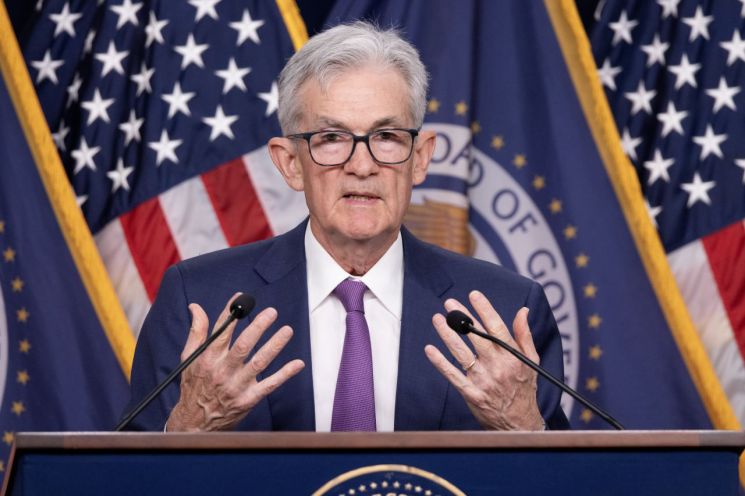
On the 9th (local time), Powell appeared before the U.S. Senate for the semiannual monetary policy report and stated, "Rising inflation is not the only risk we face." He added, "Recent data indicate that the current labor market situation has cooled considerably compared to two years ago," and warned, "If policy constraints are eased too late or too little, economic activity and employment could weaken excessively."
During the congressional session, Powell repeatedly emphasized the risk balance between rising prices and slowing employment. He said, "For a long time, the risk of failing to achieve the inflation target was greater," but "now the risks between rising prices and excessive labor market slowdown are increasingly balanced." This diagnosis indicates that concerns about employment slowdown risks are emerging alongside inflation. Powell also mentioned that although the unemployment rate remains historically low, an unexpected labor market slowdown could justify policy easing.
Compared to his previous focus on inflation risks, Powell's message on this day reflected a changed atmosphere. Just a week earlier, on the 2nd, he had stated, "We have entered a disinflation (slowing inflation) path, but before initiating easing policies, we want greater confidence that inflation is sustainably moving toward the 2% target." The Wall Street Journal (WSJ) described this as a "subtle but significant shift."
With recent signals of labor market cooling confirmed one after another, it is analyzed that the Fed intends to gradually shift the policy focus from price stability to employment. The U.S. unemployment rate in June reached 4.1%, the highest in two years and six months. Although still at full employment levels, concerns are rising that cumulative high-intensity tightening could slow economic growth and increase unemployment. The number of job openings per unemployed person was 1.22 as of May, the lowest since 2021, close to the pre-pandemic 2019 average of 1.19.
Powell gave a positive assessment of the current inflation situation. He said, "Recent inflation indicators have shown modest additional progress," and added, "More good data to come will strengthen our confidence that inflation is moving steadily toward 2%." When asked about the timing of rate cuts, he avoided specifics, saying, "I will not give any signals regarding the timing of future actions."
Wall Street Weighs in on September Rate Cut Outlook... S&P 500 and Nasdaq Hit New Highs Again
On Wall Street, there is an assessment that Powell has put the option of a rate cut on the table for September. Following recent inflation deceleration and signs of labor market cooling, analysts believe the Fed is building a foundation for a policy pivot. If signals accumulate over the next two to three months showing both inflation and employment slowing, the September Federal Open Market Committee (FOMC) meeting could be an appropriate time to start cutting rates.
The market views both inflation and employment as slowing. The U.S. Department of Labor is expected to report on the 11th that last month's Consumer Price Index (CPI) rose 3.1% year-over-year, below May's 3.3% increase. The CPI growth rates for April and May (3.4% and 3.3%, respectively) were both lower than the previous months (3.5% and 3.4%), suggesting a third consecutive month of CPI deceleration. The unemployment rate is also steadily rising, with Bloomberg Economics (BE), an economic research institute under Bloomberg, forecasting it to reach 4.5% in the fourth quarter.
Investors expect the Fed to implement two rate cuts within the year, starting in September. According to the Chicago Mercantile Exchange (CME) FedWatch tool, the federal funds futures market on that day priced in a 73.3% probability that the Fed will cut rates by at least 0.25 percentage points at the September FOMC meeting. The probability of a 0.25 percentage point or greater cut in November is 85%.
Krishna Guha, Vice Chairman of Evercore ISI, said, "We read Powell's remarks on risk balance particularly dovishly," adding, "If upcoming data, including the inflation report released on Thursday (11th), support the Fed's more advanced assessment, the foundation for a September rate cut will continue to build." Ian Lyngen, strategist at BMO Capital Markets, said, "Powell's remarks lay the potential groundwork for the first cut. We are focusing precisely on a September start."
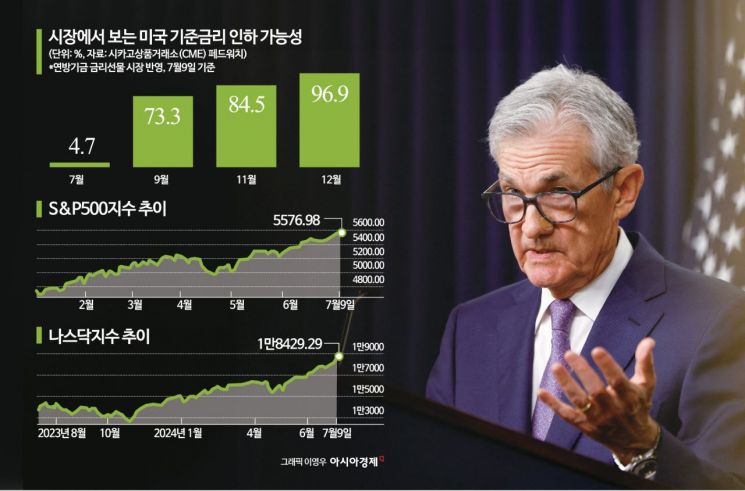
Amid dovish assessments of Powell's remarks that day, the S&P 500 and Nasdaq indices rose slightly, hitting new all-time highs once again. The S&P 500 closed up 0.07% at 5576.98, and the Nasdaq rose 0.14% to 18,429.29. The gains were limited as investors awaited the CPI data release on the 11th.
© The Asia Business Daily(www.asiae.co.kr). All rights reserved.



















