Labor Sector Lowers 1,400 Won While Management Raises 10 Won
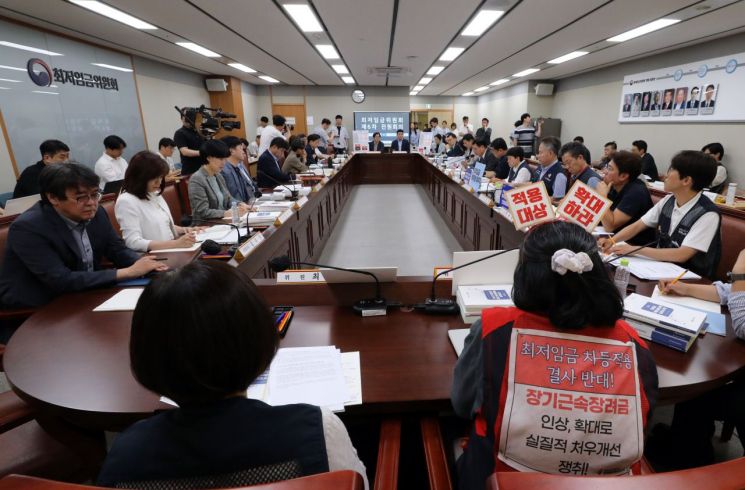
On the 9th, labor and management, who are discussing next year's minimum wage level, each proposed revised minimum wages of 11,200 won and 9,870 won, respectively. Although the gap has significantly narrowed compared to the initial demands, a considerable difference still remains.
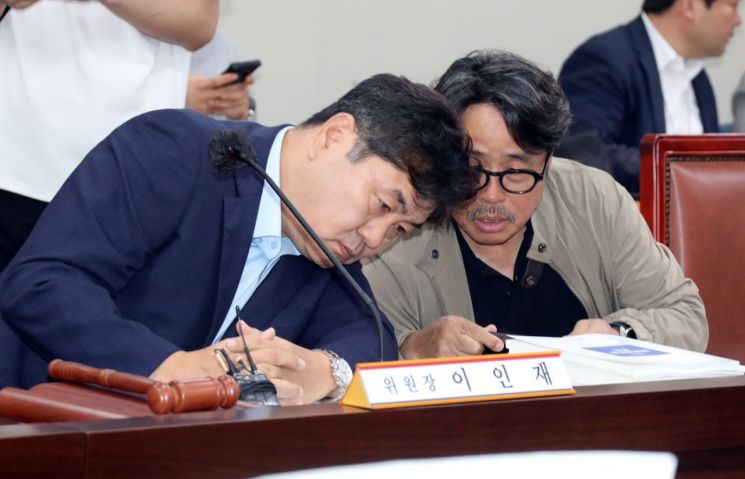
On the same day, at the 9th plenary meeting of the Minimum Wage Commission held at the Government Complex Sejong, both sides submitted their first revised proposals at the request of Chairman Lee In-jae.
The labor side proposed 11,200 won, which is 1,400 won lower than their initial demand of 12,600 won, while the management side raised their initial demand of freezing the wage at 9,860 won by 10 won. Compared to the initial demands presented that day, the gap has been greatly reduced from 2,740 won to 1,330 won, but the difference remains significant.
Since the legal deadline for minimum wage deliberations (June 27) has already passed, both labor and management submitted their initial demands and immediately followed up with revised proposals. The labor side's initial demand represents a 27.8% increase compared to this year's minimum wage of 9,860 won. On a monthly basis (assuming 209 working hours per month), this amounts to 2,633,400 won. The first revised proposal of 11,200 won is 13.6% higher than this year.
The labor side argued for a substantial increase, citing prolonged high inflation and a decline in real wages that have made it difficult for low-wage workers to make a living. Ryu Ki-seop, Secretary General of the Federation of Korean Trade Unions (FKTU), said in his opening remarks at the meeting, "In recent years, minimum wage increases have not kept pace with inflation, resulting in a decline in workers' real wages," adding, "Income distribution indicators are worsening again, raising serious concerns about growing inequality and polarization."
Secretary General Ryu emphasized, "Although inflation has recently stabilized around 2%, the perceived inflation rate centered on everyday living expenses remains high," and stressed, "This year's minimum wage level should be decided in a way that alleviates the real cost of living and raises the real wages of minimum wage workers."
Lee Mi-seon, Vice Chairperson of the Korean Confederation of Trade Unions (KCTU), also said, "The cost of living rose by 6% in 2022, but the minimum wage only increased by 5%. In 2023, the cost of living rose by 3.9%, but the minimum wage increased by only 2.5%," adding, "It's truly an era where everything except wages has gone up."
The management side initially demanded a freeze on the minimum wage. They have maintained this freeze policy for four consecutive years since 2021. After the chairman requested a revised proposal, they conceded only 10 won from their initial demand.
The management argues that the minimum wage has risen too much so far and that it should be stabilized considering the weakened payment capacity of small and medium-sized enterprises (SMEs) and small business owners.
Ryu Ki-jung, Executive Director of the Korea Employers Federation (KEF), said, "Generally, the appropriate upper limit for the minimum wage to operate without side effects is said to be 60% of the median wage, but our minimum wage is already 65.8% of the median wage, exceeding the appropriate level."
Executive Director Ryu emphasized, "In the past five years, the minimum wage increase rate has exceeded twice the inflation rate," adding, "Raising the minimum wage excessively should not cause frustration and suffering to struggling SMEs and small business owners."
Lee Myung-ro, Head of the Workforce Policy Division at the Korea Federation of SMEs, said, "The payment capacity of SMEs and small business owners has become very vulnerable," adding, "Sales are decreasing while expenses are increasing, and the absolute level of the increased minimum wage is the biggest burden."
Lee also stated, "We must consider labor market outsiders who are more vulnerable than low-wage workers, such as retired elderly, unskilled youth, and women with career interruptions," and argued, "To expand employment opportunities for vulnerable job seekers, the minimum wage should be frozen."
Considering the schedule, including the minimum wage announcement deadline (August 5), the minimum wage is expected to be decided by next week at the latest. If labor and management fail to narrow the gap, the minimum wage will be determined by a vote rather than an agreement. Since 2012, the Minimum Wage Commission has decided the minimum wage level by vote every year until last year. The next plenary meeting will be held on the 11th.
© The Asia Business Daily(www.asiae.co.kr). All rights reserved.


















