First Proposal Presented at the 9th Full Meeting of the Minimum Wage Commission
Strategic Moves Begin to Narrow the Gap... This Week a Turning Point
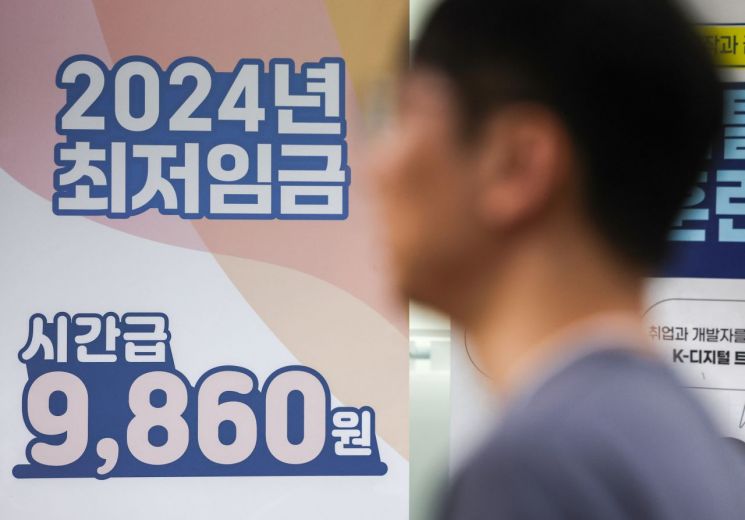
The labor sector has proposed an initial minimum wage demand for next year of 12,600 KRW per hour, a 27.8% increase from this year, while the business sector has suggested maintaining the same hourly wage of 9,860 KRW as last year. The gap between the two sides is 2,740 KRW, which is larger than ever before.
On the afternoon of the 9th, worker representatives from the labor side and employer representatives from the business side presented these initial demands at the 9th plenary meeting of the Minimum Wage Commission (hereafter, Min Wage Commission) held at the Government Complex Sejong. The difference of 2,740 KRW shows a significant gap that makes reaching an agreement difficult.
Although the deadline for deciding the minimum wage is approaching, it is widely expected that the labor and management demands will remain at an impasse. Both sides will attempt to narrow the gap by proposing several revised offers during discussions this week, and if no agreement is reached, the government-appointed public interest commissioners will mediate and put forward a proposal for a vote.
The Min Wage Commission has decided minimum wage levels by vote every year from 2012 through last year. Considering the schedule for announcing next year’s minimum wage (August 5), it is expected that the minimum wage will be decided by next week at the latest.
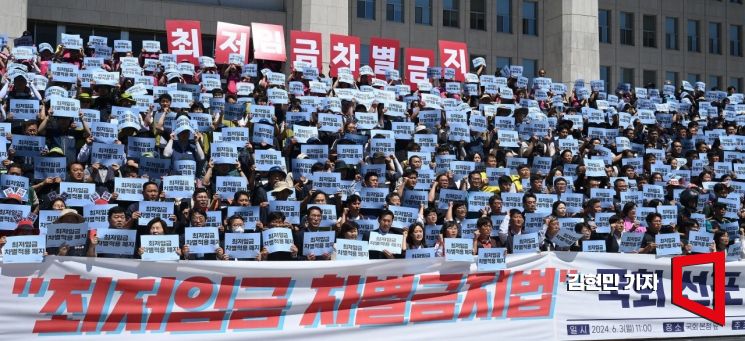 Kim Dong-myeong, Chairman of the Federation of Korean Trade Unions, Yang Kyung-soo, Chairman of the Korean Confederation of Trade Unions, and members of the two major trade unions are holding a "Press Conference for the National Assembly Proclamation of the Minimum Wage Anti-Discrimination Act" on the steps in front of the main building of the National Assembly on the 3rd. Photo by Kim Hyun-min kimhyun81@
As discussions on the minimum wage intensify, tensions between labor and management are rising. Ryu Gi-seop, Secretary General of the Korean Confederation of Trade Unions (KCTU) and a worker representative, emphasized in his opening remarks, "Although inflation has recently stabilized around 2%, the perceived inflation centered on everyday living costs remains high," adding, "This year’s minimum wage level must be decided in a way that alleviates the real cost-of-living burden and raises the real wages of minimum wage workers."
Lee Mi-seon, Vice Chairperson of the Federation of Korean Trade Unions (FKTU), also stated, "The living cost inflation rate was 6% in 2022, but the minimum wage only increased by 5%. In 2023, living costs rose by 3.9%, yet the minimum wage increased by just 2.5%," calling it "an era where everything except wages has gone up."
Vice Chairperson Lee questioned, "The current minimum wage does not even meet the actual living expenses of a single-person, unmarried household, which is 2.46 million KRW. How can people be expected to marry and raise children when the wages are insufficient even to live alone?"
On the other hand, Ryu Ki-jung, Executive Director of the Korea Employers Federation (KEF) and an employer representative, pointed out, "Generally, the appropriate upper limit for the minimum wage to operate without side effects is 60% of the median wage, but our minimum wage is already 65.8% of the median wage, exceeding the appropriate level."
Executive Director Ryu emphasized, "In the past five years, the minimum wage increase rate has been more than twice the inflation rate," adding, "We must not raise the minimum wage excessively and cause frustration and hardship for struggling small and medium-sized enterprises (SMEs) and small business owners."
Lee Myung-ro, Head of the Human Resources Policy Division at the Korea Federation of SMEs, also argued, "The payment capacity of SMEs and small business owners has become very vulnerable," stating, "Sales are decreasing while expenses are increasing, and the higher absolute level of the minimum wage is the biggest burden."
© The Asia Business Daily(www.asiae.co.kr). All rights reserved.


















