The nuclear battery installed on the Nuri rocket performance verification satellite has been confirmed to have no performance issues in long-term reliability evaluation. Based on the evaluation results, it is expected that the domestically developed nuclear battery can be used as a heat and power source for lunar, Mars, deep space exploration spacecraft, and rovers in the future.
The Korea Atomic Energy Research Institute announced on the 9th that it confirmed stable power generation over a long period by evaluating the reliability of the nuclear battery, which it developed independently and installed on the Nuri rocket performance verification satellite since 2022, in low Earth orbit.
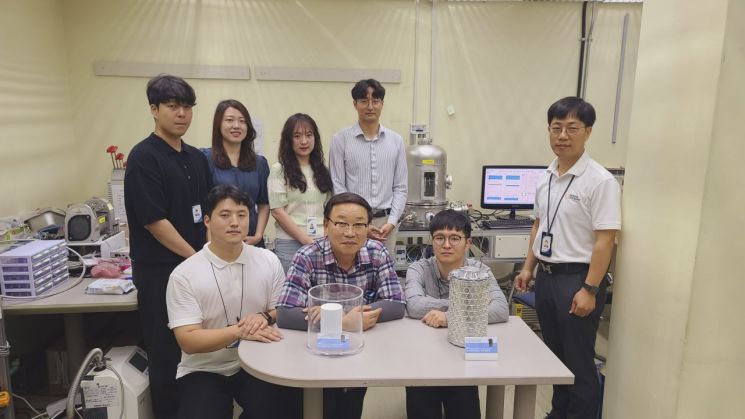 Dr. Hong Jintae (first on the right), who developed the nuclear battery, and the research team are gathered for a commemorative photo. Photo by Korea Atomic Energy Research Institute
The nuclear battery was developed as the world's third by Dr. Hong Jin-tae's research team at the Institute's Isotope Research Division. This battery uses plutonium isotope (Pu-238) as a heat source and consists of a thermoelectric device that converts heat into electricity and a thermal control structure that prevents heat loss inside the battery while transferring heat, developed with a thermal output of 10W.
The evaluation was conducted from November 2022 to May this year to verify whether the nuclear battery could maintain electrical output over a long period. The satellite body received the output voltage and internal temperature of the nuclear battery, stored the data for a certain period, and then transmitted the data during communication with the ground station, where the data was analyzed to verify normal operation.
As a result, the Korea Atomic Energy Research Institute confirmed that it continuously produced 120mW of power without output reduction or component failure.
In particular, the institute replaced the radioactive isotope heat source with an electric heater in the experiment in accordance with the UN international regulations prohibiting the use of radioactive materials in low Earth orbit.
Using 10W of power supplied from the satellite body, the internal electric heater of the battery was operated to generate heat equivalent to the radioactive isotope decay heat for the experiment, confirming that the target power could be normally produced. This level is sufficient to perform missions such as environmental temperature monitoring and space radiation measurement on the extremely cold lunar surface.
South Korea has set space exploration plans for the moon in 2032 and Mars in 2045. To achieve space exploration goals, securing an energy source capable of withstanding the extreme environment of space is crucial, and since the core of energy acquisition is the nuclear battery, the institute explained that this evaluation result is meaningful.
Jung Young-wook, director of the Hanaro Quantum Science Research Institute, said, “The Korea Atomic Energy Research Institute will continue to devote itself to developing high-performance nuclear batteries that can safely complete missions in the extreme environments of space, such as lunar and Mars exploration.”
© The Asia Business Daily(www.asiae.co.kr). All rights reserved.
![Clutching a Stolen Dior Bag, Saying "I Hate Being Poor but Real"... The Grotesque Con of a "Human Knockoff" [Slate]](https://cwcontent.asiae.co.kr/asiaresize/183/2026021902243444107_1771435474.jpg)











