Targets Including Suspension Bridges and Skywalks
Safety inspections of facilities such as suspension bridges will be strengthened in the future, and users will be able to easily check the inspection results.
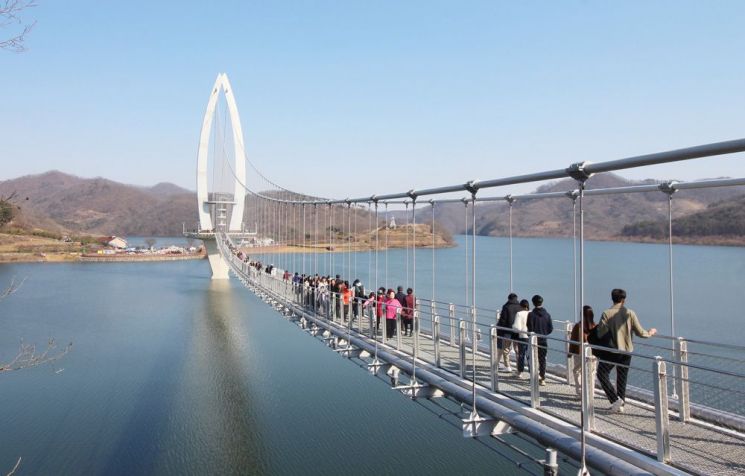
On the 9th, the Anti-Corruption and Civil Rights Commission (ACRC) announced that it had prepared a 'Safety Management Plan for Users of Aerial Walkway Facilities such as Suspension Bridges' and recommended it to the Ministry of Land, Infrastructure and Transport, the Korea Forest Service, 123 local governments, the Korea National Park Service, and the Korea Water Resources Corporation.
Currently, there are a total of 349 aerial walkway facilities installed and operated by local governments across mountains, rivers, and beaches nationwide, including 254 suspension bridges and 42 skywalks.
Local governments can designate aerial walkway facilities requiring safety management as Class 3 facilities and conduct regular safety inspections to prevent disasters. However, there are concerns that the current regular safety inspection methods have limitations in conducting detailed diagnoses of safety threats to pedestrians.
Additionally, 42% (145 facilities) of the facilities are not designated as Class 3 facilities, and a significant number have been in place for over 20 years, creating blind spots in safety management.
Accordingly, the ACRC has recommended that suspension bridges, skywalks, and protruding decks be explicitly designated as Class 3 facilities in ordinances, and that regular safety inspections be conducted after such designation.
Furthermore, to enhance the level of safety inspections, facilities that receive consecutive C grades or have passed a certain period since completion are to undergo higher-level safety inspections such as detailed safety checks. The results of regular safety inspections and major repair or reinforcement measures will be posted on facility status maps so that users can easily verify safety information.
Safety equipment will also be strengthened. Since some facilities lack safety equipment such as CCTV or loudspeakers, and safety equipment varies by site making emergency response difficult, it is recommended to install safety equipment to respond to emergencies, equip sites with devices such as automated external defibrillators (AEDs) and life jackets for on-site emergency measures, and conduct safety education.
Kim Tae-gyu, Vice Chairman of the ACRC, said, "With this institutional improvement, safety management of facilities such as suspension bridges will be strengthened, and it is expected to enhance the safety of users."
© The Asia Business Daily(www.asiae.co.kr). All rights reserved.
!["I'd Rather Live as a Glamorous Fake Than as a Poor Real Me"...A Grotesque Success Story Shaking the Korean Psyche [Slate]](https://cwcontent.asiae.co.kr/asiaresize/183/2026021902243444107_1771435474.jpg)
















