"The United States' approach is failing on all fronts. It cannot 'contain' China, it escalates tensions, undermines economic well-being and the efficiency of the global economy, divides the world economy, and pushes us toward war."
Jeffrey Sachs, a world-renowned economist and professor at Columbia University, recently strongly criticized the U.S. policy toward China, blaming the escalating U.S.-China tensions on America's fear of losing power. He also argued that the U.S. should stop interfering in the Taiwan issue.
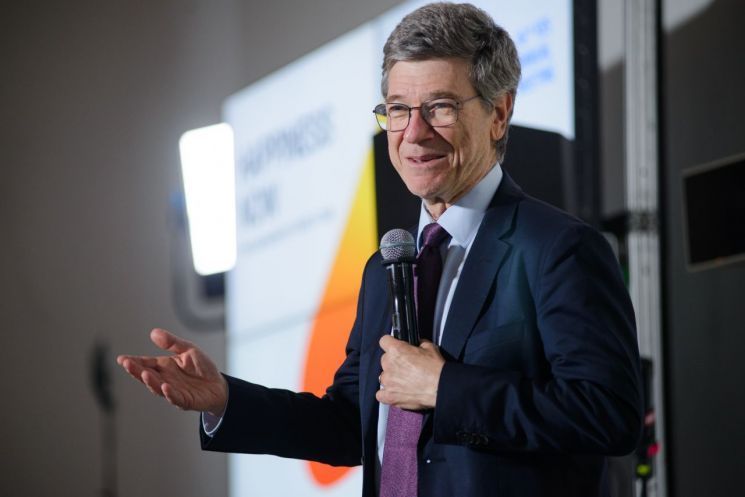
In an interview with the Hong Kong South China Morning Post (SCMP) released on the 8th, Professor Sachs said, "The U.S.-China tension arises from America's anxiety over its declining global power," adding, "U.S. policymakers often respond defensively and fearfully, sometimes very unwisely."
He noted that the U.S. began a full-scale containment policy against China starting in 2015, citing examples such as the Trans-Pacific Partnership (TPP) excluding China, export bans on advanced products like semiconductors, increased trade barriers, militarization of the South China Sea, and new military alliances like AUKUS (the security alliance between the U.S., the U.K., and Australia).
He further stated, "I consider all these approaches to be failures," pointing out that they have led to heightened tensions, reduced economic welfare and efficiency, and brought us closer to war.
Contrary to recent Western criticism, including from the U.S., about overproduction of Chinese electric vehicles, Professor Sachs dismissed the notion of "overproduction." He predicted, "Unfortunately, protectionism is likely to intensify in the U.S. and Europe, and the market for Chinese electric vehicles will be significantly closed off." He added that China needs to build its EV market in emerging and developing countries, asserting, "U.S. and European EV manufacturers will not be able to compete with Chinese EVs in third markets such as emerging and developing countries."
Professor Sachs assessed, "China is already at the forefront in many key technologies needed over the next 25 years, including solar power, wind power, modular nuclear power, long-distance transmission, 5G, batteries, and electric vehicles," and concluded, "As a result, the Chinese economy will continue to develop." He also noted that as the U.S. and Europe turn toward protectionism, China's markets will expand to Asia, Russia, the Middle East, North Africa, Sub-Saharan Africa, and South America. He highlighted that China's trade and financial relations are increasingly tilting toward emerging and developing countries, pointing out that the GDP of BRICS already exceeds that of the Group of Seven (G7).
Having previously expressed anti-hegemonic views in official settings, Professor Sachs reiterated in this interview that "it is highly likely that no country will achieve hegemony in the 21st century." He explained, "Technological and military capabilities are widely dispersed, and demographic trends are unfavorable to a single hegemon," predicting that each country will have regional roles. For China, which currently accounts for about 18% of the world population, it is expected to drop to around 10% by 2100. Consequently, while per capita income will continue to rise, China's share of global GDP is not expected to exceed 20%.
He also spoke about the impact of the upcoming U.S. presidential election in November on U.S.-China relations. Professor Sachs said, "No matter who becomes president, the relationship will be difficult," criticizing, "The U.S. deep state has not accepted the reality of China's success." The "deep state" he referred to includes U.S. security agencies such as the White House, Department of Defense, intelligence agencies, and Congress.
Furthermore, he pointed out, "Both Donald Trump and Joe Biden, the U.S. presidential candidates, are competing to show who is tougher on China," and criticized that the majority in Congress rely on dangerous anti-China rhetoric.
Regarding U.S. involvement in Taiwan, he emphasized, "The meddling must stop," and stressed, "Without U.S. interference, the Taiwan issue would be peacefully resolved by both sides (China and Taiwan)."
Professor Sachs criticized the recent flood of war talk with China in the U.S. media as "terribly irresponsible, ignorant, and dangerous," adding, "Such a war must be avoided at all costs. Even casual discussions about the possibility show a lack of prudence and judgment." He also argued that the U.S. pushing NATO eastward into Ukraine despite Russian opposition caused the war, warning that a similar situation could occur in the Taiwan Strait.
Additionally, Professor Sachs rejected claims that globalization is ending and that the global economy is fragmenting, stating, "The end of globalization has not yet come." However, he observed, "We are seeing increased protectionism in the U.S. and Europe as they respond defensively to the rise of China, Russia, and India," diagnosing that "geopolitical tensions are definitely rising." He sarcastically added, "President Joe Biden still believes the U.S. leads a unipolar world, and this delusion is why conflicts are escalating."
© The Asia Business Daily(www.asiae.co.kr). All rights reserved.
![Clutching a Stolen Dior Bag, Saying "I Hate Being Poor but Real"... The Grotesque Con of a "Human Knockoff" [Slate]](https://cwcontent.asiae.co.kr/asiaresize/183/2026021902243444107_1771435474.jpg)
















