Mayor Oh appears on broadcast to explain 'Gwanghwamun Taegeukgi'
Responding to 'tax waste' criticism: "Will explain directly soon"
"Need to foster patriotism" vs "Ensure flood prevention properly"
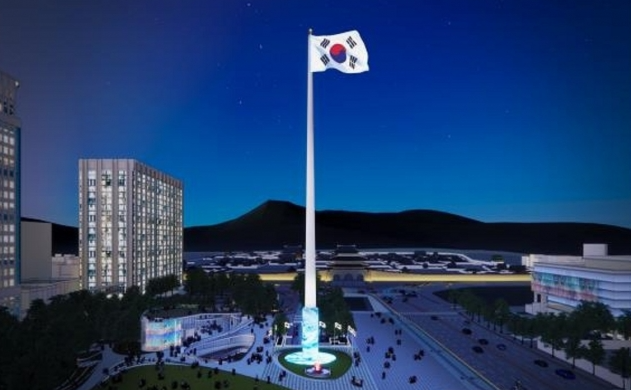
Recently, the Seoul Metropolitan Government announced plans to install a large 100-meter-high Taegukgi (Korean national flag) in Gwanghwamun Square, sparking heated debates among citizens. Seoul Mayor Oh Se-hoon stated that he will soon provide an explanation to persuade the public. On the 7th, during an appearance on KBS's 'Sunday Diagnosis Live,' Mayor Oh said, “The explanation was very insufficient,” and added, “The perspective drawing was created without considering proportions to make the explanation easier, which caused misunderstandings.” He further explained, “Once the design competition is held, the flagpole will be much slimmer, and the design of Gwanghwamun Square will not be disrupted.”

Earlier, the Seoul city government announced the 'Gwanghwamun National Symbol Space Creation Plan' with the aim of fostering national pride. The plan includes creating an 'eternal flame' symbolizing everlasting patriotism and immortality, along with a giant 100-meter-high Taegukgi flagpole in Gwanghwamun Square. While some supported Seoul's intention, others criticized it as "anachronistic." In particular, the revelation that the project would cost 11 billion won led to accusations of wasteful spending of taxpayers' money.
In response, Mayor Oh explained, “The 11 billion won is not just for building the flagpole itself but also includes various auxiliary facilities underneath,” and promised, “I will provide a direct explanation soon.” He continued, “Gwanghwamun Square is a national symbol space. Statues of historical figures from the Joseon Dynasty, such as King Sejong and Admiral Yi Sun-sin, are difficult to represent the symbols of a democratic republic,” adding, “This project started from the idea that there is a need for facilities to embody the characteristics of a national symbol space.” If the Seoul city government’s plan proceeds as scheduled, construction will begin in May next year, with the national symbol space completed by February 2026 and Sejong-ro Park by November 2026.
Despite Mayor Oh’s clarification, public reactions remain divided. On the YouTube channel of the broadcast, some comments supported the plan, saying, “In the past, the Taegukgi was displayed in every school, and honoring the patriotic martyrs was basic, but as these things have gradually disappeared, the term 'Hell Joseon' emerged. I think places and cultures that promote patriotism are good.” On the other hand, an online community expressed criticism such as, “Even 100 million won is a lot, but spending 11 billion won of taxpayers’ money on such an eyesore is outrageous,” “It would be better to use that money to improve sewage systems to prevent flood damage during this year’s monsoon,” and “There are many urgent needs elsewhere, so is it really necessary to do this now when funds are tight?”
© The Asia Business Daily(www.asiae.co.kr). All rights reserved.


















