June Global Food Price Index Unchanged from Previous Month
Ministry of Agriculture, Food and Rural Affairs Expands Application of Tariff Quotas
Global food prices remained steady last month, with sugar and dairy prices rising while grain and meat prices fell.
According to the 'Food and Agriculture Organization (FAO) Global Food Price Index' announced by the Ministry of Agriculture, Food and Rural Affairs on the 6th, the index stood at 120.6 points last month, unchanged from the previous month. The FAO surveys international price trends for 24 items and publishes monthly food price indices for five commodity groups: grains, oils, meat, dairy, and sugar. The index uses the 2014?2016 average as 100; values above indicate price increases, while values below indicate decreases.
The global food price index, which had risen for three consecutive months from March to May this year, remained stable last month. By commodity, the grain price index fell 3.0% from the previous month to 115.2 points. This was due to ongoing wheat harvests in the Northern Hemisphere and improved production outlooks in major exporting countries such as Kazakhstan and Ukraine. T?rkiye's temporary ban on wheat imports also contributed to the price decline. Corn prices dropped due to increased harvests in Argentina and Brazil and expected expansion of cultivation areas in the United States. International rice prices also fell amid sluggish trading.
The meat price index decreased slightly by 0.1% from the previous month to 116.9 points. Increased supply from major producing countries led to a decline in poultry prices, while pork prices rose slightly due to imports and steady domestic demand in North America. Beef prices remained generally stable as supply and demand balanced out.
The oils price index rose 3.1% from the previous month to 131.8 points. Palm oil shifted to an upward trend as international import demand recovered following a price decline. Soybean oil and sunflower oil prices increased due to rising biofuel demand in American countries and reduced export availability in the Black Sea region, respectively.
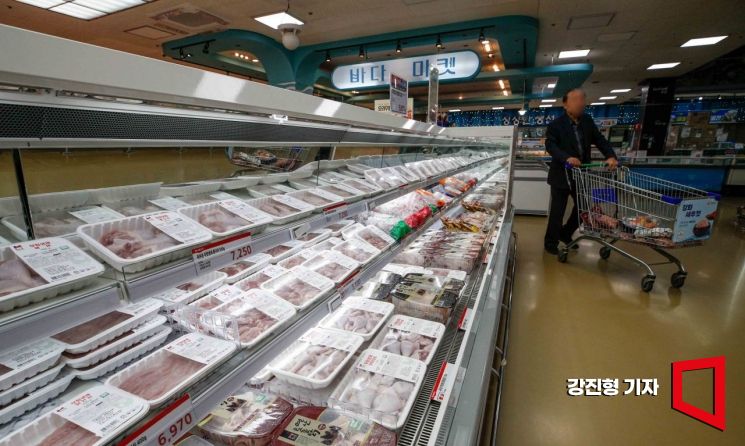 Chicken sales area at Hanaro Mart Yangjae Branch, Seocho-gu, Seoul. Photo by Jinhyung Kang aymsdream@
The dairy price index increased 1.2% from the previous month to 127.8 points. Reduced milk production and increased demand in Western Europe and Oceania were the main factors. Skimmed milk powder and whole milk powder prices rose due to import demand in East Asia, increased domestic consumption in Western Europe, and low production in Oceania. However, cheese prices declined due to a slowdown in international import demand.
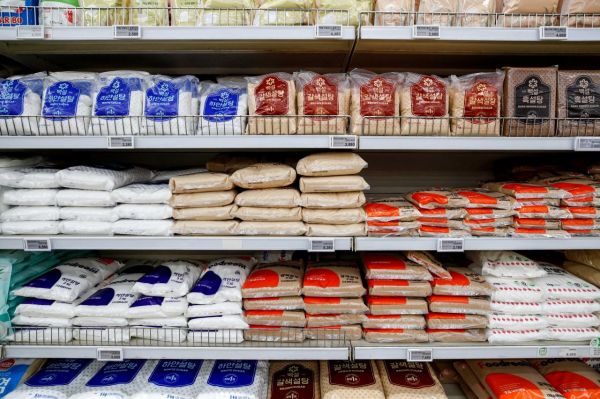
The sugar price index rose 1.9% from the previous month to 119.4 points. Price increases were driven by reduced harvests in Brazil in May, continued dry weather, irregular monsoon rainfall in India, and downward revisions of harvest forecasts in the European Union. However, the rise was somewhat limited by the weakness of the Brazilian real.
The FAO forecasts global grain production for 2024?2025 at 2.8542 billion tons, a 0.1% decrease compared to 2023?2024. During the same period, global grain consumption is expected to increase by 0.5% to 2.8564 billion tons.
In response to rising international food raw material prices, the government is expanding the application of tariff quotas from 30 items in the first half of the year to 37 items to ease the management burden on food companies and stabilize consumer prices. The Ministry of Agriculture stated, “We will continue to closely communicate with the industry and monitor market conditions.”
© The Asia Business Daily(www.asiae.co.kr). All rights reserved.


















